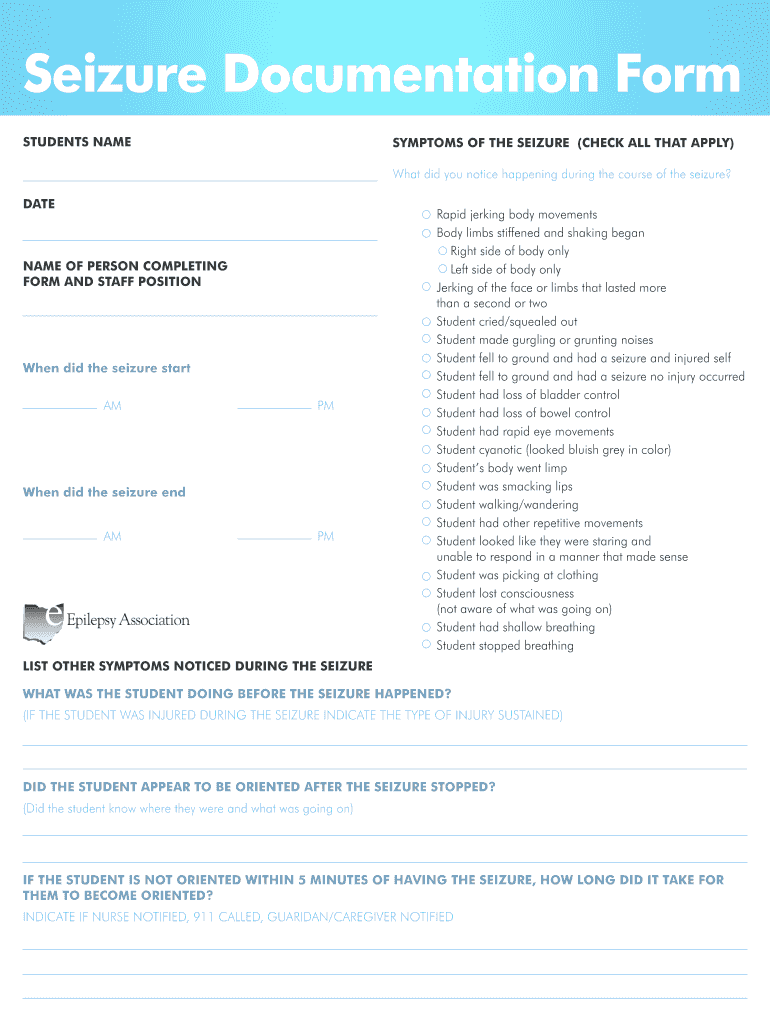
DATE NAME OF PERSON COMPLETING FORM AND STAFF POSITION When did the seizure start AM PM When did the seizure end AM PM Rapid jerking body movements Body limbs stiffened and shaking began Right side of body only Left side of body only Jerking of the face or limbs that lasted more than a second or two Student cried/squealed out Student made gurgling or grunting noises Student fell to ground and had a seizure and injured self Student fell to ground and had a seizure no.
Loading

Open form follow the instructions

Easily sign the form with your finger

Send filled & signed form or save
How to fill out the Epilepsy Risk Assessment Template online
Completing the Epilepsy Risk Assessment Template is an important step in documenting seizures and understanding seizure-related risks. This guide offers clear, step-by-step instructions on how to fill out the form online, ensuring that you provide comprehensive and accurate information.
Follow the steps to complete the epilepsy risk assessment template online.
- Select the ‘Get Form’ button to access the Epilepsy Risk Assessment Template and open it in your preferred online editor.
- Enter the name of the student in the designated field at the top of the form.
- Check all applicable symptoms of the seizure in the symptom section, ensuring that you accurately reflect what occurred during the seizure.
- Fill in the date of the seizure in the corresponding field.
- Provide your name and staff position in the section for the person completing the form.
- Indicate the start time of the seizure by selecting either AM or PM.
- Indicate the end time of the seizure by selecting either AM or PM.
- If applicable, add any additional symptoms that were noticed during the seizure in the designated 'Other symptoms' section.
- Describe what the student was doing before the seizure occurred in the appropriate field.
- If the student experienced any injuries during the seizure, clearly indicate the type of injury sustained.
- Answer whether the student appeared oriented after the seizure. If not, specify how long it took for them to become oriented.
- Indicate if the nurse was notified, if 911 was called, or if a guardian or caregiver was informed.
- Once all fields are completed, save your changes, and choose to download, print, or share the completed form as needed.
Take the next step in ensuring safety and awareness by filling out your documents online today.
Experience a faster way to fill out and sign forms on the web. Access the most extensive library of templates available.
Related content
by R Ison · 2020 · Cited by 7 — The ERA Scale is a validated tool that aims to change...
The Trace Center's Photosensitive Epilepsy Analysis Tool (PEAT) is a free, downloadable...
CCO/HHs must provide training, guidance, and resource support for all staff (including...
Get answers to your most pressing questions about US Legal Forms API.
Can anyone conduct a risk assessment?
While anyone can attempt to conduct a risk assessment, it is ideal for individuals who understand epilepsy well. Using the Epilepsy Risk Assessment Template can provide structure and essential questions to consider during the process. However, it's beneficial to involve healthcare professionals for accuracy and depth. This collaboration ensures a thorough understanding of risks and appropriate management strategies.
How to create a risk assessment?
To create a risk assessment, begin by gathering relevant information about the individual's epilepsy and associated risks. Utilize the Epilepsy Risk Assessment Template to systematically record insights, triggers, and potential consequences. Engage with healthcare professionals to validate the assessment and ensure it is comprehensive. Finally, develop actionable steps to mitigate identified risks.
What is a risk assessment for someone with epilepsy?
A risk assessment for someone with epilepsy identifies potential hazards related to the condition. It examines triggers, symptoms, and environmental factors that may pose safety concerns. The Epilepsy Risk Assessment Template can aid in documenting these elements systematically. This approach allows individuals and caregivers to devise strategies for risk management and health safety.
Who is qualified to write a risk assessment?
Qualified individuals who can write a risk assessment typically include healthcare professionals, caregivers, or personal advocates with knowledge about epilepsy. They should have the expertise to understand various risks and the necessary interventions. Using the Epilepsy Risk Assessment Template can help streamline the process for anyone involved. Collaboration among qualified personnel and the individual with epilepsy ensures a thorough assessment.
Can you do your own risk assessment?
Absolutely, you can conduct your own risk assessment if you have a clear understanding of your epilepsy. The Epilepsy Risk Assessment Template serves as a practical guide for documenting risks and triggers effectively. It allows you to prioritize your concerns and identify personal strategies for safety. Remember, your insights are crucial for creating an effective assessment.
Can I write my own risk assessment?
Yes, you can write your own risk assessment, especially if you are familiar with your epilepsy condition. Utilize the Epilepsy Risk Assessment Template to organize your thoughts and document important details. Ensure you highlight specific triggers and risks that are unique to your situation. This personalized assessment can be a valuable tool in managing your health.
Who can write an epilepsy management plan?
An epilepsy management plan can be written by healthcare professionals like neurologists, general practitioners, or epilepsy specialists. However, individuals may also contribute personal insights to make the plan more relevant. The Epilepsy Risk Assessment Template can assist in recording essential information to create a comprehensive management plan. Ultimately, collaboration is key to a successful management strategy.
How do you write a personal risk assessment?
To write a personal risk assessment, start by identifying the specific factors influencing your epilepsy. Document the triggers, symptoms, and potential hazards you face daily. Use the Epilepsy Risk Assessment Template to guide your process and ensure you capture all relevant information. Finally, include recommendations for managing these risks based on your findings.
How do you answer a risk assessment form?
Answering a risk assessment form requires you to provide honest and accurate information regarding the person's condition. When using the Epilepsy Risk Assessment Template, focus on clarity and specificity in your responses. Take your time to consider questions carefully and provide detailed insights based on your knowledge and observations, ensuring that caregivers gain a complete understanding of the situation.
How to document seizure activity?
Documenting seizure activity requires careful recording of details such as the date, time, duration, and type of seizure. Using the Epilepsy Risk Assessment Template allows for organized and consistent documentation, which can be valuable for medical professionals. Additionally, noting any warning signs or triggers before the seizure can provide insights into patterns and help in managing epilepsy effectively.
Use professional pre-built templates to fill in and sign documents online faster. Get access to thousands of forms.
If you believe that this page should be taken down, please follow our DMCA take down process here.