Get Ks Request Foradmission 2005-2026
How it works
-

Open form follow the instructions
-

Easily sign the form with your finger
-

Send filled & signed form or save
How to fill out the KS Request for Admission online
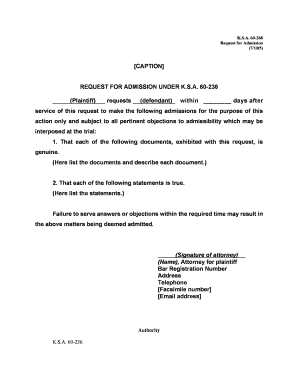
The KS Request for Admission is a critical document used in legal proceedings that allows one party to request the other to admit or deny the truth of specific statements or the genuineness of documents. This guide provides a step-by-step approach to help users efficiently fill out this form online and ensure compliance with legal standards.
Follow the steps to complete the KS Request for Admission online.
- Click the ‘Get Form’ button to access the KS Request for Admission form and open it in an online editor.
- Identify the parties involved in the action. In the 'CAPTION' section, enter the title of the legal action including the name of the plaintiff and the defendant.
- In the section that begins with 'requests', specify the number of days (fill in the blank) after service of this request for the defendant to respond.
- List all documents that are to be admitted as genuine. This should be clearly detailed under the statement, 'That each of the following documents, exhibited with this request, is genuine.' Provide a description for each document.
- Next, incorporate statements that the other party is requested to admit as true. Format this section with clear labeling following the template provided.
- Ensure that you have included appropriate objections to admissibility, if any, that may apply to the contents of this request.
- Sign the document in the 'Signature of attorney' field, including your name, bar registration number, address, telephone, facsimile number, and email address.
- After filling out the form, review all entries for accuracy and completeness before finalizing your changes. Then, save the document, download it for your records, print out a hard copy if necessary, or share it with the relevant parties.
Complete the KS Request for Admission online to streamline your legal process.
In criminal procedure, Rule 36 serves a different purpose than in civil cases. While the rule primarily applies to the request for admissions in civil litigation, its principles emphasize the importance of clarity and efficiency in legal proceedings. For those involved in criminal cases, understanding the implications of admissions can also play a critical role.