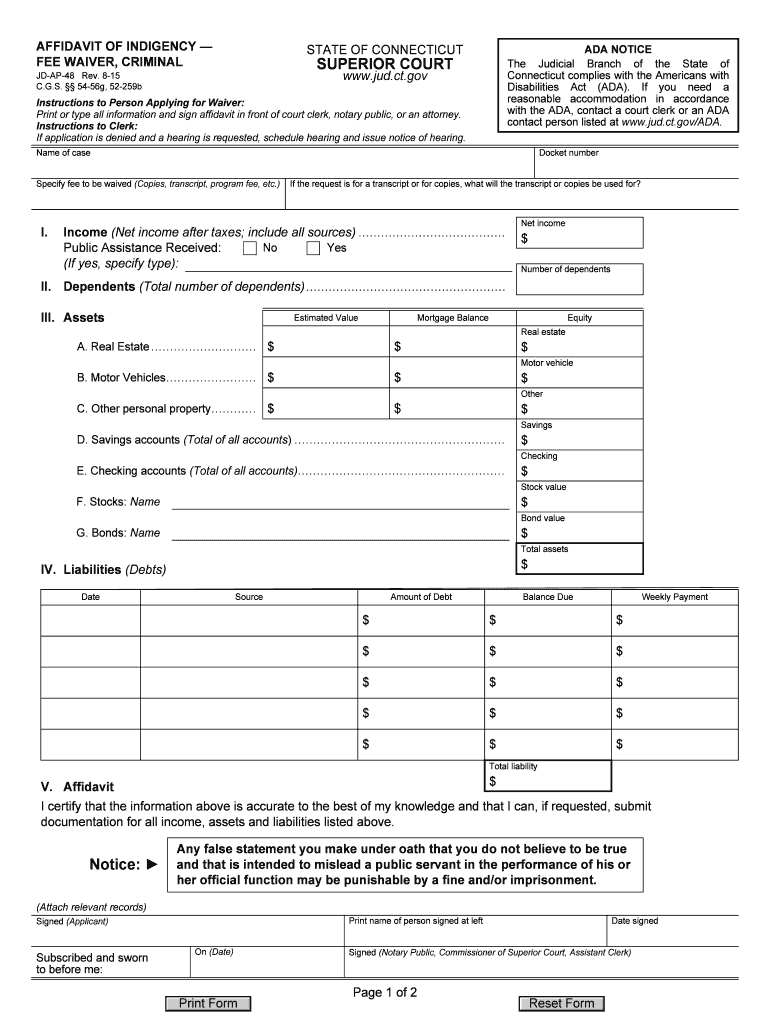
Ble accommodation in accordance with the ADA, contact a court clerk or an ADA contact person listed at www.jud.ct.gov/ADA. SUPERIOR COURT www.jud.ct.gov JD-AP-48 Rev. 8-15 C.G.S. 54-56g, 52-259b Instructions to Person Applying for Waiver: Print or type all information and sign affidavit in front of court clerk, notary public, or an attorney. Instructions to Clerk: If application is denied and a hearing is requested, schedule hearing and issue notice of hearing. Name of case Docket numbe.
Loading

Open form follow the instructions

Easily sign the form with your finger

Send filled & signed form or save
How to fill out the Ct Criminal Protective Order Form online
Filling out the Ct Criminal Protective Order Form online can seem daunting, but with the right guidance, you can complete it effectively. This comprehensive guide will walk you through each section of the form, ensuring you provide the necessary information clearly and accurately.
Follow the steps to successfully complete the form online.
- Click ‘Get Form’ button to obtain the form and open it in a user-friendly editor.
- Begin by filling out the name of your case and the docket number. Ensure that this information reflects the details of your specific legal matter.
- Indicate the fees that you are requesting to be waived, such as court copies, transcripts, or program fees. Clearly specify the purpose of the requested transcript or copies.
- Provide detailed financial information under the Income section, including net income after taxes and all sources of income. Be honest and thorough.
- List all dependents in the Dependents section, ensuring you include the total number of people who rely on you financially.
- In the Assets section, disclose the estimated value of your real estate, motor vehicles, and other personal properties. Include the mortgage balance and equity for real estate.
- Complete the Liabilities section by detailing debts. List each source of debt and indicate the amount due and weekly payments.
- Review the Affidavit section carefully. You will need to certify that the information provided is accurate and you may need to submit documentation if requested.
- Once all sections are completed, you have options to save your changes, download the form, print it, or share it as necessary.
Start filling out your Ct Criminal Protective Order Form online today for a smoother legal process.
Experience a faster way to fill out and sign forms on the web. Access the most extensive library of templates available.
Related content
You will also find links to the forms you will need below: Application for Relief from...
Criminal Sanctions for Protective Order Violations. Criminal sanctions are the...
“In order to deny information, the public authority must form an affirmative opinion...
Get answers to your most pressing questions about US Legal Forms API.
How long does a criminal protective order last in CT?
In Connecticut, a criminal protective order typically lasts until the criminal case is resolved, or up to five years, depending on the specific circumstances. The duration can vary based on the details of your case and the judge's decision. For precise paperwork and clear instructions, the Ct Criminal Protective Order Form can simplify this process.
Who is eligible for a restraining order in CT?
Anyone who experiences harassment or threats may be eligible to seek a restraining order in Connecticut. This includes individuals who feel unsafe due to a current or former partner's behavior. Understanding the requirements can be overwhelming, but a Ct Criminal Protective Order Form can guide you through your options.
How to get a protective order in CT?
To obtain a protective order in Connecticut, you need to file an application with the court, providing details of the incidents that prompted your request. The court may issue a temporary order before a hearing is held. Completing a Ct Criminal Protective Order Form accurately will enhance your chances of receiving the protection you need.
What is the difference between a restraining order and a TPO?
A restraining order is a civil remedy designed to prevent harassment and domestic violence, while a Temporary Protective Order (TPO) is a short-term order designed to provide immediate protection until a hearing can be held. The TPO is often sought in situations requiring quick action. If you need to file for immediate protection, the Ct Criminal Protective Order Form could be the first step.
What are the three types of protection?
In Connecticut, there are three main types of protection available: criminal protective orders, civil restraining orders, and domestic violence protective orders. Each type serves different situations and legal contexts. It's beneficial to understand which type fits your circumstances best, and using a Ct Criminal Protective Order Form can streamline the process.
What is the difference between a restraining order and a protective order in CT?
The key difference lies in the context of issuance. A protective order applies in criminal cases, designed to protect a victim from potential further harm. On the other hand, restraining orders fall under civil law and are typically used to prevent harassment. If you're considering these options, the Ct Criminal Protective Order Form may assist in navigating the protective order process.
What is the difference between a protective order and a restraining order in CT?
In Connecticut, a protective order is issued in criminal cases, usually related to domestic violence, while a restraining order is often sought in civil cases. A protective order can impose restrictions on the accused, such as requiring them to stay away from the victim. Understanding these nuances can be crucial when filling out a Ct Criminal Protective Order Form.
Is a protective order different than a no contact order?
Yes, a protective order and a no contact order serve different purposes, although they can overlap. A protective order is broader, offering protection from physical harm and harassment, while a no contact order specifically prohibits communication. Understanding these distinctions is essential for seeking the right legal support. The CT Criminal Protective Order Form will help you determine which order best suits your needs.
What is another word for a no contact order?
Another term for a no contact order is a 'stay away order.' This legal directive requires one person to maintain a certain distance from another, preventing any form of contact. It functions to protect individuals from harm or harassment. When addressing such matters, utilizing the CT Criminal Protective Order Form can help clarify your legal rights and obligations.
Does an order of protection include phone calls?
Yes, an order of protection often includes restrictions on phone calls, preventing the alleged abuser from contacting the victim by any means. This includes verbal, written, or electronic communications. Such provisions are vital for ensuring the safety and peace of mind of the person seeking protection. When filling out the CT Criminal Protective Order Form, you can specify these types of communications to ensure comprehensive protection.
Use professional pre-built templates to fill in and sign documents online faster. Get access to thousands of forms.
If you believe that this page should be taken down, please follow our DMCA take down process here.