Loading
Form preview
  • US Legal Forms
  • Other Templates
  • Industry Forms
  • Industry Academic Forms
  • Reading Activity: The Organization Of Human Body

Get Reading Activity: The Organization Of Human Body

The circulatory (sir-cue-la-tore-ee) system is a good example. Your circulatory system performs a BIG job for the body – it transports materials we need, like food and oxygen, throughout our bodies. To do this, the system uses the heart to pump blood, and your blood vessels (for example, your veins) to carry the blood all over. We’ll spend most of this unit learning all about organ systems! Turn To The Next Page  A map of the circulatory system, which transports materials around your b.

How it works

  1. Open form

    Open form follow the instructions

  2. Easily sign form

    Easily sign the form with your finger

  3. Share form

    Send filled & signed form or save

How to fill out the Reading Activity: The Organization of Human Body online

This guide provides a comprehensive overview of how to complete the Reading Activity: The Organization of Human Body online. Users will gain clear instructions on each section of the form, ensuring an efficient and effective completion process.

Follow the steps to successfully fill out the form.

  1. Click the ‘Get Form’ button to access the form and open it in your preferred online document editor.
  2. Begin by entering your physiologist’s name in the designated field, followed by your class number and the current date. This information will help personalize your submission.
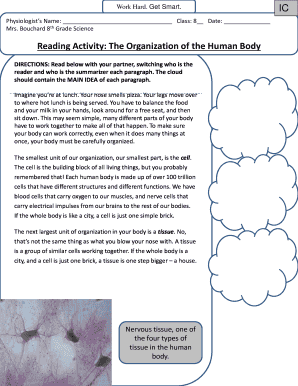
  3. Follow the directions at the beginning of the activity. Read through the material provided with your partner, switching roles as suggested with the reader and summarizer. Make sure to capture the main idea of each paragraph in the graphic organizer.
  4. Fill out the graphic organizer based on the reading. Start with the middle oval for the smallest level of organization and work your way to the outer shapes. Ensure that you provide the correct terms, such as 'cell', 'tissue', 'organ', and 'organ system'.
  5. Move to the Level 2 questions. Answer each question, which pertains to the four levels of organization within the human body. Ensure clarity and accuracy in your responses.
  6. Proceed to the Level 3 analogies section. Here, create analogies that correlate with the structure of the human body, matching the levels of organization with appropriate comparisons.
  7. Conclude by reviewing all completed sections for accuracy and completeness. Make necessary edits to ensure clarity.
  8. Finally, save your changes, download, print, or share the form as needed to submit it successfully.

Start completing your Reading Activity: The Organization of Human Body online today!

Get form

Experience a faster way to fill out and sign forms on the web. Access the most extensive library of templates available.
Get form

Related content

ORISE Lesson Plan: Organization of Multicellular...
▫ This video is about the levels of organization in a human body. The video talks about...
Learn more
Structural Organization of the Human Body –...
Describe the structure of the human body in terms of six levels of organization · List...
Learn more
Human Practices | ABOA - iGEM 2025
Currently, crime scene investigators rely heavily on indirect clues to establish...
Learn more

Related links form

Hebrew Loan Society Application Form Declaration And Claim Of Exemption For Wages Delaware Divorce Forms Forpdffiller 2020 EMCBC On-the-Spot Award Nomination Form - U.S. Department Of ... - Emcbc Doe 2020

Questions & Answers

Get answers to your most pressing questions about US Legal Forms API.

Contact support

The organization of the human body refers to the systematic arrangement of its components, including cells, tissues, organs, and systems. This organization allows for specialized functions and interactions essential for maintaining life. Understanding this organization is key to grasping how the body operates as a cohesive unit, which is a primary focus of the Reading Activity: The Organization of Human Body.

An effective analogy for understanding body organization is comparing it to a city. Just as a city consists of various structures like buildings, parks, and roads, the human body consists of cells, tissues, and organs. In both cases, each component plays a vital role in maintaining the overall function and harmony of the system, demonstrating the importance of organization.

Organizing the levels of organization in the human body involves categorizing structures from simple to complex. Start by identifying cells that make up tissues, followed by recognizing how tissues form organs. Lastly, consider how organs collaborate in systems, emphasizing the interdependence of each level. This structured approach enhances understanding of bodily functions and systems.

To arrange the levels of organization in the human body, begin with the smallest unit, which is the cell. Next, cells group together to form tissues, then tissues combine to create organs. Finally, groups of organs work together as organ systems, forming the complete human body. This arrangement showcases the intricate connections and functions that allow the body to operate effectively.

The organization of the human body activity explores how various systems and structures within the body are arranged and interact. Through engaging exercises and readings, this activity helps individuals understand the hierarchy of organization, from cells to organs and systems. By participating, you will gain insights into the complexity and functionality of your body, making the learning process enjoyable.

The seven levels of organization in the human body encompass atoms, molecules, cells, tissues, organs, organ systems, and the entire organism. Each level builds upon the last, creating a complex and functional living system. Understanding these levels is crucial for anyone studying health and biology.

The term 'seven systems of the body' often refers to the major organ systems, which include the skeletal, muscular, cardiovascular, respiratory, nervous, endocrine, and digestive systems. Each system plays an essential role in maintaining bodily functions and supporting life. Recognizing these systems helps you appreciate the interconnectedness of the human body.

The seven major organ systems are the integumentary, skeletal, muscular, nervous, endocrine, circulatory, and digestive systems. Each system performs specific functions vital for maintaining overall health and homeostasis. Learning about these systems can enhance your understanding of how the body operates.

On Quizlet, the seven levels of organization in the human body typically include atoms, molecules, cells, tissues, organs, organ systems, and the complete organism. This resource can help you study and reinforce your knowledge. Engaging with such platforms enhances your learning experience regarding the organization of the human body.

The seven levels of organization in the body include atoms, molecules, cells, tissues, organs, organ systems, and the organism itself. Each level represents a distinct unit that plays a critical role in bodily function. Understanding these levels can deepen your appreciation for the intricate design of the human body.

Get This Form Now!

Use professional pre-built templates to fill in and sign documents online faster. Get access to thousands of forms.
Get form
If you believe that this page should be taken down, please follow our DMCA take down processhere.
Get Reading Activity: The Organization of Human Body
Get form
  • Adoption
  • Bankruptcy
  • Contractors
  • Divorce
  • Home Sales
  • Employment
  • Identity Theft
  • Incorporation
  • Landlord Tenant
  • Living Trust
  • Name Change
  • Personal Planning
  • Small Business
  • Wills & Estates
  • Packages A-Z
  • Affidavits
  • Bankruptcy
  • Bill of Sale
  • Corporate - LLC
  • Divorce
  • Employment
  • Identity Theft
  • Internet Technology
  • Landlord Tenant
  • Living Wills
  • Name Change
  • Power of Attorney
  • Real Estate
  • Small Estates
  • Wills
  • All Forms
  • Forms A-Z
  • Other Templates
  • Legal Hub
  • About Us
  • Help Portal
  • Legal Resources
  • Blog
  • Affiliates
  • Contact Us
  • Delete My Account
  • Site Map
  • Industries
  • Forms in Spanish
  • Localized Forms
  • State-specific Forms
  • Forms Kit
  • Real Estate Handbook
  • All Guides
  • Notarize
  • Incorporation services
  • For Consumers
  • For Small Business
  • For Attorneys
  • USLegal
  • FormsPass
  • pdfFiller
  • signNow
  • altaFlow
  • DocHub
  • Instapage
Form Packages
  • Adoption
  • Bankruptcy
  • Contractors
  • Divorce
  • Home Sales
  • Employment
  • Identity Theft
  • Incorporation
  • Landlord Tenant
  • Living Trust
  • Name Change
  • Personal Planning
  • Small Business
  • Wills & Estates
  • Packages A-Z
Form Categories
  • Affidavits
  • Bankruptcy
  • Bill of Sale
  • Corporate - LLC
  • Divorce
  • Employment
  • Identity Theft
  • Internet Technology
  • Landlord Tenant
  • Living Wills
  • Name Change
  • Power of Attorney
  • Real Estate
  • Small Estates
  • Wills
  • All Forms
  • Forms A-Z
  • Other Templates
Customer Service
  • Legal Hub
  • About Us
  • Help Portal
  • Legal Resources
  • Blog
  • Affiliates
  • Contact Us
  • Delete My Account
  • Site Map
  • Industries
  • Forms in Spanish
  • Localized Forms
  • State-specific Forms
  • Forms Kit
Legal Guides
  • Real Estate Handbook
  • All Guides
Prepared for you
  • Notarize
  • Incorporation services
Our Customers
  • For Consumers
  • For Small Business
  • For Attorneys
Our Sites
  • USLegal
  • FormsPass
  • pdfFiller
  • signNow
  • altaFlow
  • DocHub
  • Instapage
Social Media
Call us now toll free:
+1 833 426 79 33
As seen in:
© Copyright 1999-2026 airSlate Legal Forms, Inc. 17 Station Street, Ste. 203, Brookline, MA 02445
  • Your Privacy Choices
  • Terms of Service
  • Privacy Notice
  • Content Takedown Policy
  • Bug Bounty Program