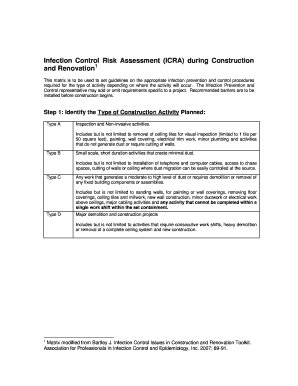
Infection Control Risk Assessment (ICRA) during Construction and Renovation1 This matrix is to be used to set guidelines on the appropriate infection prevention and control procedures required for.
Open form follow the instructions
Easily sign the form with your finger
Send filled & signed form or save
How to fill out the Infection Control Risk Assessment (ICRA) During Construction online
This guide provides a comprehensive overview of how to fill out the Infection Control Risk Assessment (ICRA) form during construction activities. It is designed to support users in understanding the necessary steps and components required for accurate completion.
Follow the steps to effectively complete the ICRA form.
- Click ‘Get Form’ button to access the ICRA form and open it in your preferred online environment.
- Identify the type of construction activity planned. Choose from Type A (inspection and non-invasive activities), Type B (small scale, short duration activities), Type C (moderate to high dust generation), or Type D (major demolition and construction projects).
- Determine the risk group impacted by the proposed construction activity. Classify the areas affected as 'Lowest Risk', 'Medium Risk', 'High Risk', or 'Highest Risk', based on specified criteria.
- Assign a class based on prior assessments and the type of construction activity. Refer to the risk levels associated with each activity type to categorize the construction appropriately.
- Identify any surrounding areas that could be impacted by the construction work, including above, below, lateral, or adjacent risk groups.
- Review the traffic flow and debris control measures, noting if hand washing sinks will be accessible and if an Interim Life Safety Measures (ILSM) plan is necessary.
- Execute the requirements for construction procedures based on the classification assignment. Complete any additional forms that follow the initial ICRA form, ensuring all sections are filled out as needed.
- Upon finalizing the form, ensure to save changes, download a copy, print for records, or share it with necessary stakeholders for further processing.
Complete your ICRA documents online today to ensure safety during construction activities.
Experience a faster way to fill out and sign forms on the web. Access the most extensive library of templates available.
Related content
IC Matrix - Class of Precautions: Construction Project by Patient Risk. Construction...
This process is identified as the Infection Control Risk Assessment (ICRA). The scope of...
No part of this book may be reproduced or utilised in any form or by any means ... to...
Get answers to your most pressing questions about US Legal Forms API.
What does ICRA stand for infection control?
ICRA stands for Infection Control Risk Assessment.
What is infection control risk assessment?
An infection risk assessment considers potential hazards and prioritizes them to better guide goal-setting and strategy development. Infection control risks can stem from a variety of areas in a healthcare organization, and most can lead to significant patient (or staff) harm.
What are the 3 methods of infection control?
Hand hygiene. Use of personal protective equipment (e.g., gloves, masks, eyewear). Respiratory hygiene / cough etiquette.
What are the 3 components of an infection?
Three things are necessary for an infection to occur: Source: Places where infectious agents (germs) live (e.g., sinks, surfaces, human skin) Susceptible Person with a way for germs to enter the body. Transmission: a way germs are moved to the susceptible person.
What are the three main components of infection control in an ICRA setting?
Primary interventions to interrupt transmission of small airborne particles include ventilation, filtration and isolation/pressurization.
What are the three components of infection prevention?
Core components for infection prevention and control programmes Guidelines and evidence. Implementation tools. Training tools. Monitoring tools.
What is ICRA infection control?
An infection control risk assessment (ICRA) is a systematic process that determines level of risk to patients and defines controls to reduce risk. The purpose of the risk assessment is to identify the effects of the construction or renovation activities on air and water quality.
What is ICRA in construction?
and Renovation. 1. This matrix is to be used to set guidelines on the appropriate infection prevention and control procedures required for the type of activity depending on where the activity will occur.
Use professional pre-built templates to fill in and sign documents online faster. Get access to thousands of forms.
If you believe that this page should be taken down, please follow our DMCA take down process here.