Loading
Get Biology 11 Worksheet Nematodes And Rotifers
How it works
-

Open form follow the instructions
-

Easily sign the form with your finger
-

Send filled & signed form or save
How to fill out the Biology 11 Worksheet Nematodes And Rotifers online
This guide provides a comprehensive outline for successfully completing the Biology 11 Worksheet focused on nematodes and rotifers. Follow these step-by-step instructions to ensure all sections are filled out accurately and thoroughly.
Follow the steps to complete your worksheet effectively.
- Press the ‘Get Form’ button to access the Biology 11 Worksheet Nematodes and Rotifers and open it in your editing interface.
- In the designated fields at the top of the form, input your name, block number, and the date. Ensure all your personal information is correct and clearly visible.
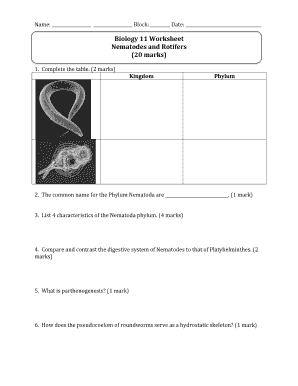
- Complete the table in section 1 by filling in the appropriate answers for 'Kingdom' and 'Phylum.' Refer to your course materials for accurate information.
- For question 2, write the common name used for the Phylum Nematoda. This may require some research or reference to your textbook.
- In question 3, list four characteristics of the Nematoda phylum, considering their biology and habits.
- Question 4 requires comparing and contrasting the digestive systems of Nematodes and Platyhelminthes. Use clear and concise language to highlight the differences and similarities.
- For question 5, define parthenogenesis succinctly, ensuring that your explanation captures the essence of this biological process.
- In question 6, describe how the pseudocoelom functions as a hydrostatic skeleton for roundworms, referring to specific examples or functions.
- Answer question 7(a) by identifying four common parasitic roundworms that infect humans, clearly stating their names. For 7(b), indicate whether roundworms can cause plant diseases and specify which types of plants are affected. Then, for 7(c), detail which parts of plants are generally susceptible.
- In question 8, outline the beneficial roles nematodes play in environmental ecosystems.
- For question 9, discuss the evolutionary developments that are shared between nematodes and rotifers.
- In question 10, list three characteristics unique to the Rotifer phylum.
- Finally, for question 11, explain how rotifers take in and digest their food, detailing the process to ensure clarity.
- Once all sections of the form have been completed, make sure to save your changes. You can then download, print, or share the worksheet as necessary.
Complete your Biology 11 Worksheet online and enhance your understanding of nematodes and rotifers.