Loading
Form preview
  • US Legal Forms
  • Other Templates
  • More Forms
  • More Multi-State Forms
  • Identifying Kinds Of Pronouns Worksheet - 1doc

Get Identifying Kinds Of Pronouns Worksheet - 1doc

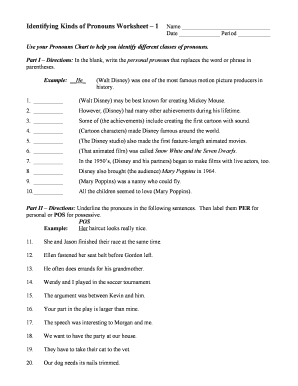
Identifying Kinds of Pronouns Worksheet 1 Name Date Period Use your Pronouns Chart to help you identify different classes of pronouns. Part I Directions: In the blank, write the personal pronoun that.

How it works

  1. Open form

    Open form follow the instructions

  2. Easily sign form

    Easily sign the form with your finger

  3. Share form

    Send filled & signed form or save

How to use or fill out the Identifying Kinds of Pronouns Worksheet - 1doc online

Filling out the Identifying Kinds of Pronouns Worksheet - 1doc online provides an effective way to learn about different classes of pronouns. This guide aims to assist users through each step to ensure clarity and accuracy in completing the worksheet.

Follow the steps to complete your worksheet online.

  1. Click ‘Get Form’ button to obtain the worksheet and open it in your preferred online document viewer or editor.
  2. Begin with Part I by looking at the phrases in parentheses and using your Pronouns Chart to find the correct personal pronoun that replaces each phrase. Write your answers in the blank spaces provided.
  3. Proceed to Part II, where you will underline the pronouns within each sentence. Then, label them as PER for personal or POS for possessive, based on their use in the context of the sentence.
  4. In Part III, underline the intensive and reflexive pronouns. Label them using INT for intensive or REF for reflexive, as specified in the directions.
  5. Move to Part IV, where you will fill in the blanks with the appropriate intensive or reflexive pronouns and label whether they are INT or REF.
  6. For Part V, underline the correct interrogative pronoun that best fits each sentence to complete them appropriately.
  7. Finally, in Part VI, underline the demonstrative pronouns which should not be functioning as modifiers. Ensure to review your answers.
  8. Once completed, save your changes, and choose to download, print, or share the worksheet as needed.

Start filling out your worksheets online today to enhance your understanding of pronouns!

Get form

Experience a faster way to fill out and sign forms on the web. Access the most extensive library of templates available.
Get form

Related content

DOCUMENT RESUME ED 383 236 FL 800 988 ... - ERIC
by D Skinner · 1994 · Cited by 1 — It is for students whose first or dominant language...
Learn more
14 sent[br[
Dative of pronouns. Russian years and summers. In class: Supp. Lesson 2.1; Lesson 2.A.1-3...
Learn more

Related links form

NOTICE OF PHYSICIAN S LIEN RELEASE Fnu Admission Form 2020 Pdf Premier Designs Jewelry Catalog Online Horse Lease Agreement

Questions & Answers

Get answers to your most pressing questions about US Legal Forms API.

Contact support

A pronoun is a word that can replace a noun in a sentence. The noun that is replaced by a pronoun is called an antecedent. For example, in the sentence I love my dog because he is a good boy, the word he is a pronoun that replaces the noun dog.

Pronouns are an important component of vocabulary development as they are crucial to the comprehension of language. Pronouns are used frequently in language production in English (Al-Shaer, 2014). In addition, the recent emphasis on pronouns in speech in society may also have an impact on how pronouns are acquired.

What are pronouns, and why are they important? Typically, when we communicate in English, we use pronouns to refer to ourselves and one another, such as “I,” “you,” “he,” or “she.” To create and maintain an inclusive environment, it's important that we don't make assumptions about a person's pronouns.

The main function of pronouns is to replace nouns. Because of this, they are used in sentences in similar ways to nouns. Like nouns, pronouns commonly serve as the subject of a sentence, followed by a verb (a word expressing an action). Examples: Pronouns as subjects I like to play chess.

In the late 1970s there was another public push for gender neutral pronouns, and “le” was briefly used before dying out. Fast forward to the 2010s, and we see a sharp rise in gender neutral pronouns from something talked about primarily within LGBTQ+ communities, to a broader global conversation.

RULE: Pronouns have three cases: nominative (I, you, he, she, it, they), possessive (my, your, his, her, their), and objective (me, him, her, him, us, them). Use the nominative case when the pronoun is the subject of your sentence, and remember the rule of manners: always put the other person's name first!

Properly using an individual's correct pronoun is an easy way to show respect. In an instance where a pronoun is not indicated or unknown, gender-neutral pronouns provide a useful option. Whether intentional or not, using the wrong pronouns can be hurtful, angering, and even distracting.

personal, possessive, relative, partitive, reflexive, demonstrative, interrogative, indefinite, distributive, universal and reciprocal Pronouns.

Get This Form Now!

Use professional pre-built templates to fill in and sign documents online faster. Get access to thousands of forms.
Get form
If you believe that this page should be taken down, please follow our DMCA take down processhere.
Get Identifying Kinds Of Pronouns Worksheet - 1doc
Get form

Form categories

Real Estate
  • Home Sale
  • Deeds
  • Leases
  • Landlord Tenant
  • First Refusal Agreement
  • Lis Pendens
  • View all Real Estate
Business & Commercial
  • Small Business
  • Contracts
  • Construction
  • Employment
  • Limited Liability Company
  • Partnerships
  • View all Business & Commercial
Estate Planning
  • Personal Planning
  • Last Will and Testament
  • Living Trust
  • Power of Attorney
  • Living Will (Healthcare Directive)
  • Probate
  • Trusts
  • Small Estate
  • View all Estate Planning

Other Legal Areas

  • Civil Actions
  • Civil Procedure
  • Animals
  • Affidavits
  • Bill of Sale
  • Oil Gas and Minerals
  • Name Change
  • Other
Family Law
  • Divorce
  • Annulment
  • Adoption
  • Marriage
  • Child Justice
  • View all Family Law
  • Forms Catalog
  • Other Templates

Company

  • About Us
  • Pricing
  • Legal Hub
  • Affiliate Program

Knowledge Base

  • Help Portal
  • Legal Resources
  • Blog
  • Industries
  • Legal Guides
  • Sitemap

Services

  • Notarize
  • Form Selector

Support

  • Contact Us
  • Delete My Account

Products

  • USLegal
  • FormsPass
  • pdfFiller
  • signNow
  • altaFlow
  • DocHub
  • Instapage
Social Media
Call us now toll free:
+1 833 426 79 33
As seen in:
© 2026 US Legal Forms. All rights reserved.
  • Your Privacy Choices
  • Terms of Service
  • Privacy Notice
  • Content Takedown Policy
  • Bug Bounty Program