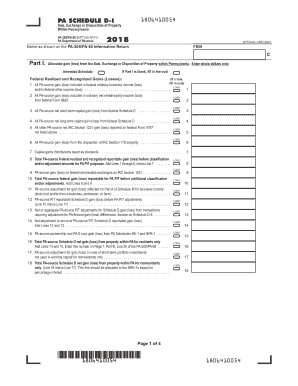
Get Pa Pa-20s/pa-65 D - Schedule D-i 2018
How it works
-

Open form follow the instructions
-

Easily sign the form with your finger
-

Send filled & signed form or save
How to fill out the PA PA-20S/PA-65 D - Schedule D-I online
Filling out the PA PA-20S/PA-65 D - Schedule D-I form is essential for reporting gains or losses from the sale, exchange, or disposition of property within Pennsylvania. This guide provides a clear and supportive framework to assist you in accurately completing the form online.
Follow the steps to complete your PA PA-20S/PA-65 D - Schedule D-I online.
- Press the ‘Get Form’ button to obtain the form, ensuring it opens in your preferred editing software.
- Enter the name of your entity or business exactly as it appears on the PA-20S/PA-65 Information Return.
- Input the nine-digit federal employer identification number (FEIN) in the designated field.
- If this is an amended schedule, fill in the appropriate oval indicating it is amended.
- In Part I, report the allocated gain (loss) from the sale, exchange, or disposition of property within Pennsylvania.
- Complete the lines detailing various types of PA-source gains or losses, referring to your federal documentation for accuracy.
- Calculate the total reportable gains (losses) before any adjustments and enter that figure in the required field.
- If applicable, itemize any necessary adjustments on Schedule D-II, and fill any remaining fields with complete accuracy.
- Review all entries for accuracy before moving on to save, download, print, or share your completed form.
Complete your PA PA-20S/PA-65 D - Schedule D-I online today to ensure your property disposals are accurately reported.
Get form
Related links form
Any corporation that has income from a pass-through entity or operates as a partnership in Pennsylvania must file PA-65 Corp. This includes various business structures that are taxed as partnerships or LLCs. Filing this form is necessary for corporations to report their share of profits and losses accurately. Doing so keeps your business compliant with state tax regulations and avoids unnecessary penalties.