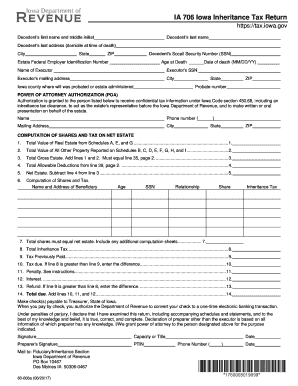
IA 706 Iowa Inheritance Tax Return https://tax.iowa.gov Decedents first name and middle initialDecedents last nameDecedents last address (domicile at time of death) CityStateZIPDecedents Social Security.

How it works
  • Open form

    Open form follow the instructions

  • Easily sign form

    Easily sign the form with your finger

  • Share form

    Send filled & signed form or save

How to fill out the IA DoR 706 online

Filling out the IA DoR 706, Iowa Inheritance Tax Return, online can seem daunting. This guide provides a straightforward, step-by-step approach to assist you in accurately completing the form, ensuring compliance and clarity.

Follow the steps to fill out the IA DoR 706 effectively.

  1. Press the ‘Get Form’ button to access the document and open it in your editor.
  2. Begin by entering the decedent's information in the appropriate fields, including their first name, middle initial, last name, and address at the time of death, followed by their city, state, ZIP code, and Social Security Number (SSN).
  3. Next, input the Estate Federal Employer Identification Number and the decedent’s age at death along with the date of death formatted as MM/DD/YY.
  4. Fill in the name of the executor, their Social Security Number, and mailing address, including city, state, and ZIP code.
  5. Indicate the Iowa county where the will was probated or the estate administered, and provide the probate number.
  6. For the Power of Attorney Authorization section, specify the authorized individual's name, phone number, mailing address, city, state, and ZIP code.
  7. In the Computation of Shares and Tax on Net Estate section, provide the total value of real estate and other properties, and calculate the total gross estate by adding those values.
  8. Deduct allowable expenses from the gross estate to determine the net estate.
  9. List each beneficiary’s name, address, age, SSN, relationship to the decedent, share, and corresponding inheritance tax.
  10. Ensure the total shares equal the net estate and include any additional computation sheets if necessary.
  11. Complete the final calculations for tax due and any penalties or interest as applicable. Prepare to authorize your payment by check and review the declaration statement.
  12. Once you have filled out all necessary fields, save your changes, and you will have the option to download, print, or share the form.

Complete your IA DoR 706 online today to ensure a smooth filing process.

Get form

Experience a faster way to fill out and sign forms on the web. Access the most extensive library of templates available.

Related content

IA 706 Iowa Inheritance Tax Return, 60-008

May 28, 2024 — This designation allows for the designee to receive the estate's...

Learn more
Estudo dos efeitos auditivos e extra- ...

by M Fernandes · 2002 · Cited by 135 — queixas de saúde e achados audiológicos de...

Learn more
MigMag 170-230 - BA - DE/EN/FR/NL - metabo-service

This MIG welding machine is factory set for welding low-carbon steel. Use a mixed gas...

Learn more
Questions & Answers

Get answers to your most pressing questions about US Legal Forms API.

Contact support

How long does it take the IRS to process Form 706?

The IRS generally takes about six to nine months to process Form 706. However, times can vary based on the complexity of the estate and any delays in documentation. If you’re dealing with the IA DoR 706, being organized can expedite the process. Should you have questions or need assistance with your filing, uslegalforms offers helpful tools to streamline your experience.

If there is no executor available, the responsibilities for signing Form 706 typically fall to the closest relative or the person in possession of the estate's assets. In such cases related to the IA DoR 706, it’s important to ensure that the designated individual understands their responsibilities. This process might be complex, so utilizing uslegalforms can help clarify details and provide necessary documentation.

TurboTax does include Form 706 for estate tax returns, which may be essential for your needs in relation to the IA DoR 706. It is helpful in guiding you through the preparation of estate-related tax filing. Be sure to choose the right version of TurboTax that supports estate returns. If you encounter complications, uslegalforms can provide additional resources to assist you.

Yes, you must report the sale of inherited property to the IRS. Under the IA DoR 706 rules, when you sell inherited property, you need to report the sale on your tax return. Although generally, inherited property is not subject to income tax, any gain from the sale may require reporting. It’s wise to consult tax professionals or use platforms like uslegalforms to ensure compliance.

To obtain a closing letter regarding the IRS Form 706, you need to ensure that all necessary tax filings related to the estate are complete. After the IRS processes Form 706, you can request the closing letter by following the guidelines specified for the IA DoR 706. It is essential to keep abreast of deadlines and requirements to acquire this documentation promptly.

To avoid Iowa inheritance tax on property, individuals can employ techniques such as gifting property during their lifetime or setting up trusts that may offer tax advantages. Additionally, researching the specific provisions within the IA DoR 706 can reveal potential savings. Relying on professional assistance may further enhance your strategy in mitigating taxes.

One notable tax loophole for inherited property is the step-up in basis rule, which allows the heirs to adjust the property's value for tax purposes to its fair market value at the time of inheritance. This change can significantly reduce capital gains taxes when the property is eventually sold. Understanding the nuances of the IA DoR 706 can help you fully benefit from this loophole.

To avoid taxes when inheriting a house in Iowa, consider strategies such as utilizing the exemptions available under the IA DoR 706 and making use of estate planning tools. Additionally, maintaining clear records of your inherited property's value can help in tax assessments. Engaging with an estate planning expert can provide tailored advice based on your specific circumstances.

Yes, Iowa imposes an inheritance tax on real estate, just like other forms of property. The IA DoR 706 outlines how this tax is calculated, and it's vital to recognize its implications when dealing with inherited property. To navigate this tax efficiently, consider consulting a professional who is well- in Iowa’s tax laws.

In Iowa, certain individuals are exempt from the inheritance tax, including spouses, parents, grandparents, children, grandchildren, and recipients of property valued under a specific threshold. These exemptions are crucial to understanding how the IA DoR 706 applies to your situation. By knowing who is exempt, you can better plan your estate and avoid unnecessary taxation.

Get This Form Now!

Use professional pre-built templates to fill in and sign documents online faster. Get access to thousands of forms.

If you believe that this page should be taken down, please follow our DMCA take down process here.

IA DoR 706 Form

This form is available in several versions. Select the version you need from the drop-down list below.

Get IA DoR 706