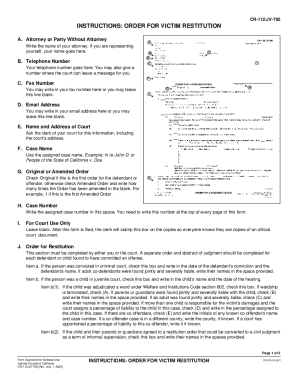
This document outlines the instructions for completing the Order for Victim Restitution, including the necessary details to be filled out regarding the victim, offender, and restitution amounts.
Loading
Open form follow the instructions
Easily sign the form with your finger
Send filled & signed form or save
How to fill out the CA CR-112/JV-792 online
Filling out the CA CR-112/JV-792 form can seem daunting at first, especially for those unfamiliar with legal processes. This guide aims to provide clear, step-by-step instructions to help you efficiently complete the form online with confidence.
Follow the steps to easily complete the CA CR-112/JV-792 form online.
- Click ‘Get Form’ button to obtain the form and open it in the editing area.
- In the 'Attorney or Party Without Attorney' section, enter your name if you are representing yourself or the name of your attorney.
- Input your telephone number in the designated field, providing a number for court communication if desired.
- If you have a fax number, enter it here; otherwise, you may leave this section blank.
- Provide your email address in the appropriate field. This is optional.
- Fill in the name and address of the court by consulting your local court clerk for accurate details.
- Record the assigned case name exactly as it appears in your court documents.
- Indicate whether this is an original or amended order by checking the relevant box and fill in the number of amendments if applicable.
- Write the assigned case number in the provided space, ensuring you replicate this number at the top of every form page.
- Leave the 'For Court Use Only' section blank, as this will be completed by the court staff.
- Complete the 'Order for Restitution' section by providing the necessary details according to the defendant's case, checking applicable boxes based on whether they were convicted in criminal court or in juvenile court.
- Fill out the 'Judicial Determination of Restitution' section, ensuring to check the appropriate boxes regarding hearings.
- In the 'Restitution Ordered to Pay' section, input your name as the victim along with the exact amount ordered by the court.
- Reiterate the case name and number in this section for consistency.
- Finally, check the boxes that apply to the reasons for restitution, specifying any additional costs if necessary.
- Once you have confirmed all information is correct, save your changes, download the form, print it, or share it as needed.
Start completing your documents online today for a streamlined experience.
Experience a faster way to fill out and sign forms on the web. Access the most extensive library of templates available.
Related content
Browsing Form Files on California Courts. The Judicial .... 3/1/2014, Order Concerning...
Cavallari LH, Van Driest SL, Prows CA, Bishop JR, IGNITE Network., et al. Multi-site...
Aug 17, 2016 - ... 2014/12/12-00:43:15 Metadata Date : 2015:12:15 11:13:50+01:00 Creator...
Get answers to your most pressing questions about US Legal Forms API.
How much do court appointed attorneys make?
Thus, the maximum that attorneys can earn from court appointed work annually would range from $70,000 (handling lower end cases) to $84,500 (at the upper end). pay lawyers, quite generously, for representation in criminal matters. criminal work and certainly weren't getting $60 an hour for it.
Is a court appointed lawyer good?
Court-appointed lawyers aren't automatically less skillful than retained counsel, and are often just as good or better. ... If a person does not have the financial means to hire an attorney, courts will appoint a lawyer free of charge in all cases, including misdemeanors, that have the possibility of incarceration.
Who are court appointed lawyers?
What's a Court Appointed Attorney? Court appointed attorneys are attorneys who are appointed by the state to assist persons during criminal law proceedings. A court appointed attorney performs various tasks, such as arguing the defense case before court, researching laws, and providing legal advice to the defendant.
What is the difference between a court appointed lawyer and a public defender?
Remember, an assigned counsel is a private attorney who takes court-appointed cases and gets paid by the hour, whereas the public defender is an attorney who works only for the government - although they are bound by ethics to defend their client to the best of their ability - and gets paid a salary, no matter the ...
Can you be denied a public defender?
Yes, the court can refuse to appoint a public defender if your case is in municipal court and the prosecutor is not asking for jail time. Also, you can be refused a public defender if you were able to pay the bond and get out of jail.
How does court appointed lawyers work?
What's a Court Appointed Attorney? Court appointed attorneys are attorneys who are appointed by the state to assist persons during criminal law proceedings. A court appointed attorney performs various tasks, such as arguing the defense case before court, researching laws, and providing legal advice to the defendant.
Is a lawyer better than a public defender?
A big difference between a public defender vs private attorney is the fact that if a lawyer does a poor job their business will suffer. A public defender gets more cases than they can handle no matter the outcomes. Another benefit of a private lawyer is access to more defense possibilities.
Are court appointed attorneys paid?
As with privately hired attorneys, court-appointed lawyers are legally obligated to zealously defend their clients' interests. Also, despite the fact that public defenders and other lawyers appointed by the court are paid by the same entity that pays the prosecutors and judges (the government), they work for you.
Are court appointed lawyers any good?
Court-appointed lawyers aren't automatically less skillful than retained counsel, and are often just as good or better. ... If a person does not have the financial means to hire an attorney, courts will appoint a lawyer free of charge in all cases, including misdemeanors, that have the possibility of incarceration.
Does everyone have the right to a public defender?
Sixth Amendment Right to Counsel The right to an attorney, regardless of financial means, is one of the fundamental rights included in the Miranda warnings that police must read to people during or after their arrest.
Use professional pre-built templates to fill in and sign documents online faster. Get access to thousands of forms.
If you believe that this page should be taken down, please follow our DMCA take down process here.