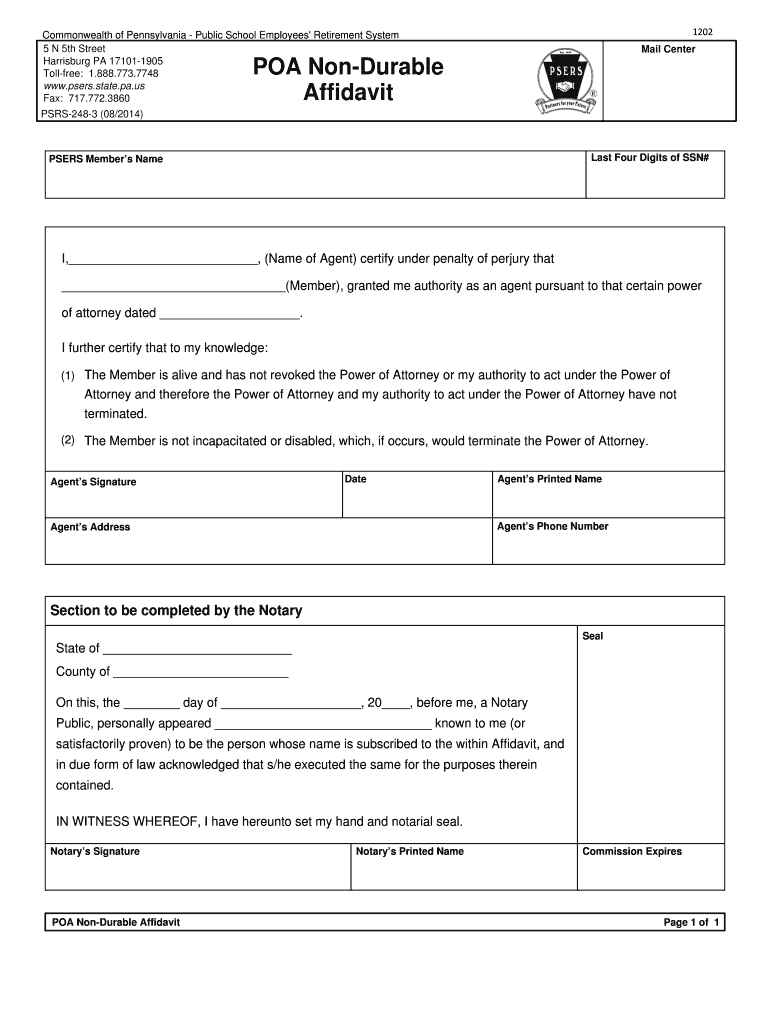
R POA Non-Durable Affidavit PSRS-248-3 (08/2014) Last Four Digits of SSN# PSERS Member s Name I, , (Name of Agent) certify under penalty of perjury that (Member), granted me authority as an agent pursuant to that certain power of attorney dated . I further certify that to my knowledge: (1) The Member is alive and has not revoked the Power of Attorney or my authority to act under the Power of Attorney and theref.
Loading

Open form follow the instructions

Easily sign the form with your finger

Send filled & signed form or save
How to fill out the PA PSRS-248-3 online
The PA PSRS-248-3 form, also known as the Power of Attorney Non-Durable Affidavit, is essential for confirming the authority granted to an agent by a member of the Public School Employees' Retirement System of Pennsylvania. This guide will provide clear, step-by-step instructions on how to accurately complete this form online.
Follow the steps to complete the form efficiently.
- Press the ‘Get Form’ button to access the PA PSRS-248-3 and open it for editing.
- In the first field, enter your first name, middle initial (if applicable), and last name as the agent acting under the power of attorney. This is important for identifying yourself.
- Next, provide the name of the PSERS member, who has granted you the authority to act on their behalf, in the designated area.
- In the date section, fill in the day, month, and year when the power of attorney was executed.
- You must confirm that the PSERS member is alive and has not revoked the power of attorney by checking the appropriate box or providing a statement as required.
- Indicate whether the member is incapacitated or disabled, confirming that the power of attorney remains valid under current circumstances.
- Sign the document in the section marked ‘Agent’s Signature’ to affirm the authenticity of the affidavit.
- Enter the date of your signature in the ‘Date’ field below your signature.
- Provide your printed name, phone number, and address in the specified areas to ensure your contact information is accurate.
- Proceed to the notary section where a notary public will complete their portion, including providing their signature, printed name, and the commission expiration date.
- Review the completed form for accuracy before finalizing. You can save changes, download a copy, print it, or share the form as needed.
Complete your PA PSRS-248-3 form online today for a smooth process.
Experience a faster way to fill out and sign forms on the web. Access the most extensive library of templates available.
Related content
PSRS- 248-3 (07/2019). Commonwealth of Pennsylvania - Public School Employees' Retirement...
Reaction Design provides an allotment of technical support to its Licensees free of...
• Adaptor: PA-301, PA-300 or an equivalent recommended by. Yamaha. Dimensions (W x D x...
Get answers to your most pressing questions about US Legal Forms API.
What are the four types of power of attorney near Pennsylvania?
In Pennsylvania, the four primary types of power of attorney include general power of attorney, durable power of attorney, limited power of attorney, and medical power of attorney. General POA grants broad authority, while durable POA remains effective even if the principal becomes incapacitated. Limited POA restricts authority to specific tasks, and medical POA allows someone to make health care decisions. Understanding these types can help you choose the right form, such as PA PSRS-248-3, for your needs.
Do you need a lawyer for power of attorney in Pennsylvania?
While it is not mandatory to hire a lawyer for establishing power of attorney in Pennsylvania, having legal guidance can be beneficial. A lawyer can clarify the nuances of the PA PSRS-248-3 form and ensure it meets all legal requirements. If your situation involves significant assets or complex decisions, professional advice may save you time and prevent issues down the line.
How do I get a POA for a deceased person?
Acquiring power of attorney for a deceased person is not possible, as POA responsibilities end upon death. Instead, the estate must go through probate, where a personal representative is appointed to handle the deceased's affairs. If needed, consult with an attorney to navigate this legal process effectively, especially for complexities that may arise.
How do I get power of attorney for an elderly parent in PA?
Getting power of attorney for your elderly parent in Pennsylvania starts with form PA PSRS-248-3. First, discuss your intentions with your parent to ensure they agree. You must both complete and sign the form, then have it notarized for legal standing. Using a platform like USLegalForms can streamline this process and provide you with additional resources.
How to get a poa in PA?
To obtain a power of attorney (POA) in Pennsylvania, you must complete a specific form known as PA PSRS-248-3. This document allows you to designate someone to act on your behalf in financial or health matters. You can acquire the form through various sources, including legal websites or local government offices. After filling it out, ensure you sign it in front of a notary public to validate your authority.
What is the PA teacher pension multiplier?
The PA teacher pension multiplier is generally 2%, which refers to how much a teacher earns per year of service when calculating retirement benefits. This multiplier is crucial as it helps project the total pension amount based on years of service and the average salary. In the context of PA PSRS-248-3, grasping this multiplier lets educators better plan their future financial landscape. This calculation plays a significant role in simplifying pension planning.
Does a power of attorney need to be recorded in Pennsylvania?
In Pennsylvania, a power of attorney does not need to be recorded to be effective, but recording can add a layer of protection. While you can keep the document safe without filing it, recording can help in asserting the agent’s authority if questioned. This is especially relevant for real estate transactions and other legal matters. Hence, understanding these details is essential if using power of attorney in the context of PA PSRS-248-3.
What is the formula for teacher retirement in PA?
The formula for teacher retirement in Pennsylvania includes the retirement multiplier, years of service, and average final salary. Teachers typically calculate their pension benefits using the formula: Years of Service × Retirement Multiplier × Average Final Salary. In essence, this straightforward equation helps educators plan for their financial future. It's important to understand how these components relate to PA PSRS-248-3 for accurate retirement forecasting.
How does a retirement multiplier work?
A retirement multiplier calculates the pension amount based on years of service and average salary. For teachers under the PA PSRS-248-3, you multiply years of service by the retirement multiplier, usually 2%, and then multiply by the average final salary. This calculation provides a clear picture of what a retiree can expect to receive monthly. Thus, it's essential for educators to grasp this calculation for effective retirement planning.
What is the 2% 62 formula?
The 2% 62 formula is used in the Pennsylvania Teacher's Retirement System to calculate retirement benefits. Under this formula, retirees earn 2% of their average final salary for each year of service, provided they are at least 62 years old. This approach allows for a straightforward method of determining benefits, making it clear how much a teacher can expect upon retiring. Understanding this formula is essential for anyone anticipating retirement benefits under PA PSRS-248-3.
Use professional pre-built templates to fill in and sign documents online faster. Get access to thousands of forms.
If you believe that this page should be taken down, please follow our DMCA take down process here.
This form is available in several versions. Select the version you need from the drop-down list below.