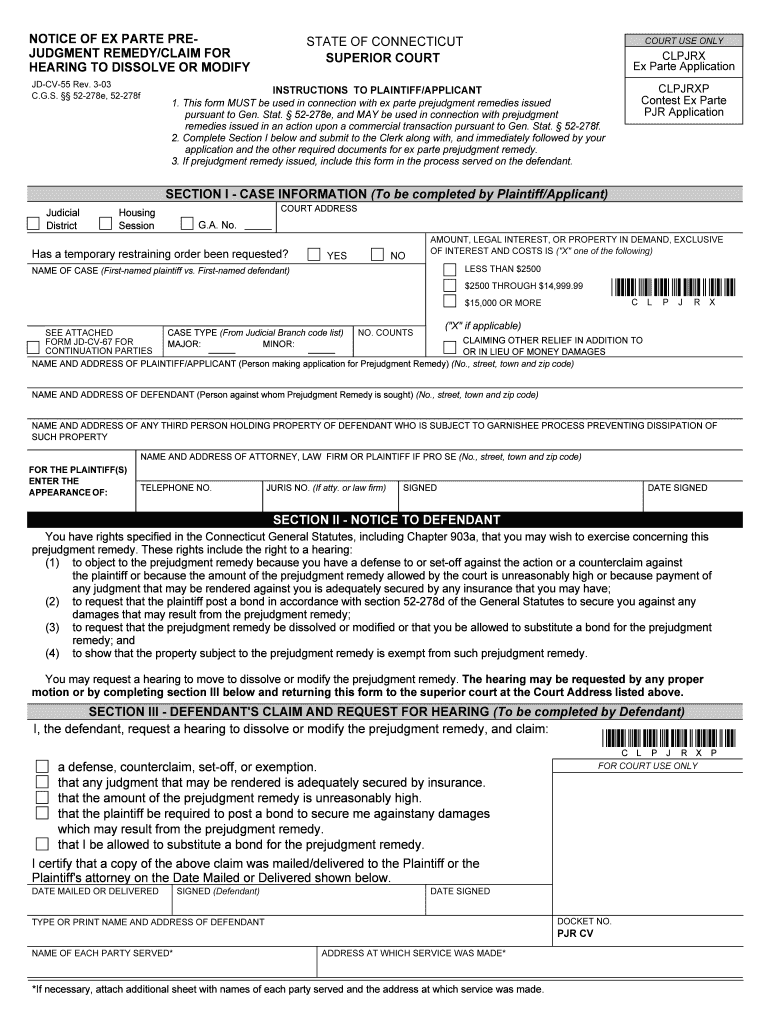
Lication CLPJRXP Contest Ex Parte PJR Application INSTRUCTIONS TO PLAINTIFF/APPLICANT 1. This form MUST be used in connection with ex parte prejudgment remedies issued pursuant to Gen. Stat. 52-278e, and MAY be used in connection with prejudgment remedies issued in an action upon a commercial transaction pursuant to Gen. Stat. 52-278f. 2. Complete Section I below and submit to the Clerk along with, and immediately followed by your application and the other required documents for ex parte.
Loading

Open form follow the instructions

Easily sign the form with your finger

Send filled & signed form or save
How to fill out the CT JD-CV-55 online
The CT JD-CV-55 form is essential for initiating an ex parte prejudgment remedy in Connecticut. This guide provides users with clear, step-by-step instructions to assist in completing the form accurately and efficiently online.
Follow the steps to complete the CT JD-CV-55 form online.
- Click ‘Get Form’ button to obtain the CT JD-CV-55 form and open it in your preferred document editor.
- In Section I, fill out the case information including the judicial district, court address, and G.A. number. Indicate if a temporary restraining order has been requested by selecting 'Yes' or 'No.'
- Specify the amount in demand by checking the appropriate box: less than $2,500, between $2,500 and $14,999.99, or $15,000 or more.
- Provide the names of the parties involved in the case. Enter the name of the case in the format 'First-named plaintiff vs. First-named defendant.'
- List the names and addresses of the plaintiff/applicant and defendant, ensuring all details are accurate and complete.
- If applicable, include the name and address of any third person holding property of the defendant subject to garnishee process.
- Input the name, address, and jurisdiction number of the attorney or law firm representing the plaintiff, or indicate if the plaintiff is proceeding pro se.
- In Section II, as appropriate, acknowledge the notice to the defendant about their rights concerning the prejudgment remedy.
- If you are the defendant and wish to request a hearing to dissolve or modify the prejudgment remedy, complete Section III with relevant claims.
- After filling in all sections, review the form for accuracy. Users can then save changes, download, print, or share the completed form.
Begin completing your CT JD-CV-55 form online today for a seamless process.
Experience a faster way to fill out and sign forms on the web. Access the most extensive library of templates available.
Related content
Instructions To Plaintiff/Applicant 1. This form MUST be used in connection with ex...
Jan 9, 2024 — ... JD, Pandian V. The Value of History and Physical Examination to...
Design Circumaural Supra-auricular de Costas. Fechadas • Curva de EQ para Música e...
Get answers to your most pressing questions about US Legal Forms API.
What does it mean when pleadings are closed?
When pleadings are closed, it means that the parties in a lawsuit have finished exchanging their formal documents related to the case. At this point, no new claims or defenses can be introduced without court approval. Closing pleadings is a critical phase in legal proceedings, particularly relevant for those using the CT JD-CV-55. To ensure your case adheres to these standards, consider using resources like uslegalforms for guidance.
What is Section 10 35 of the CT practice book?
Section 10 35 of the Connecticut Practice Book outlines the rules regarding the pleadings and their closure in civil cases. This section provides important guidelines for how and when parties must submit their pleadings, ensuring that all relevant issues are raised in a timely manner. Understanding this section is important when you are preparing documents like the CT JD-CV-55, as it impacts the case's progress. If you need help navigating these rules, uslegalforms can offer valuable assistance.
When to file certificate of closed pleadings CT?
You should file the certificate of closed pleadings in Connecticut after both parties have submitted their pleadings and before proceeding to any hearings or trials. This document is crucial to confirm that the court has received all necessary filings, allowing the case to advance efficiently. Ensure your CT JD-CV-55 is complete, as this process is an essential step in judicial proceedings. Consider using uslegalforms to manage your filing timelines.
What does a certificate of closed pleadings mean?
A certificate of closed pleadings confirms that all necessary documents in a case have been submitted and reviewed by the court. This certificate plays a vital role in moving a case forward, as it signifies that all sides have completed their pleadings. When filing the CT JD-CV-55, you may need to obtain this certificate to progress to the next steps in litigation. Check guidelines or consult uslegalforms for clarity on this process.
What do prejudgment remedies mean?
Prejudgment remedies refer to court orders that protect a plaintiff's interests before a final judgment is made. In Connecticut, these remedies can allow for the attachment of property or assets, securing what you may win in your lawsuit. Understanding these provisions is important when filling out documents like the CT JD-CV-55. If you need assistance, consult legal resources or professionals.
How to write a strong motion to dismiss?
Writing a strong motion to dismiss involves presenting a concise argument that clearly outlines the legal grounds for dismissal. Use straightforward language and evidence to support your claims while addressing any counterarguments from the opposition. Be sure to follow the format and filing procedures established by the court for the CT JD-CV-55. This preparation will enhance the credibility of your motion and improve your chances of success.
How to file small claims in CT?
To file small claims in Connecticut, prepare the required forms and file them in the appropriate court that handles small claims, typically the Superior Court. Use the CT JD-CV-55 to detail your complaint clearly, ensuring that you meet the court's jurisdictional limits for small claims. It's advisable to maintain copies of all documents for your records and to follow any specific court procedures. Taking these steps can streamline your small claims filing process.
What is the rule 12 motion to dismiss?
A Rule 12 motion to dismiss targets the legal sufficiency of the complaint, often focusing on jurisdictional issues or the failure to meet the legal requirements for a valid claim. This motion is a critical tool for defendants to challenge cases early in the litigation process. Properly framing your arguments under this rule is essential for success. Familiarizing yourself with the CT JD-CV-55 can enhance your understanding and effectiveness.
What goes into a motion to dismiss?
A motion to dismiss should include a clear statement of the legal basis for the dismissal, supported by relevant facts and legal arguments. Structure your motion logically, addressing each argument clearly and concisely. It’s beneficial to back up your claims with statutory references and case law. Having a comprehensive understanding of the CT JD-CV-55 will guide you in creating a more effective motion.
How do you request leave to amend a complaint in CT?
To request leave to amend a complaint in Connecticut, file a motion with the court that details the proposed amendments and the reason for the change. Ensure you comply with the requirements outlined in the Connecticut Practice Book to increase your chances of approval. Remember to reference the original complaint and how the changes will benefit justice. The CT JD-CV-55 can serve as a helpful tool during this process.
Use professional pre-built templates to fill in and sign documents online faster. Get access to thousands of forms.
If you believe that this page should be taken down, please follow our DMCA take down process here.