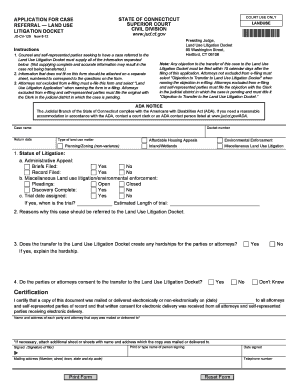
Tigation Docket 95 Washington Street, Hartford, CT 06106 Instructions 1. Counsel and self-represented parties seeking to have a case referred to the Land Use Litigation Docket must supply all of the information requested below. (Not supplying complete and accurate information may result in the case not being transferred.) 2. Information that does not fit on this form should be attached on a separate sheet, numbered to correspond to the questions on the form. 3. Attorneys not excluded from e-fi.
Loading
Open form follow the instructions
Easily sign the form with your finger
Send filled & signed form or save
How to fill out the CT JD-CV-129 online
Filling out the CT JD-CV-129 form online is essential for individuals seeking to refer a case to the Land Use Litigation Docket. This guide provides clear and detailed instructions to help you complete the form accurately and efficiently.
Follow the steps to fill out the CT JD-CV-129 form online.
- Press the ‘Get Form’ button to access the CT JD-CV-129 form and open it in the online editor.
- Begin by providing the case name, return date, and docket number at the top of the form. Ensure that all entries are accurate to avoid complications in the referral process.
- Select the type of land use matter from the provided options, such as planning/zoning, affordable housing appeals, or miscellaneous land use litigation.
- Indicate the status of litigation by answering the relevant questions regarding administrative appeals and miscellaneous land use litigation, ensuring to mark whether briefs and records have been filed.
- In the section for trial information, provide the assigned trial date if applicable, along with the estimated length of the trial.
- Describe the reasons why this case should be referred to the Land Use Litigation Docket in the section provided, offering specific details to support your request.
- Answer whether the transfer to the Land Use Litigation Docket creates any hardships for the parties or attorneys. If yes, explain the hardship clearly.
- State whether the parties or attorneys consent to the transfer to the Land Use Litigation Docket by checking the appropriate response.
- In the certification section, enter the date you mailed or delivered a copy of the document and provide the name and address of each party and attorney to whom the document was sent.
- Print or type your name, sign the form, indicate the date signed, and include your telephone number and mailing address.
- Once all sections are filled out, you can save your changes, download the completed form, print it, or share it as needed.
Complete your documents online today for a seamless filing experience.
Experience a faster way to fill out and sign forms on the web. Access the most extensive library of templates available.
Related content
JD-CV-129, Application For Case Referral - Land Use Litigation Docket, Rev. 04 ... CT.gov...
Use of modern CT simulation and 3-D radiation therapy planning system to develop and...
Design Circumaural Supra-auricular de Costas. Fechadas • Curva de EQ para Música e...
Get answers to your most pressing questions about US Legal Forms API.
When to file a certificate of closed pleadings in CT?
You should file a certificate of closed pleadings in Connecticut once all pleadings have been submitted and the case is ready for trial. This filing often supports motions or helps clarify the status of your case. When preparing your certificate, consider referencing CT JD-CV-129 for accuracy in your documentation.
How to serve a small claims writ and notice of suit in CT?
To serve a small claims writ and notice of suit in Connecticut, you must deliver the documents in person to the defendant or via certified mail. It’s essential to keep track of service timelines and to file a return of service with the court. For guidance on forms like CT JD-CV-129, using US Legal Forms can provide the templates and instructions needed.
What is the local rule 56 in CT?
Local Rule 56 in Connecticut pertains to summary judgment motions, guiding how parties may seek judgment when there are no genuine disputes of material fact. This rule sets out the specific procedures and requirements for filing such motions, helping to expedite the resolution of disputes. Understanding local rules, such as those emphasized in CT JD-CV-129, is crucial for effective legal strategy.
How long does a judge have to rule on a motion in CT?
Judges in Connecticut generally aim to rule on motions within a reasonable timeframe, with many striving to make decisions within 120 days. This timeline can vary based on various factors, including the court's caseload and the specific details of the motion at hand. Utilizing CT JD-CV-129 can streamline your process and keep your case on track.
How long are judgments good for in Connecticut?
In Connecticut, most judgments remain valid for 20 years from the date they are issued. After this period, a judgment may be renewed if certain conditions are met. It is advisable to keep related documents, such as those generated by CT JD-CV-129, in case you need to reference your judgment in the future.
What happens if a judge doesn't rule on a motion?
If a judge does not rule on a motion, the motion may be considered denied by default in some situations. However, in practice, the delay might simply reflect the judge's busy docket. Keeping track of your motion's status and utilizing resources such as CT JD-CV-129 can aid in understanding your court proceedings better.
How long does a judge have to make a decision on a motion?
In Connecticut, a judge typically has a reasonable period to make a decision on a motion. The expectation is often that judges will rule within 120 days, but this timeframe can vary depending on the complexity of the case and the court’s schedule. When dealing with motions related to forms like CT JD-CV-129, staying informed about timelines helps you manage expectations.
How to file a civil lawsuit in CT?
Filing a civil lawsuit in Connecticut involves several steps, starting with the preparation of necessary legal forms, including the CT JD-CV-129. Properly completing and submitting these forms ensures that your case is officially recognized. Next, you will need to serve the defendant with your complaint, which is a critical step in the process. Legal platforms can provide guidance and resources to help you file correctly, making the entire experience manageable.
When to file certificate of closed pleadings CT?
You should file a certificate of closed pleadings in Connecticut when all parties have completed their pleadings and no further amendments are necessary. This is essential for moving forward with your case, particularly when using forms such as the CT JD-CV-129. Timely filing helps streamline the legal process and ensures your case can proceed without unnecessary delays. Consult with legal resources to confirm the appropriate timing for your situation.
How long do you have to sue someone in CT?
In Connecticut, the statute of limitations typically gives you a limited time to sue, usually ranging from one to six years, depending on the type of claim. For example, contract disputes generally have a six-year limit. Understanding this timeline is crucial, especially when using forms like the CT JD-CV-129, as timely filing can impact the success of your case. Be proactive to ensure your rights are protected.
Use professional pre-built templates to fill in and sign documents online faster. Get access to thousands of forms.
If you believe that this page should be taken down, please follow our DMCA take down process here.
This form is available in several versions. Select the version you need from the drop-down list below.