Loading
Form preview
  • US Legal Forms
  • Other Templates
  • Legal Forms
  • California Legal Forms
  • Ca Unlawful Detainer (eviction) Instructions

Get Ca Unlawful Detainer (eviction) Instructions

How it works

  1. Open form

    Open form follow the instructions

  2. Easily sign form

    Easily sign the form with your finger

  3. Share form

    Send filled & signed form or save

How to use or fill out the CA Unlawful Detainer (Eviction) Instructions online

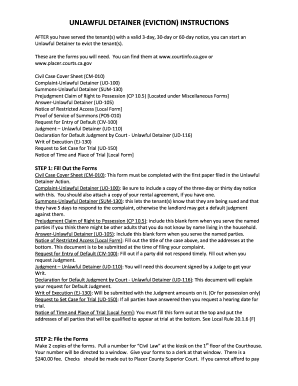
Navigating the process of eviction can be complex, but understanding the CA Unlawful Detainer Instructions is essential for landlords looking to legally remove a tenant. This guide will provide you with clear and supportive steps to successfully fill out the necessary forms online.

Follow the steps to fill out the CA Unlawful Detainer Instructions online.

  1. Click the ‘Get Form’ button to obtain the CA Unlawful Detainer Instructions form and open it in your preferred online document editor.
  2. Begin filling out the Civil Case Cover Sheet (CM-010), which is the first document required in the Unlawful Detainer action. Provide accurate information as it will be used to identify your case.
  3. Complete the Complaint-Unlawful Detainer (UD-100). Ensure you attach a copy of the three-day or thirty-day notice and, if available, your rental agreement.
  4. Fill out the Summons-Unlawful Detainer (SUM-130), noting that this informs the tenant of the legal action and specifies that they have five days to respond.
  5. If applicable, include the Prejudgment Claim of Right to Possession (CP 10.5) to provide notice of potential additional occupants.
  6. Prepare the Answer-Unlawful Detainer (UD-105) form to serve the tenant, allowing them an opportunity to respond.
  7. Complete the Notice of Restricted Access [Local Form] with case title and addresses, as this is crucial for your filing.
  8. Use the Request for Entry of Default (CIV-100) if the tenant has not responded by the deadline.
  9. Fill out the Judgment - Unlawful Detainer (UD-110) and the Declaration for Default Judgment by Court (UD-116) to formally request a judgment.
  10. Prepare the Writ of Execution (EJ-130), ensuring that it includes the appropriate judgment amounts.
  11. If necessary, use the Request to Set Case for Trial (UD-150) to arrange a hearing date for your case.
  12. Complete the Notice of Time and Place of Trial [Local Form], including addresses of all parties involved.
  13. Make two copies of all forms for your records. You are now ready to submit your documents to the court.
  14. File the completed forms with the court by following the process laid out, including paying the required filing fee.
  15. Serve the completed forms to the tenant, ensuring that this is done by someone over 18, not the landlord, or hire a process server.
  16. File the Proof of Service of Summons (POS-010) to confirm that the tenant has been served.
  17. After serving the tenant, wait five days for their response. Depending on their action, you will either seek a default judgment or set a trial date.

Complete your CA Unlawful Detainer Instructions online today and streamline your eviction process.

Get form

Experience a faster way to fill out and sign forms on the web. Access the most extensive library of templates available.
Get form

Related content

Eviction cases in California
Eviction cases in California. This guide explains the eviction process (called unlawful...
Learn more
A Summary of California Eviction Process
The Landlord starts an eviction case in court by filing a Unlawful Detainer Complaint and...
Learn more
united states securities and exchange commission
Sep 24, 2015 — Landlord of any notice pursuant to the unlawful detainer or eviction...
Learn more

Related links form

VA Form 40-1330M 2024 VA 26-6807 2023 VA COR 0341 2017 VA 26-1852 2024

Questions & Answers

Get answers to your most pressing questions about US Legal Forms API.

Contact support

The new law on eviction in California includes protections for tenants and specifies conditions under which landlords can evict tenants. Landlords must provide just cause for eviction and follow outlined procedures in the CA Unlawful Detainer (Eviction) Instructions. This law aims to create a fairer process for tenants, ensuring they are not evicted without legitimate reasons.

If you have been served with an unlawful detainer in California, it is vital to respond within the specified time frame, usually five days. Ignoring the notice can lead to default judgment against you. To effectively address the situation, consult the CA Unlawful Detainer (Eviction) Instructions, which can guide you on your rights and responsibilities in this process.

Currently, evictions in California may take several weeks to a few months to complete, depending on the court's workload and case specifics. Factors like tenant responses and potential delays can also influence this timeline. For those facing an eviction, adhering to the CA Unlawful Detainer (Eviction) Instructions ensures you understand each step and helps expedite resolution where possible.

Yes, after receiving an eviction notice in California, you generally have 30 days to vacate the premises. However, this is contingent on the type of notice served. To navigate this process, refer to the CA Unlawful Detainer (Eviction) Instructions, which provide helpful details on how to respond appropriately to such notices.

In California, a landlord typically must provide at least 30 days' notice for tenants who have lived there for more than one year. For tenants in residence for less than one year, a 30-day notice is also applicable in most cases. Understanding these timelines is crucial, and following proper CA Unlawful Detainer (Eviction) Instructions can help ensure compliance with the law.

The new tenant eviction law in California includes guidelines that landlords must follow when initiating an eviction. Primarily, they require a valid reason for the eviction, such as non-payment of rent. As part of the CA Unlawful Detainer (Eviction) Instructions, the law emphasizes tenant rights, ensuring that evictions occur only under specific circumstances and following a clear process.

In an unlawful detainer case, the burden of proof lies with the landlord. The landlord must provide evidence to support the claim for eviction, demonstrating that the tenant failed to meet their lease obligations. Understanding CA Unlawful Detainer (Eviction) Instructions can help you prepare your case effectively.

Yes, an unlawful detainer refers to the legal process of eviction in California. This term describes the situation where a landlord seeks to regain possession of a rental property from a tenant. If you're facing an unlawful detainer situation, understanding the principles of CA Unlawful Detainer (Eviction) Instructions can help you navigate the legal requirements.

To legally evict someone in California, you must follow a structured process that includes providing the tenant with a clear eviction notice and filing an unlawful detainer lawsuit if necessary. It's crucial to adhere to the CA Unlawful Detainer (Eviction) Instructions throughout the process to ensure your actions comply with state laws. Seeking assistance from platforms like USLegalForms can provide you with the necessary documents and guidelines to navigate this situation effectively.

To start the eviction process in California, first, ensure you have a valid reason for eviction, such as non-payment of rent or lease violations. Then, follow the CA Unlawful Detainer (Eviction) Instructions by serving the tenant with a proper notice, which outlines the issue and gives them an opportunity to fix it or leave. If the tenant does not respond accordingly, you can proceed to file an unlawful detainer lawsuit in court.

Get This Form Now!

Use professional pre-built templates to fill in and sign documents online faster. Get access to thousands of forms.
Get form
If you believe that this page should be taken down, please follow our DMCA take down processhere.
Get CA Unlawful Detainer (Eviction) Instructions
Get form
  • Adoption
  • Bankruptcy
  • Contractors
  • Divorce
  • Home Sales
  • Employment
  • Identity Theft
  • Incorporation
  • Landlord Tenant
  • Living Trust
  • Name Change
  • Personal Planning
  • Small Business
  • Wills & Estates
  • Packages A-Z
  • Affidavits
  • Bankruptcy
  • Bill of Sale
  • Corporate - LLC
  • Divorce
  • Employment
  • Identity Theft
  • Internet Technology
  • Landlord Tenant
  • Living Wills
  • Name Change
  • Power of Attorney
  • Real Estate
  • Small Estates
  • Wills
  • All Forms
  • Forms A-Z
  • Other Templates
  • Legal Hub
  • About Us
  • Help Portal
  • Legal Resources
  • Blog
  • Affiliates
  • Contact Us
  • Delete My Account
  • Site Map
  • Industries
  • Forms in Spanish
  • Localized Forms
  • State-specific Forms
  • Forms Kit
  • Real Estate Handbook
  • All Guides
  • Notarize
  • Incorporation services
  • For Consumers
  • For Small Business
  • For Attorneys
  • USLegal
  • FormsPass
  • pdfFiller
  • signNow
  • altaFlow
  • DocHub
  • Instapage
Form Packages
  • Adoption
  • Bankruptcy
  • Contractors
  • Divorce
  • Home Sales
  • Employment
  • Identity Theft
  • Incorporation
  • Landlord Tenant
  • Living Trust
  • Name Change
  • Personal Planning
  • Small Business
  • Wills & Estates
  • Packages A-Z
Form Categories
  • Affidavits
  • Bankruptcy
  • Bill of Sale
  • Corporate - LLC
  • Divorce
  • Employment
  • Identity Theft
  • Internet Technology
  • Landlord Tenant
  • Living Wills
  • Name Change
  • Power of Attorney
  • Real Estate
  • Small Estates
  • Wills
  • All Forms
  • Forms A-Z
  • Other Templates
Customer Service
  • Legal Hub
  • About Us
  • Help Portal
  • Legal Resources
  • Blog
  • Affiliates
  • Contact Us
  • Delete My Account
  • Site Map
  • Industries
  • Forms in Spanish
  • Localized Forms
  • State-specific Forms
  • Forms Kit
Legal Guides
  • Real Estate Handbook
  • All Guides
Prepared for you
  • Notarize
  • Incorporation services
Our Customers
  • For Consumers
  • For Small Business
  • For Attorneys
Our Sites
  • USLegal
  • FormsPass
  • pdfFiller
  • signNow
  • altaFlow
  • DocHub
  • Instapage
Social Media
Call us now toll free:
+1 833 426 79 33
As seen in:
© Copyright 1999-2026 airSlate Legal Forms, Inc. 17 Station Street, Ste. 203, Brookline, MA 02445
  • Your Privacy Choices
  • Terms of Service
  • Privacy Notice
  • Content Takedown Policy
  • Bug Bounty Program