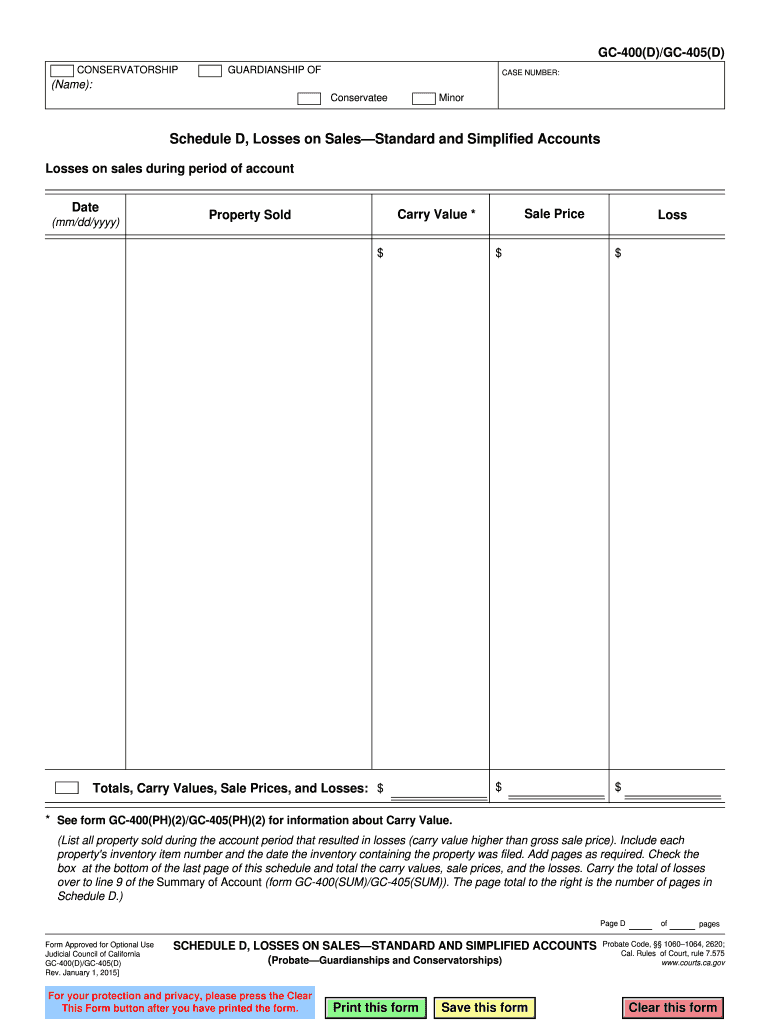
Nt Date (mm/dd/yyyy) Sale Price Carry Value * Property Sold Loss $ $ $ Totals, Carry Values, Sale Prices, and Losses: $ $ $ * See form GC-400(PH)(2)/GC-405(PH)(2) for information about Carry Value. (List all property sold during the account period that resulted in losses (carry value higher than gross sale price). Include each property's inventory item number and the date the inventory containing the property was filed. Add pages as required. Check the box at the bottom of the last pa.
Loading

Open form follow the instructions

Easily sign the form with your finger

Send filled & signed form or save
How to fill out the CA GC-400(D)/GC-405(D) online
Filling out the CA GC-400(D)/GC-405(D) form online is a straightforward process that helps individuals manage conservatorship and guardianship accounts. This guide will assist you through each step to ensure accurate completion of the form.
Follow the steps to successfully complete the form online.
- Press the ‘Get Form’ button to obtain the form and open it in an online editor.
- Begin by entering the case number at the top of the form. This is important for tracking your account.
- In Schedule D, Losses on Sales—Standard and Simplified Accounts, list each property sold during the account period that resulted in losses. Begin with the date of sale in the designated format (mm/dd/yyyy).
- Continue listing properties by providing the inventory item number and the date the inventory containing the property was filed for each entry.
- Once all properties are listed, total the carry values, sale prices, and losses at the end of the schedule. Ensure that all calculations are correct.
- Carry the total of losses over to line 9 of the Summary of Account (form GC-400(SUM)/GC-405(SUM)).
- After ensuring everything is complete, save your changes. You can download a copy of the completed form for your records, print it, or share it as needed.
Start filling out your CA GC-400(D)/GC-405(D) form online today for efficient document management.
Experience a faster way to fill out and sign forms on the web. Access the most extensive library of templates available.
Related content
* See form GC-400(PH)(2)/GC-405(PH)(2) for information about Carry Value. (List all...
NOAEL de 6,1 mg/m3 après exposition continue à du tétrachlorure de carbone. Lors d'une...
Oct 2, 2024 — Ao ligar a alimentação CA do sistema de áudio, sempre ligue o...
Get answers to your most pressing questions about US Legal Forms API.
How difficult is it to get conservatorship?
Obtaining conservatorship can be challenging, primarily due to the legal requirements involved. You must complete the necessary forms, like the CA GC-400(D)/GC-405(D), and present a compelling case to the court. Factors such as the individual's condition and the specifics of your petition play a significant role. However, the process can be made easier with the right resources and assistance, such as those provided by US Legal Forms, which offers clear guidance and the necessary documents.
What forms are needed for conservatorship in California?
For conservatorship in California, the essential forms include the CA GC-400(D) and GC-405(D). These forms serve as official documents to request the court’s appointment of a conservator. Additionally, you may need to complete supporting documents to provide a complete picture of the individual's situation. Using the US Legal Forms platform can simplify this process, providing you with guided instructions and templates to ensure you have everything needed.
What are the two types of conservatorship?
The two main types of conservatorship are limited conservatorship and general conservatorship. A limited conservatorship typically helps individuals who have certain disabilities manage specific aspects of their life. In contrast, a general conservatorship provides comprehensive oversight over an individual's personal and financial affairs. Understanding these options is crucial when considering the CA GC-400(D)/GC-405(D) forms for initiating conservatorship.
What is the final accounting form for probate?
The final accounting form for probate is typically completed using the CA GC-400(D)/GC-405(D). This form presents a clear summary of the estate’s financial activities, detailing income, expenses, and distributions. It helps ensure transparency and accountability in the probate process. By using these specific forms, you comply with the legal requirements, making the process smoother for all parties involved.
What is the meaning of final account in accounting?
In accounting, the final account represents a summary of all transactions that have occurred during a specific period, concluding with a fiscal balance. For estates, it outlines the final settlement of assets and liabilities. By using CA GC-400(D)/GC-405(D), you provide a thorough account that reflects the true financial standing of the estate.
What is the final account of the executor?
The final account of the executor is a comprehensive report detailing the financial activities undertaken during the probate process. This includes all receipts and disbursements related to the estate. Utilizing the CA GC-400(D)/GC-405(D) forms can simplify the preparation and submission of this critical document, ensuring that you meet all legal requirements.
What is probate final accounting?
Probate final accounting is the process where the executor presents a detailed financial report of the estate's management. It summarizes all transactions, including income, expenses, and distributions to heirs. Completing the CA GC-400(D)/GC-405(D) forms is essential in this stage, as it ensures transparency and proper handling of the estate's finances.
What accounting is required by the probate code?
The probate code requires executors to provide a clear account of all financial transactions related to the estate. This accounting must include income, expenses, and distributions made to beneficiaries. By adhering to the CA GC-400(D)/GC-405(D) forms, you can keep your records organized and ensure compliance with legal standards.
What is a final decree of distribution?
A final decree of distribution is a court order that confirms the distribution of an estate's assets to beneficiaries. It concludes the probate process, providing a legal resolution that protects both the executor and the beneficiaries. By filing the appropriate forms, including the CA GC-400(D)/GC-405(D), executors can obtain this decree, ensuring a smooth transition of ownership to the heirs.
How are funds distributed after probate?
Funds are distributed after probate by following the guidelines set forth in the will or state laws if no will exists. Executors must first settle any debts and taxes before allocating remaining assets to beneficiaries. Using the CA GC-400(D)/GC-405(D) forms allows for a clear and legal approach to this distribution process, ensuring transparency and fairness for all parties involved.
Use professional pre-built templates to fill in and sign documents online faster. Get access to thousands of forms.
If you believe that this page should be taken down, please follow our DMCA take down process here.