Loading
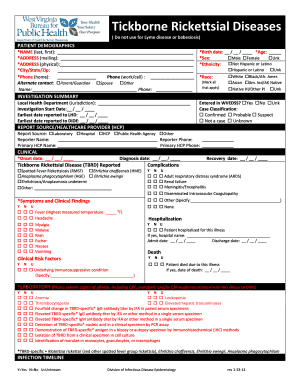
Get Wv Dhhr Tickborne Rickettsial Diseases 2013-2026
How it works
-

Open form follow the instructions
-

Easily sign the form with your finger
-

Send filled & signed form or save
How to fill out the WV DHHR Tickborne Rickettsial Diseases online
This guide provides step-by-step instructions for filling out the WV DHHR Tickborne Rickettsial Diseases form online. By following these instructions, users can ensure they complete the form accurately and efficiently to report tickborne diseases.
Follow the steps to fill out the form seamlessly
- Click ‘Get Form’ button to obtain the form and open it in the editor.
- Begin with the patient demographics section. Enter the last and first name of the patient in the designated fields. Ensure the address information provided includes both mailing and physical addresses, along with the city, state, and zip code.
- Fill in the phone numbers where the patient can be contacted. Choose the alternate contact type (parent/guardian, spouse, or other) and provide the name and phone number of the alternate contact.
- Record the patient's birth date and age. Indicate the patient's sex by selecting one of the options available: male, female, unknown, or non-Hispanic/Latino. Specify the patient's ethnicity and race by marking all applicable options.
- In the investigation summary section, enter the jurisdiction of the local health department. Document the start date of the investigation and the earliest dates reported to the local health department and DIDE.
- Indicate whether the case has been entered in WVEDSS (West Virginia Electronic Disease Surveillance System) and select the appropriate case classification from the options provided.
- For the report source section, select the source from which the report is coming and provide the reporter's name along with their contact phone number. Fill in the primary healthcare provider's name and phone number as well.
- In the clinical section, record the onset date, diagnosis date, and recovery date. Check all applicable tickborne rickettsial diseases reported and document any complications.
- Enter symptoms and clinical findings by checking the appropriate boxes. If hospitalizations occurred, fill in the hospital name, admit date, and discharge date.
- Document any laboratory findings associated with the illness. Be sure to submit copies of all relevant lab work.
- For the infection timeline, enter the onset date in the designated box and count backwards to establish the probable exposure period. Fill in the maximum and minimum incubation periods as needed.
- In the epidemiologic exposures section, indicate any relevant histories of travel, exposure to environments that may harbor ticks, and whether a tick was found on the patient.
- Address public health issues by indicating if the case knows someone with similar symptoms and if public health actions were taken. Provide any notes as needed.
- Finally, review all entries for completeness and accuracy. At the end, users can save changes, download, print, or share the completed form.
Complete the form online today to ensure accurate and efficient reporting of tickborne diseases.
Rocky Mountain spotted fever is often regarded as the most severe tick-borne disease due to its high rate of complications if untreated. This disease is a key focus of the WV DHHR Tickborne Rickettsial Diseases efforts. Awareness and education can help in reducing its impact on our communities.