Operty is stopped and held in transit upon request of the shipper, owner or party entitled to make such request; or from faulty or impassable highway, or by lack of capacity of a highway bridge or ferry; if from a defect or vice in the property; or from riots or strikes. The burden to prove freedom from negligence is on the carrier or the party in possession. Sec. 2. Unless arranged or agreed upon, in writing, prior to shipment, carrier is not bound to transport a shipment by a particular schedu.
Loading

Open form follow the instructions

Easily sign the form with your finger

Send filled & signed form or save
How to fill out the HI HFSNET Bill of Lading online
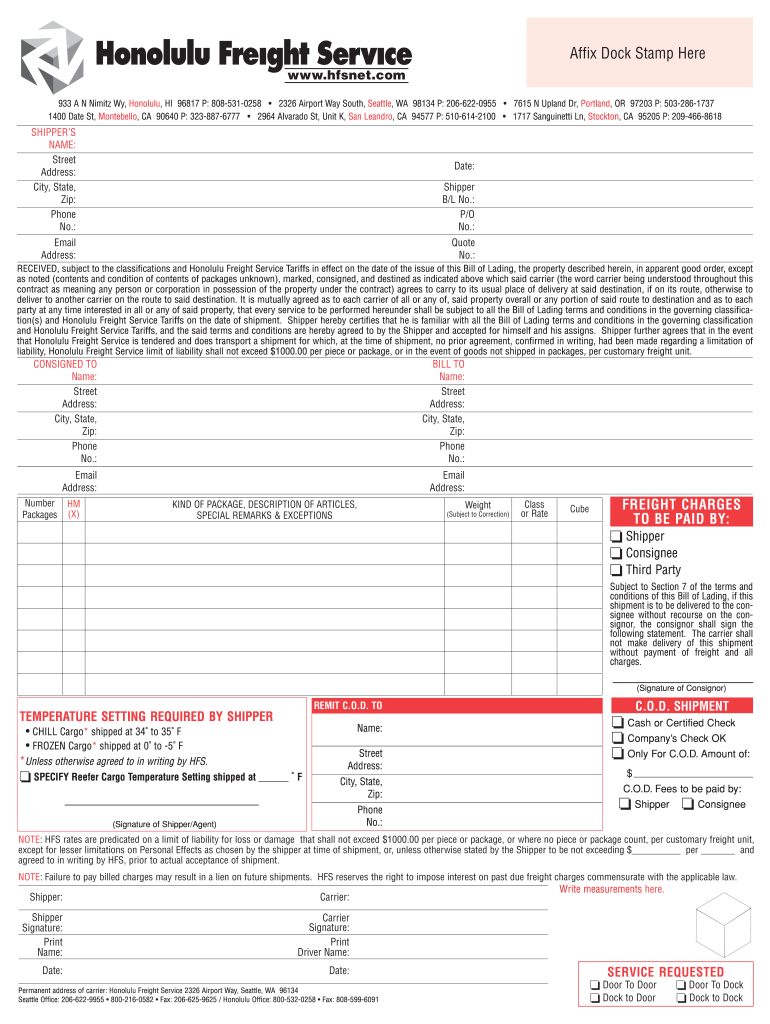
The HI HFSNET Bill of Lading is a crucial document used for shipping goods, ensuring that all necessary information is clearly communicated. Filling it out online streamlines the process, making it easier for users to provide accurate details for effective shipping.
Follow the steps to complete the HI HFSNET Bill of Lading online
- Press the ‘Get Form’ button to access the Bill of Lading and open it in your preferred online editor.
- In the 'Shipper’s Name' section, enter the name of the individual or company sending the shipment.
- Fill in the 'Street Address', 'City, State, Zip' fields with the shipper's complete address information.
- Provide the 'Phone No.' of the shipper for contact purposes.
- Enter the 'Shipper B/L No.' and 'P/O No.' in the specified fields. These numbers are essential for tracking and reference.
- Include the shipper's 'Email Address' to receive confirmations and updates on the shipment.
- Fill in the 'Quote No.' and 'Date' fields to ensure all records are properly organized.
- In the 'Consigned To' section, enter the name, street address, city, state, zip, and phone number of the recipient.
- Complete the 'Bill To' section with the appropriate billing information including name, address, and phone number.
- Indicate the 'Number of Packages' being shipped.
- Detail the 'Kind of Package, Description of Articles, Special Remarks & Exceptions' to provide clarity on the contents.
- Enter the 'Weight', 'Class or Rate', and 'Cube' for shipping calculations.
- Select who will pay the freight charges: Shipper, Consignee, or Third Party.
- If applicable, fill out the 'C.O.D. Shipment' section, specifying payment options and amounts.
- Sign the document where indicated, providing the names of both shipper and carrier, along with the date.
- Review all entered information for accuracy before submitting.
- Once completed, save changes, download, print, or share the form as needed.
Start completing your HI HFSNET Bill of Lading online today!
Experience a faster way to fill out and sign forms on the web. Access the most extensive library of templates available.
Get answers to your most pressing questions about US Legal Forms API.
Who is responsible for filling out a BOL?
The shipper is generally responsible for filling out a bill of lading (BOL). This includes providing accurate information about the shipment, such as the consignee details and cargo description. Using the HI HFSNET Bill of Lading not only clarifies responsibilities but also ensures that all necessary information is included for smooth processing.
How do I file a bill of lading?
Filing a bill of lading typically involves submitting the completed document to your freight carrier or shipping line. Make sure to retain copies for your records and inform the consignee of the shipping details. Use the HI HFSNET Bill of Lading to streamline this process, as it provides clear instructions for filing and tracking.
How to fill up a bill of lading?
Filling up a bill of lading involves gathering essential shipment details. Start with the shipper and consignee's names, followed by the vessel's name and voyage number. For best practices, refer to the HI HFSNET Bill of Lading, which offers an organized format that reduces errors and saves time during completion.
How to properly fill out a bill of lading?
To properly fill out a bill of lading, begin by entering the shipper and consignee’s information clearly. Include a detailed description of the cargo, including its nature, quantity, and weight. For precision, utilize the HI HFSNET Bill of Lading template, which provides structured fields to ensure you don’t miss any important sections.
What is required on the ocean bill of lading?
An ocean bill of lading requires crucial information such as the names and addresses of the shipper and consignee, cargo details, and the shipping route. Additionally, it should specify the terms of transport, including freight payment responsibility. Using the HI HFSNET Bill of Lading helps ensure you include all required elements for compliance and efficiency.
How do I fill out an ocean bill of lading?
To fill out an ocean bill of lading, start by providing the details of the shipper and consignee, including names and addresses. Next, include the vessel name, voyage number, and description of the cargo, including package type and weight. Make sure to use the HI HFSNET Bill of Lading form for accuracy, as it simplifies the process by guiding you through each necessary field.
Is it mandatory to mention HS code in Bill of Lading?
Mentioning the HS code in a bill of lading is not universally mandatory, but it is highly recommended for efficient customs processing. Including this code can expedite clearance and reduce delays at borders. Always verify the requirements for your specific shipment. The HI HFSNET Bill of Lading can guide you in deciding whether or not to include the HS code.
Is the HS code mandatory on a bill of lading?
The HS code is not always mandatory on a bill of lading, but it is often required for international shipments. It helps customs authorities identify products and regulates trade smoothly. Therefore, it's wise to check your specific shipping requirements. The HI HFSNET Bill of Lading can assist you in determining when inclusion is necessary.
What information is mandatory on a Bill of Lading?
Mandatory information on a bill of lading includes shipper details, consignee contact information, a description of the shipment, and the date of shipment. It also should specify any special handling instructions. Properly filling out these elements helps ensure a smooth shipping process. Ensure your HI HFSNET Bill of Lading captures all this essential information.
What is legally required on a Bill of Lading?
A bill of lading must include vital information such as the shipper's and receiver's details, a description of the goods, and shipping conditions. Additionally, specific labels, like hazardous material classifications, may be necessary. Adhering to these requirements is crucial for legal compliance in freight transport. Using the HI HFSNET Bill of Lading can help you meet these legal standards efficiently.
Use professional pre-built templates to fill in and sign documents online faster. Get access to thousands of forms.
If you believe that this page should be taken down, please follow our DMCA take down process here.