Loading
Form preview
  • US Legal Forms
  • Other Templates
  • Industry Forms
  • Industry Realtor Forms
  • Whole-house Heat Loss & Gain Worksheet Preliminary Estimate

Get Whole-house Heat Loss & Gain Worksheet Preliminary Estimate

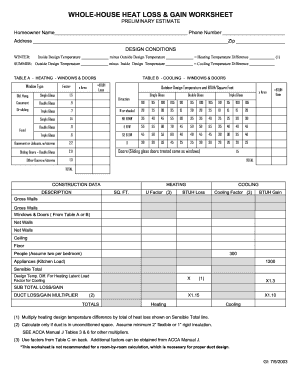
WHOLEHOUSE HEAT LOSS & GAIN WORKSHEET PRELIMINARY ESTIMATE Homeowner Name Phone Number Address Zip DESIGN CONDITIONS WINTER: Inside Design Temperature minus Outside Design Temperature Heating.

How it works

  1. Open form

    Open form follow the instructions

  2. Easily sign form

    Easily sign the form with your finger

  3. Share form

    Send filled & signed form or save

How to fill out the Whole-House Heat Loss & Gain Worksheet Preliminary Estimate online

This guide provides detailed instructions on how to effectively fill out the Whole-House Heat Loss & Gain Worksheet Preliminary Estimate online. By following these steps, users will be able to accurately estimate heating and cooling requirements for their home.

Follow the steps to complete the worksheet accurately.

  1. Click ‘Get Form’ button to obtain the worksheet and open it for editing.
  2. Begin by entering the homeowner's name, phone number, and address in the spaces provided at the top of the form.
  3. For design conditions, input the inside and outside design temperatures for both winter and summer conditions and calculate the temperature differences according to the formulas provided.
  4. Measure the total area of windows and doors and record the measurements in Tables A and B, ensuring that the total area from Table A matches that of Table B.
  5. Calculate the gross wall area by multiplying the total length of exposed walls by the ceiling height, recording this in the gross wall line.
  6. Subtract the total area of windows and doors from the gross wall area to determine the net wall area, and record this value.
  7. Record the exposed ceiling area and exposed floor area, noting any special conditions such as concrete slabs.
  8. Select appropriate heat transfer multipliers from Table C and enter these factors in the designated columns.
  9. Multiply the area of walls, windows, and ceilings by their respective factors to fill in the BTUH loss and gain columns.
  10. Calculate the total number of occupants based on two people per bedroom, multiplying this number by 300 and entering the total in the BTUH gain column.
  11. Sum the BTUH loss and gain for the sensible total and apply any necessary multipliers if ductwork is located in unconditioned space.
  12. Finally, save your changes, download, or print the worksheet as needed for your records.

Start filling out your Whole-House Heat Loss & Gain Worksheet Preliminary Estimate online today!

Get form

Experience a faster way to fill out and sign forms on the web. Access the most extensive library of templates available.
Get form

Related content

******************1c*******************************************...
by D Stephenson · 1991 — This curriculum guide contains 18 units of instruction for a...
Learn more
Advanced Strategy Guideline: Air Distribution...
by A Burdick · 2011 · Cited by 24 — The heat loss and gain values are estimated using...
Learn more
climate change planning handbook
• National Institute of Building Sciences – Whole Building Design Guide – Life-Cycle...
Learn more

Related links form

Security Cheat Sheet 2020 Enterprise Rent-a-Car Reservation Form_DSA Tampa General Hospital Discharge Papers 2020 Pba Dependent Student Verification Form

Questions & Answers

Get answers to your most pressing questions about US Legal Forms API.

Contact support

The amount of heat your house loses depends on various factors, including insulation quality, building materials, and air leakage. You can gain insights into your home's specific heat loss by using the Whole-House Heat Loss & Gain Worksheet Preliminary Estimate. This tool simplifies the calculation process, offering tailored solutions for managing heat efficiency.

To perform a heat load calculation, measure your home's dimensions, identify insulation types, and factor in local climate conditions. The Whole-House Heat Loss & Gain Worksheet Preliminary Estimate provides a comprehensive framework for efficiently gathering this information. With this worksheet, you can accurately determine the heating requirements for your home.

Calculating heat loss in a whole house involves assessing each room's surface area, calculating the U-values, and considering the temperature difference between inside and outside. The Whole-House Heat Loss & Gain Worksheet Preliminary Estimate serves as a useful tool, guiding you through this detailed process step by step. This ensures precision in your heat loss evaluation.

Average heat loss can vary significantly by region, but many homes lose around 30-50% of heat through walls, windows, and roofs. Utilizing a Whole-House Heat Loss & Gain Worksheet Preliminary Estimate allows you to obtain a personalized assessment for your specific home. Understanding your average heat loss helps in implementing effective energy-saving solutions.

A common rule of thumb for heat loss is to consider about 20 BTUs per square foot of your home's living area. However, this estimate can vary based on several factors, including insulation and window types. The Whole-House Heat Loss & Gain Worksheet Preliminary Estimate can help refine this calculation for greater accuracy.

The formula for calculating heat loss in a house generally involves multiplying the area of each surface by its U-value, then factoring in the temperature difference. Utilizing the Whole-House Heat Loss & Gain Worksheet Preliminary Estimate provides a structured approach to applying this formula effectively. This method ensures you don't overlook any critical components.

To calculate heat loss and gain, you must consider factors like your home's dimensions, insulation level, and outdoor temperature. Using the Whole-House Heat Loss & Gain Worksheet Preliminary Estimate can simplify this process. This worksheet helps you itemize each area of your home, ensuring accuracy while calculating the overall heat dynamics.

When calculating heat gain or heat loss, consider factors such as the size and orientation of the house, the type of insulation, and the efficiency of heating or cooling systems. It's also crucial to account for external factors like local climate conditions, sunlight exposure, and air infiltration. Using the Whole-House Heat Loss & Gain Worksheet Preliminary Estimate helps you integrate these aspects effectively, leading to a comprehensive analysis.

To account for heat loss, you must identify and measure the pathways through which heat escapes your home, including walls, ceilings, and windows. The Whole-House Heat Loss & Gain Worksheet Preliminary Estimate serves as a valuable resource, allowing you to clearly outline these elements and determine their impact on overall energy efficiency. This proactive approach enables you to make necessary adjustments for better thermal comfort.

Calculating heat gain and heat loss involves assessing factors like sunlight exposure, appliance heat, insulation, and heat transfer. By utilizing the Whole-House Heat Loss & Gain Worksheet Preliminary Estimate, you can systematically evaluate these factors in your home. This tool not only enhances accuracy but also assists in creating strategies to manage your home's climate effectively.

Get This Form Now!

Use professional pre-built templates to fill in and sign documents online faster. Get access to thousands of forms.
Get form
If you believe that this page should be taken down, please follow our DMCA take down processhere.
Get Whole-House Heat Loss & Gain Worksheet Preliminary Estimate
Get form

Form categories

Real Estate
  • Home Sale
  • Deeds
  • Leases
  • Landlord Tenant
  • First Refusal Agreement
  • Lis Pendens
  • View all Real Estate
Business & Commercial
  • Small Business
  • Contracts
  • Construction
  • Employment
  • Limited Liability Company
  • Partnerships
  • View all Business & Commercial
Estate Planning
  • Personal Planning
  • Last Will and Testament
  • Living Trust
  • Power of Attorney
  • Living Will (Healthcare Directive)
  • Probate
  • Trusts
  • Small Estate
  • View all Estate Planning

Other Legal Areas

  • Civil Actions
  • Civil Procedure
  • Animals
  • Affidavits
  • Bill of Sale
  • Oil Gas and Minerals
  • Name Change
  • Other
Family Law
  • Divorce
  • Annulment
  • Adoption
  • Marriage
  • Child Justice
  • View all Family Law
  • Forms Catalog
  • Other Templates

Company

  • About Us
  • Pricing
  • Legal Hub
  • Affiliate Program

Knowledge Base

  • Help Portal
  • Legal Resources
  • Blog
  • Industries
  • Legal Guides
  • Sitemap

Services

  • Notarize
  • Form Selector

Support

  • Contact Us
  • Delete My Account

Products

  • USLegal
  • FormsPass
  • pdfFiller
  • signNow
  • altaFlow
  • DocHub
  • Instapage
Social Media
Call us now toll free:
+1 833 426 79 33
As seen in:
© 2026 US Legal Forms. All rights reserved.
  • Your Privacy Choices
  • Terms of Service
  • Privacy Notice
  • Content Takedown Policy
  • Bug Bounty Program