Loading
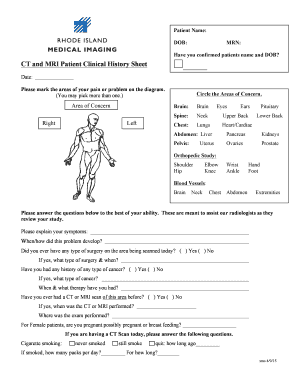
Get Ct And Mri Patient Clinical History Sheet
How it works
-

Open form follow the instructions
-

Easily sign the form with your finger
-

Send filled & signed form or save
How to fill out the CT and MRI Patient Clinical History Sheet online
Completing the CT and MRI Patient Clinical History Sheet online is an important step in providing healthcare professionals with the necessary information to support your assessment and treatment. This guide will walk you through each section of the form to ensure it is filled out accurately and thoroughly.
Follow the steps to complete the form successfully.
- Click ‘Get Form’ button to obtain the form and open it in the editor.
- Enter your personal information at the top of the form, including your full name, date of birth, and medical record number (MRN). These details are crucial for accurate identification.
- Confirm that you have verified the patient's name and date of birth. This ensures the correct patient information is being processed.
- Fill in the date of completion at the designated area to ensure timeliness of the form.
- Use the diagram provided to indicate any areas of pain or concern. You may select multiple areas by marking them accordingly.
- In the following section, circle any specific areas of concern, such as the brain, chest, or abdomen, based on your symptoms.
- Answer the questions regarding your symptoms, including when they developed and if any surgeries were performed in the scanned area. Provide details about previous CT or MRI scans, if applicable.
- If you are a female patient, indicate your pregnancy status or if you are breastfeeding.
- If you are having a CT scan today, please provide information about your smoking history and any relevant details.
- After filling out all sections, review your information for accuracy and completeness before proceeding.
- Once confirmed, you may save the changes, download the file, print, or share the form as needed.
Complete your CT and MRI Patient Clinical History Sheet online today for a smoother healthcare experience.
Instruct the patient to remove all metallic objects, including jewelry, hairpins, and watches. Ask the patient if he has any implanted metal devices or prostheses, such as vascular clips, shrapnel, pacemakers, joint implants, filters, and intrauterine devices. If so, the test may not be able to be performed.