Loading
Form preview
  • US Legal Forms
  • Other Templates
  • Miscellaneous Forms
  • Frequency Spectrum Of Familiar Sounds 2005

Get Frequency Spectrum Of Familiar Sounds 2005-2026

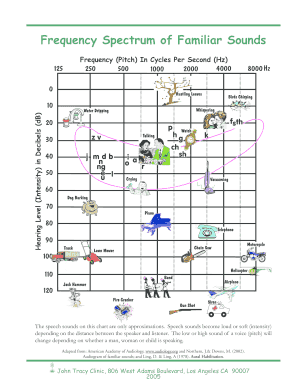
Frequency Spectrum of Familiar Sounds Hearing Level Intensity in Decibels dB Frequency Pitch In Cycles Per Second Hz The speech sounds on this chart are only approximations. Speech sounds become loud or soft intensity depending on the distance between the speaker and listener. The low or high sound of a voice pitch will change depending on whether a man woman or child is speaking. Adapted from American Academy of Audiology www. audiology. org and Northern J* Downs M. 2002. Audiogram of familiar sounds and Ling D. Speech sounds become loud or soft intensity depending on the distance between the speaker and listener. The low or high sound of a voice pitch will change depending on whether a man woman or child is speaking. The low or high sound of a voice pitch will change depending on whether a man woman or child is speaking. Adapted from American Academy of Audiology www. audiology. org and Northern J* Downs M. 2002. Audiogram of familiar sounds and Ling D. Speech sounds become loud or s....

How it works

  1. Open form

    Open form follow the instructions

  2. Easily sign form

    Easily sign the form with your finger

  3. Share form

    Send filled & signed form or save

How to fill out the Frequency Spectrum of Familiar Sounds online

The Frequency Spectrum of Familiar Sounds document is essential for understanding the intensity and pitch of various speech sounds. This guide offers easy-to-follow instructions for completing the form online to ensure clarity and accuracy in your entries.

Follow the steps to successfully complete the Frequency Spectrum of Familiar Sounds form.

  1. Click the ‘Get Form’ button to obtain the form and open it in the online editor. This action enables you to access the necessary document for completion.
  2. Review the introduction section that provides essential context about the form. Understand that the chart represents approximations and that intensity (measured in decibels) can vary based on distance.
  3. Locate the first section titled 'Hearing Level (Intensity) in Decibels (dB)'. Here, you will need to input the appropriate decibel levels corresponding to familiar sounds based on your needs or observations.
  4. Next, find the section labeled 'Frequency (Pitch) in Cycles Per Second (Hz)'. Record the frequency of the sounds you are assessing, ensuring that you utilize accurate measures to reflect your analysis.
  5. Take note of the additional context provided in the document, including how various voices affect loudness and pitch. This information aids in making informed entries on the spectrum chart.
  6. Once you have filled out all relevant fields, review your entries for accuracy. Ensure that all data reflects your intended analysis of familiar sounds.
  7. Finally, save your changes, and utilize options to download, print, or share the completed form as required for your purposes.

Start completing your Frequency Spectrum of Familiar Sounds form online today!

Get form

Experience a faster way to fill out and sign forms on the web. Access the most extensive library of templates available.
Get form

Related content

Common Sounds Audiograms: Quantitative Analyses...
by CL Hillis · 2023 · Cited by 5 — In the 2nd edition of their textbook (1978)...
Learn more
Pediatric - Otolaryngology | Head and Neck Surgery
A tool that can be used to understand sounds we can hear (or can't hear) based on hearing...
Learn more
Introduction to Equalization - RG Sound
The next octave up is 80Hz, then 160Hz and so on until we reach the limit of our hearing...
Learn more

Related links form

CA FCSS Notification Log Form 2019 CA Contra Costa Requirements And Directions For Temporary Food Facilities 2018 GA Providence Classical Christian School Application for Admission 2018 OK Eastern Oklahoma County Technology Center Admission Requirements 2017

Questions & Answers

Get answers to your most pressing questions about US Legal Forms API.

Contact support

The six sounds typically represented on the Ling audiogram are 'm', 'ah', 'ee', 'oo', 'sh', and 's'. Together, these sounds cover a range of frequencies essential for speech understanding. By testing your ability to hear these specific sounds, you can gain insight into your overall hearing ability. Utilizing resources, like those offered by uslegalforms, can help you better understand audiograms and improve your auditory skills.

Hearing at 4000 Hz can indicate good hearing, but context is essential. This frequency falls within the range of critical speech sounds important for communication. If you can perceive sounds at this frequency, it suggests that your hearing is functioning adequately in daily life. Improving your awareness of the frequency spectrum of familiar sounds can help you appreciate the nuances of what you hear.

An audiogram of familiar sounds is a specialized chart that plots your hearing thresholds against the frequency spectrum of familiar sounds. It helps visualize how well you perceive everyday sounds, such as speech and other common noises. This type of audiogram is particularly useful for individuals seeking to understand their hearing capabilities in a practical context. It can guide your conversations with audiologists or help enhance your everyday auditory experience.

To read an audiogram of familiar sounds, first familiarize yourself with the frequency spectrum of familiar sounds indicated on the graph. Locate the circles or symbols that represent your thresholds at different pitches. Each symbol on the audiogram corresponds to specific sounds you might recognize. By checking where these symbols appear in relation to their frequency, you can gauge your ability to hear those familiar sounds.

The frequency of speech sounds generally ranges from about 250 Hz to 4000 Hz. This frequency spectrum of familiar sounds encompasses most of the phonetic components essential for understanding speech. Understanding these frequencies can help you appreciate the sounds around you, aiding in effective communication. By knowing where speech sounds lie, you can better assess your hearing capabilities.

Reading your audiogram results can feel daunting, but it’s manageable. First, locate the frequency spectrum of familiar sounds on the graph, which shows how well you can hear different pitches. The vertical axis displays your hearing sensitivity, while the horizontal axis presents various frequencies. Understanding where your results fall within this spectrum helps you identify your hearing strengths and areas for improvement.

Common sounds occur within a wide frequency range, typically from 20 Hz to 20,000 Hz. This range includes everything from a whisper to heavy machinery. By examining the frequency spectrum of familiar sounds, individuals can enhance their understanding of daily auditory experiences and improve communication.

Reading an audiogram involves analyzing a graph that displays how well one hears different frequencies. The audiogram indicates thresholds for various sounds, showing the frequency spectrum of familiar sounds that one can recognize. For anyone needing guidance, platforms like US Legal Forms provide resources to understand these tools better.

The Hz range for speech predominantly lies between 200 Hz and 10,000 Hz. Within this range, the most important elements of vocalization exist, which are critical for voice recognition. Learning about the frequency spectrum of familiar sounds helps in enhancing conversations and audio quality in various settings.

The frequency range of hearing speech usually falls between 300 Hz and 3,500 Hz. This encompasses the essential sounds that people need to interpret spoken language clearly. Understanding this frequency spectrum of familiar sounds is vital for effective hearing assessments and speech therapy solutions.

Get This Form Now!

Use professional pre-built templates to fill in and sign documents online faster. Get access to thousands of forms.
Get form
If you believe that this page should be taken down, please follow our DMCA take down processhere.
Get Frequency Spectrum of Familiar Sounds
Get form

Form categories

Real Estate
  • Home Sale
  • Deeds
  • Leases
  • Landlord Tenant
  • First Refusal Agreement
  • Lis Pendens
  • View all Real Estate
Business & Commercial
  • Small Business
  • Contracts
  • Construction
  • Employment
  • Limited Liability Company
  • Partnerships
  • View all Business & Commercial
Estate Planning
  • Personal Planning
  • Last Will and Testament
  • Living Trust
  • Power of Attorney
  • Living Will (Healthcare Directive)
  • Probate
  • Trusts
  • Small Estate
  • View all Estate Planning

Other Legal Areas

  • Civil Actions
  • Civil Procedure
  • Animals
  • Affidavits
  • Bill of Sale
  • Oil Gas and Minerals
  • Name Change
  • Other
Family Law
  • Divorce
  • Annulment
  • Adoption
  • Marriage
  • Child Justice
  • View all Family Law
  • Forms Catalog
  • Other Templates

Company

  • About Us
  • Pricing
  • Legal Hub
  • Affiliate Program

Knowledge Base

  • Help Portal
  • Legal Resources
  • Blog
  • Industries
  • Legal Guides
  • Sitemap

Services

  • Notarize
  • Form Selector

Support

  • Contact Us
  • Delete My Account

Products

  • USLegal
  • FormsPass
  • pdfFiller
  • signNow
  • altaFlow
  • DocHub
  • Instapage
Social Media
Call us now toll free:
+1 833 426 79 33
As seen in:
© 2026 US Legal Forms. All rights reserved.
  • Your Privacy Choices
  • Terms of Service
  • Privacy Notice
  • Content Takedown Policy
  • Bug Bounty Program