Loading
Form preview
  • US Legal Forms
  • Other Templates
  • Foreign Forms
  • Foreign Canada Realtor Forms
  • Canada Residential Tenancy Agreement - Ontario 2008

Get Canada Residential Tenancy Agreement - Ontario 2008-2026

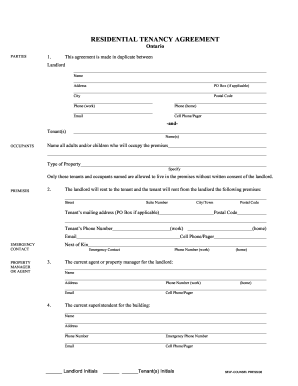
Hone/Pager -andTenant(s) Name(s) OCCUPANTS Name all adults and/or children who will occupy the premises Type of Property Specify Only those tenants and occupants named are allowed to live in the premises without written consent of the landlord. PREMISES 2. The landlord will rent to the tenant and the tenant will rent from the landlord the following premises: Street Suite Number City/Town Tenant s mailing address (PO Box if applicable) Tenant s Phone Number Postal Code (work) Email.

How it works

  1. Open form

    Open form follow the instructions

  2. Easily sign form

    Easily sign the form with your finger

  3. Share form

    Send filled & signed form or save

How to fill out the Canada Residential Tenancy Agreement - Ontario online

Filling out the Canada Residential Tenancy Agreement is an important step in establishing a rental relationship in Ontario. This guide is designed to assist you in completing the agreement online, ensuring that all necessary information is accurately provided.

Follow the steps to complete the agreement online.

  1. Click ‘Get Form’ button to obtain the agreement and open it in the online editor.
  2. In the parties section, provide the landlord's name, address, and contact details. Include the tenant's name(s) and list all occupants who will reside in the premises.
  3. For the premises section, specify the street address, suite number, city or town, and the tenant’s mailing address along with contact information.
  4. Designate an emergency contact and enter details for a property manager or agent, including their address and phone numbers.
  5. Indicate the start date of the tenancy and whether it is a fixed term or periodic.
  6. Fill in the rent details, specifying the amount, frequency (weekly/monthly), and payment method.
  7. Mark which utilities and services are included in the rent, and list additional responsibilities, such as lawn care or snow removal.
  8. Decide if a deposit is required and enter the amount, ensuring it does not exceed the maximum allowable limit.
  9. Familiarize yourself with the rules regarding notices to terminate, ensuring compliance with required notice periods.
  10. Review all terms, including tenant and landlord responsibilities, before signing the agreement. Ensure both parties initial the document where required.
  11. Once completed, save your changes, and choose to download, print, or share the agreement as needed.

Take the next step in your rental journey by completing your Canada Residential Tenancy Agreement online today.

Get form

Experience a faster way to fill out and sign forms on the web. Access the most extensive library of templates available.
Get form

Related content

Ontario Canada Office Lease
The Tenant will pay Basic Rent and Additional Rent when due and payable as set out in this...
Learn more
Free rental agreement template ontario
The Ontario Standard Lease Agreement outlines a comprehensive strategy for filling...
Learn more
National cyber threat assessment 2025–2026
Oct 30, 2024 — The Canadian Centre for Cyber Security's National Cyber Threat Assessment...
Learn more

Related links form

IL VSD 665.5 2012 IL VSD 669.3 2014 IL VSD 670 2005 IL VSD 671.4 2013

Questions & Answers

Get answers to your most pressing questions about US Legal Forms API.

Contact support

A distinguishing characteristic between a lease and a rental agreement is the length of the term. A lease is typically a fixed-term contract that lasts for an agreed period, while a rental agreement is more flexible and usually operates on a month-to-month basis. Recognizing this difference can guide you in creating the appropriate Canada Residential Tenancy Agreement - Ontario for your needs.

Renting and leasing are often used interchangeably, but they do have key differences. Renting usually refers to a short-term agreement, often month-to-month, whereas leasing is a long-term commitment typically for one year or more. Understanding these terms is critical in the context of the Canada Residential Tenancy Agreement - Ontario.

If a landlord does not use a standard lease agreement in Ontario, it can lead to confusion regarding the rights and responsibilities of both parties. The Canada Residential Tenancy Agreement - Ontario provides a framework that protects both landlords and tenants. To avoid issues, consider using a standard agreement from trusted resources like US Legal Forms to ensure compliance.

The primary difference between a lease and a rental agreement in Canada lies in the duration. A lease is usually a fixed-term contract, typically lasting one year, while a rental agreement operates on a month-to-month basis. Both are crucial components of the Canada Residential Tenancy Agreement - Ontario, and understanding these terms can help you make informed decisions.

An agreement and a lease are related but not identical concepts. A lease is a formalized contract specifying the rental conditions, while an agreement can also refer to informal arrangements between parties. When it comes to the Canada Residential Tenancy Agreement - Ontario, it is advisable to use a formal lease to protect both parties' interests.

In Canada, a lease refers to a formal contract that outlines the terms of renting a property for a specific period, while rent is the monetary payment made by the tenant to the landlord. The Canada Residential Tenancy Agreement - Ontario typically covers both concepts, with the lease governing the rental terms and the payment being a key condition of the contract. Understanding this distinction is important for both landlords and tenants.

In Ontario, using a residential tenancy agreement is mandatory in most cases. This ensures that both landlords and tenants understand their rights and obligations, fostering a smooth rental experience. Creating a clear, legally binding Canada Residential Tenancy Agreement - Ontario is essential for both parties.

Form 400 in Ontario is a standard residential lease agreement that landlords must use for most rental situations. This form outlines the rights and responsibilities of both landlords and tenants, making it a crucial part of the Canada Residential Tenancy Agreement - Ontario. Using this form helps to ensure compliance with the law.

Yes, you can create your own lease agreement in Ontario, but it must meet the legal requirements of the Canada Residential Tenancy Agreement - Ontario. Ensure that it includes essential details such as the names of the landlord and tenant, rental terms, and property address. It's also helpful to use resources like US Legal Forms to ensure your agreement is comprehensive and legally sound.

In Ontario, not all occupants need to be on the lease, but it is advisable for everyone who lives in the unit to be included. This ensures that all residents have legal protections and obligations under the Canada Residential Tenancy Agreement - Ontario. Failure to include all occupants may lead to misunderstandings regarding rights and responsibilities.

Get This Form Now!

Use professional pre-built templates to fill in and sign documents online faster. Get access to thousands of forms.
Get form
If you believe that this page should be taken down, please follow our DMCA take down processhere.
Get Canada Residential Tenancy Agreement - Ontario
Get form
  • Adoption
  • Bankruptcy
  • Contractors
  • Divorce
  • Home Sales
  • Employment
  • Identity Theft
  • Incorporation
  • Landlord Tenant
  • Living Trust
  • Name Change
  • Personal Planning
  • Small Business
  • Wills & Estates
  • Packages A-Z
  • Affidavits
  • Bankruptcy
  • Bill of Sale
  • Corporate - LLC
  • Divorce
  • Employment
  • Identity Theft
  • Internet Technology
  • Landlord Tenant
  • Living Wills
  • Name Change
  • Power of Attorney
  • Real Estate
  • Small Estates
  • Wills
  • All Forms
  • Forms A-Z
  • Other Templates
  • Legal Hub
  • About Us
  • Help Portal
  • Legal Resources
  • Blog
  • Affiliates
  • Contact Us
  • Delete My Account
  • Site Map
  • Industries
  • Forms in Spanish
  • Localized Forms
  • State-specific Forms
  • Forms Kit
  • Real Estate Handbook
  • All Guides
  • Notarize
  • Incorporation services
  • For Consumers
  • For Small Business
  • For Attorneys
  • USLegal
  • FormsPass
  • pdfFiller
  • signNow
  • altaFlow
  • DocHub
  • Instapage
Form Packages
  • Adoption
  • Bankruptcy
  • Contractors
  • Divorce
  • Home Sales
  • Employment
  • Identity Theft
  • Incorporation
  • Landlord Tenant
  • Living Trust
  • Name Change
  • Personal Planning
  • Small Business
  • Wills & Estates
  • Packages A-Z
Form Categories
  • Affidavits
  • Bankruptcy
  • Bill of Sale
  • Corporate - LLC
  • Divorce
  • Employment
  • Identity Theft
  • Internet Technology
  • Landlord Tenant
  • Living Wills
  • Name Change
  • Power of Attorney
  • Real Estate
  • Small Estates
  • Wills
  • All Forms
  • Forms A-Z
  • Other Templates
Customer Service
  • Legal Hub
  • About Us
  • Help Portal
  • Legal Resources
  • Blog
  • Affiliates
  • Contact Us
  • Delete My Account
  • Site Map
  • Industries
  • Forms in Spanish
  • Localized Forms
  • State-specific Forms
  • Forms Kit
Legal Guides
  • Real Estate Handbook
  • All Guides
Prepared for you
  • Notarize
  • Incorporation services
Our Customers
  • For Consumers
  • For Small Business
  • For Attorneys
Our Sites
  • USLegal
  • FormsPass
  • pdfFiller
  • signNow
  • altaFlow
  • DocHub
  • Instapage
Social Media
Call us now toll free:
+1 833 426 79 33
As seen in:
© Copyright 1999-2026 airSlate Legal Forms, Inc. 17 Station Street, Ste. 203, Brookline, MA 02445
  • Your Privacy Choices
  • Terms of Service
  • Privacy Notice
  • Content Takedown Policy
  • Bug Bounty Program