Loading
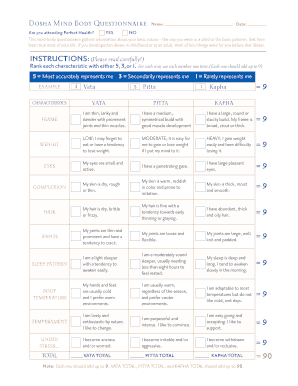
Get The Chopra Center Dosha Mind Body Questionnaire
How it works
-

Open form follow the instructions
-

Easily sign the form with your finger
-

Send filled & signed form or save
How to fill out the The Chopra Center Dosha Mind Body Questionnaire online
The Chopra Center Dosha Mind Body Questionnaire is designed to help you understand your fundamental nature through a series of characteristics. This practical guide will walk you through the process of completing the questionnaire online, ensuring clarity and ease.
Follow the steps to effectively complete the questionnaire.
- Press the ‘Get Form’ button to access the questionnaire and open it in your preferred digital editor.
- Begin with the section asking if you are attending Perfect Health. Choose 'YES' or 'NO' based on your circumstances.
- Read the instructions carefully. You will need to rank each characteristic from the provided options using 5, 3, and 1, ensuring that each row adds up to 9.
- For each characteristic row, evaluate how accurately it represents you. Assign a score of 5 to the characteristic that most accurately describes you, 3 to the second-best fit, and 1 to the least descriptive option.
- Complete the sections related to Frame, Weight, Eyes, Complexion, Hair, Joints, Sleep Pattern, Body Temperature, and Temperament by ranking each set of options.
- In the stress section, reflect on your responses and choose the ranking that best aligns with your natural reactions to stress.
- After completing all sections, fill in the total scores for Vata, Pitta, and Kapha at the bottom to ensure they sum correctly.
- Once all fields are completed and verified, you can save your changes, download a copy, print the questionnaire, or share it with others as needed.
Complete your Dosha Mind Body Questionnaire online today for greater self-awareness.
As an imbalance in any of these causes illness, depression in people with different dosha excesses causes different symptoms. So, this leads to three kinds of depression, Vata-type in those with Vata excess, Pitta-type in those with Pitta excess and Kapha-type in those with Kapha excess.