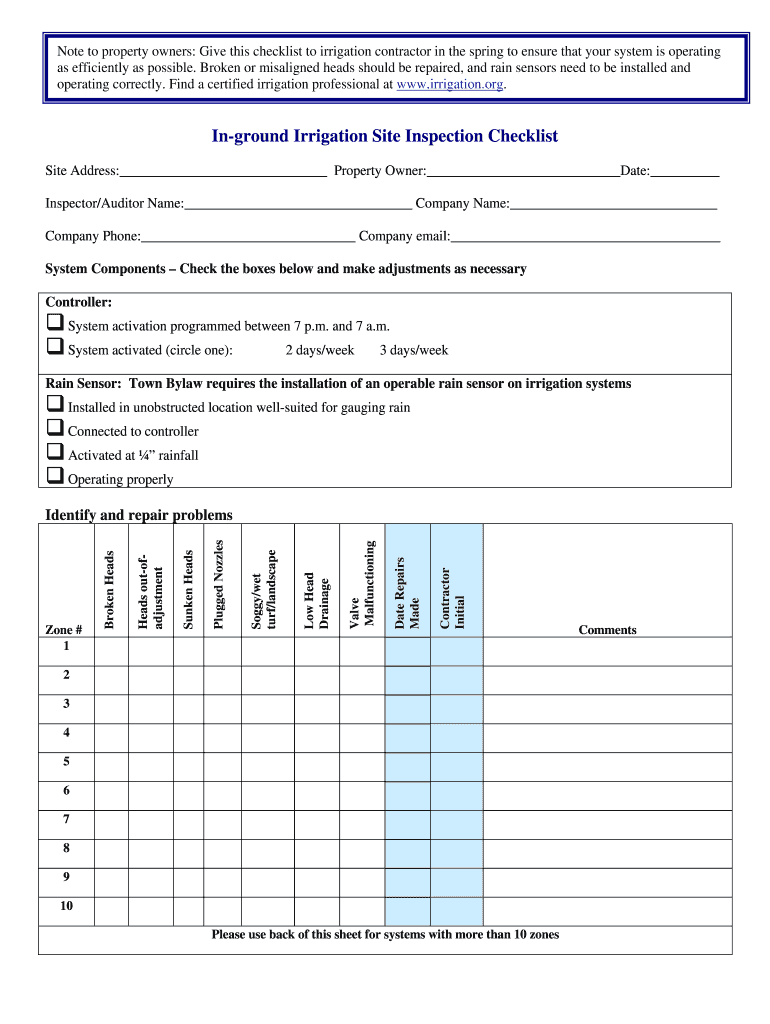
Note to property owners: Give this checklist to irrigation contractor in the spring to ensure that your system is operating as efficiently as possible. Broken or misaligned heads should be repaired,.
Loading

Open form follow the instructions

Easily sign the form with your finger

Send filled & signed form or save
How to fill out the MA In-ground Irrigation Site Inspection Checklist online
The MA In-ground Irrigation Site Inspection Checklist is a vital document for ensuring the efficient operation of your irrigation system. This guide provides clear and comprehensive steps for completing the checklist online, helping you navigate each section with ease.
Follow the steps to successfully fill out the checklist online.
- Click ‘Get Form’ button to obtain the checklist and open it in the appropriate online editor.
- Begin by entering the site address in the designated field. This will help identify where the inspection is taking place.
- Fill in the property owner's name, ensuring to include full name for accurate identification.
- Enter the date of the inspection. This is important for record-keeping and compliance.
- Provide the inspector/auditor's name and the company details, including company name, phone number, and email address for communication purposes.
- Review the system components section. Check the boxes to indicate if the controller is activated and programmed correctly between 7 p.m. and 7 a.m. Choose the appropriate activation frequency by circling either '2 days/week' or '3 days/week'.
- For the rain sensor, check the boxes confirming its installation in an unobstructed location, connection to the controller, activation at ¼” rainfall, and proper operation.
- Document any contractor involvement by having them initial and date any repairs made.
- Use the checklist to identify and check off any malfunctioning items such as broken heads, low head drainage, and plugged nozzles, noting the zone number for each issue.
- If more than 10 zones need inspection, make sure to utilize the back of the sheet to document additional zones.
- Add any additional comments or notes in the comments section for further clarification of the inspection results.
- Once all fields are filled out, save your changes, and you may download, print, or share the completed checklist as needed.
Complete your documents online efficiently and ensure your irrigation system is up to standard.
Experience a faster way to fill out and sign forms on the web. Access the most extensive library of templates available.
Related content
Dec 24, 2020 — (3) For each newly installed or renovated irrigation system within a...
All sprinkler systems must comply with local building codes, requiring building permits...
Mar 1, 2012 — organic contaminant in ground water at the site can be the best estimate...
Get answers to your most pressing questions about US Legal Forms API.
How do you perform a water audit?
Steps in a Water Audit Step 1: The Water Use Inventory. It is important that facility executives develop an understanding of exactly how and where their facility uses water. ... Step 2: Metering. ... Step 3: Review Maintenance Practices. ... Step 4: The Water Efficiency Plan.
How to do an irrigation audit?
1:52 5:39 How To Perform A Landscape Irrigation Audit - The Basics YouTube Start of suggested clip End of suggested clip Stop your timer. And record the time. Next record the amount of water collected in each catchment.MoreStop your timer. And record the time. Next record the amount of water collected in each catchment. Reading from the bottom line of the meniscus. After all catchment levels have been recorded.
What is a landscape irrigation auditor?
Certified Landscape Irrigation Auditors develop system testing strategies, check pressure and flow rates, and conduct water application distribution tests. They collect data to determine irrigation uniformity and efficiency. They take soil samples and determine soil types and root zone depths.
What method is most frequently used to audit sprinkler system rate and time?
The use of catch containers or cans has long been the standard method to determine the two primary irrigation system performance measures: precipitation rate and distribution uniformity. Catch cans are used to collect water in an area of interest (that is, individual irrigation zones) over a set time.
How do you evaluate an irrigation system?
To assess your irrigation system you need to determine the rate that water is being applied, and how uniformly that water is being distributed. To check these you need to know the MAR, the DU, and the pressures and flows within your system.
Use professional pre-built templates to fill in and sign documents online faster. Get access to thousands of forms.
If you believe that this page should be taken down, please follow our DMCA take down process here.