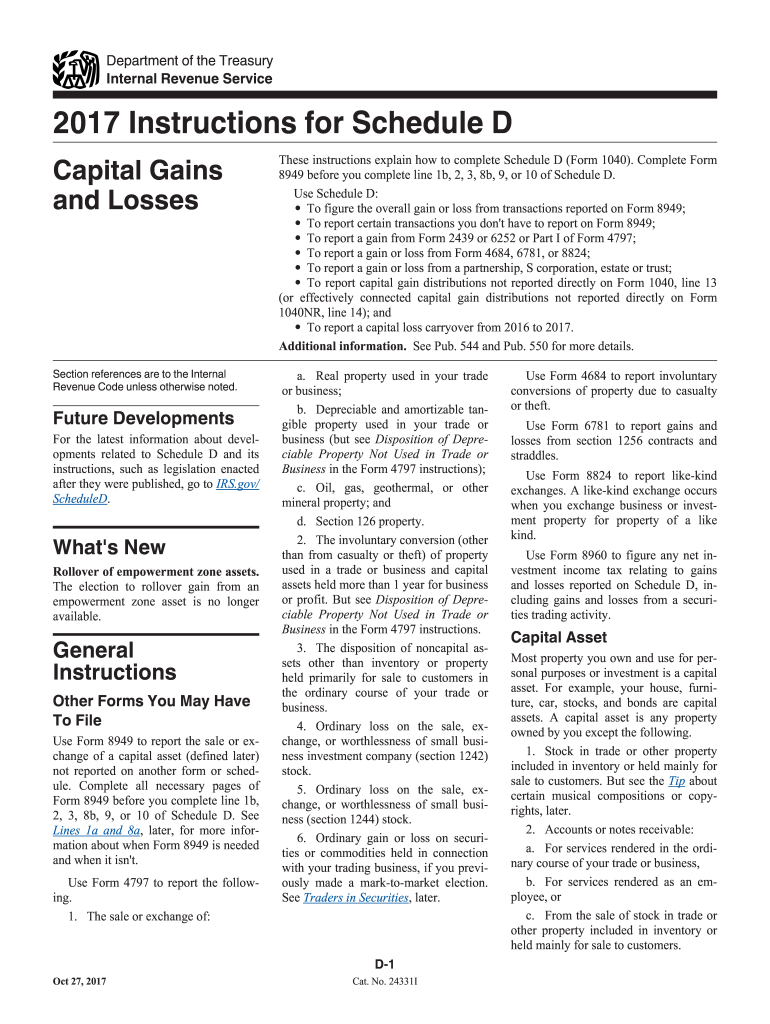
Use Form 6781 to report gains and losses from section 1256 contracts and straddles. Use Form 8824 to report like-kind exchanges. A like-kind exchange occurs when you exchange business or investment property for property of a like kind. Use Form 8960 to figure any net investment income tax relating to gains and losses reported on Schedule D, including gains and losses from a securities trading activity. Capital Asset Most property you own and use for personal purposes or investment is a capital.
Loading

Open form follow the instructions

Easily sign the form with your finger

Send filled & signed form or save
How to fill out the IRS 1040 Schedule D instructions online
Filling out the IRS 1040 Schedule D can seem complex, but with the right guidance, it can be manageable. This guide provides step-by-step instructions on how to complete the Schedule D form online accurately and confidently.
Follow the steps to effectively complete Schedule D online.
- Press the ‘Get Form’ button to obtain the IRS 1040 Schedule D document and display it in the form editor.
- Review the purpose of Schedule D. You will use it to report overall capital gains or losses from transactions that need to be disclosed on Form 8949 and certain transactions you do not need to report on Form 8949.
- Complete Form 8949 before filling in lines 1b through 10 of Schedule D. Ensure you have calculated all necessary gains or losses from your transactions.
- Enter the totals of short-term transactions on line 1a from your Form 8949 as applicable.
- Enter the totals of long-term transactions on line 8a similarly.
- For any capital gain distributions, report the totals on line 13 of Schedule D.
- If you qualify for exclusions (like the exclusion of gain on Qualified Small Business stock), ensure to report these amounts in the appropriate columns.
- At the end of the form, ensure to add up your totals appropriately in the summary sections.
- Once all sections are complete, you can save your changes, download the form, or print it as needed.
Get started by filling out the IRS 1040 Schedule D instructions online today!
Experience a faster way to fill out and sign forms on the web. Access the most extensive library of templates available.
Related content
These instructions explain how to complete Schedule D (Form 1040). Complete Form 8949...
by D SCHEDULE · Cited by 1 — Complete the Qualified Dividends and Capital Gain Tax...
Dec 6, 2017 — Attach to Form 1045 a copy of Form. 6781 and Schedule D (Form 1040) for...
Get answers to your most pressing questions about US Legal Forms API.
Do I need to fill out a qualified dividends and capital gain tax worksheet?
Filling out a qualified dividends and capital gain tax worksheet is necessary if you have qualified dividends or capital gains to report. This worksheet helps you determine the tax rates applicable to these amounts, which can be lower than ordinary income rates. If your investment situation warrants it, following the IRS 1040 Schedule D Instructions will guide you in completing this worksheet accurately. Using platforms like uslegalforms can also simplify accessing and understanding these guidelines.
When to use schedule d tax worksheet?
You should use the Schedule D tax worksheet when you have sold assets that may result in capital gains or losses during the tax year. This worksheet assists you in calculating the net amounts to report on your Schedule D. By using it, you ensure compliance with IRS guidelines. The IRS 1040 Schedule D Instructions will help you know when and how to use this valuable tool effectively.
What does D mean on taxes?
In tax terminology, 'D' refers to Schedule D, which is the form used for reporting capital gains and losses. It plays a crucial role in calculating your tax obligations related to investments. When you hear about Schedule D, think of it as the IRS's way of tracking how your investments perform financially. Familiarizing yourself with the IRS 1040 Schedule D Instructions will enhance your understanding of its significance.
What should I report on Schedule D?
On Schedule D, you should report all capital gains and losses from transactions involving stocks, bonds, real estate, and other investments. Include gains from sales, exchanges, and even some involuntary conversions. Ensure you categorize your transactions accurately to reflect the short-term and long-term distinctions. Following the IRS 1040 Schedule D Instructions will help you report these figures correctly.
Why is Schedule D required?
Schedule D is required to report capital gains and losses to ensure accurate tax reporting. It enables the IRS to assess your tax obligations based on your investment activities throughout the year. By filling out this form, you show transparency regarding your income derived from assets. Understanding the IRS 1040 Schedule D Instructions can simplify this process for you.
What is an example of a Schedule D?
An example of a Schedule D is the form you'll use to report profits from selling stocks you purchased earlier. For instance, if you bought shares for $5,000 and sold them for $8,000, you would report a $3,000 gain on your Schedule D. This form helps the IRS understand your investment activities during the year. Consult the IRS 1040 Schedule D Instructions for clarity on completing this form.
When and why must the Schedule D tax worksheet be filled out?
You must fill out the Schedule D tax worksheet when you have capital gains or losses to report. This includes any sales of stocks, real estate, or other investments within the tax year. The purpose of the worksheet is to help you compute your net gain or loss, ensuring you meet the IRS reporting requirements accurately. Following the IRS 1040 Schedule D Instructions will guide you through this process.
How do I report capital gains and losses on my tax return?
To report capital gains and losses on your tax return, you'll need to complete the IRS 1040 Schedule D Instructions. This form allows you to detail your gains and losses from the sale of assets. After filling it out, transfer the totals to your main tax return. Always ensure your calculations are accurate to avoid issues with the IRS.
Where can I get a copy of 1040 instructions?
You can find a copy of the 1040 instructions on the IRS website, which provides downloadable PDF versions of all forms and instructions. This resource is updated annually to reflect any changes in tax laws. For specific guidance relating to the IRS 1040 Schedule D Instructions, make sure to access the relevant sections on the website.
Who needs to file 1040 Schedule D?
Any taxpayer who sold stocks, bonds, or other capital assets during the year must consider filing 1040 Schedule D. This requirement includes those who have capital gains, as well as those who realized capital losses. To understand your obligations fully, consult the IRS 1040 Schedule D Instructions tailored to your scenarios.
Use professional pre-built templates to fill in and sign documents online faster. Get access to thousands of forms.
If you believe that this page should be taken down, please follow our DMCA take down process here.
This form is available in several versions. Select the version you need from the drop-down list below.