Loading
Form preview
  • US Legal Forms
  • Other Templates
  • Tax Forms
  • Executive Department Treasury IRS Forms
  • Irs 1120-reit 2017

Get Irs 1120-reit 2017

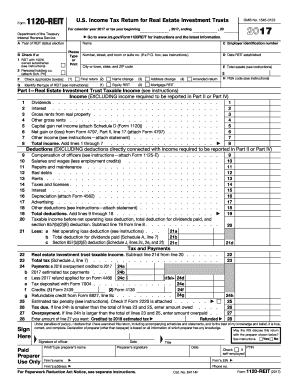
Tus election B Check if a: 1 REIT with 100% owned subsidiaries (see instructions) Please Type or Print 2 Personal holding co. (attach Sch. PH) , 2017, ending OMB No. 1545-0123 2017 , 20 Go to www.irs.gov/Form1120REIT for instructions and the latest information. Name C Employer identification number Number, street, and room or suite no. (If a P.O. box, see instructions.) D Date REIT established City or town, state, and ZIP code E Total assets (see instructions) $ (1) Final return.

This website is not affiliated with IRS

How it works

  1. Open form

    Open form follow the instructions

  2. Easily sign form

    Easily sign the form with your finger

  3. Share form

    Send filled & signed form or save

How to fill out the IRS 1120-REIT online

The IRS 1120-REIT is the U.S. income tax return specifically designed for real estate investment trusts. This guide provides a clear, step-by-step approach to help users complete the form online, ensuring a smooth filing process.

Follow the steps to complete the IRS 1120-REIT form online.

  1. Click ‘Get Form’ button to obtain the form and open it in the editor.
  2. In the top section, provide your REIT’s name, employer identification number, and address, along with the year established.
  3. Indicate the REIT status election by marking the appropriate box for the type of REIT being filed (e.g., equity or mortgage REIT).
  4. Complete Part I by entering income sources such as dividends, interest, gross rents, and other income in the specified lines, ensuring you total these amounts accurately.
  5. Proceed to report deductions related to operating expenses in Part II, including compensation, maintenance costs, and interest payments, then total these deductions.
  6. Calculate taxable income by subtracting total deductions from total income. Report net operating loss deductions if applicable.
  7. Complete Parts III and IV if applicable, by detailing tax obligations and prohibited transaction income, ensuring you refer to the guidance included in the instructions for each part.
  8. Attach any required schedules and form adjustments as specified throughout the instructions, including Schedule A for dividends paid.
  9. Review all fields for accuracy, ensure signatures are provided where required, and finalize your review of all attachments.
  10. At the final step, save your changes, download the completed form, or print it for sharing as needed.

Complete your IRS 1120-REIT form online today and streamline your filing process.

Get form

Experience a faster way to fill out and sign forms on the web. Access the most extensive library of templates available.

Related content

About Form 1120-REIT, U.S. Income Tax Return for...
Mar 28, 2025 — Information about Form 1120-REIT, U.S. Income Tax Return for Real Estate...
Learn more
Instructions for Form 1120-REIT, U.S. income tax...
Instructions for Form 1120-REIT, U.S. income tax return for real estate investment trusts...
Learn more
Instructions for Form 1125-E (Rev. October 2016)
Form 1125-E must be completed and attached to Form. 1120, 1120-C, 1120-F, 1120-RIC...
Learn more

Related links form

IRS 1120-POL 2019 VA DoT 760 2019 OK 511NR Packet 2019 IRS Instruction W-2 & W-3 2019

Questions & Answers

Get answers to your most pressing questions about US Legal Forms API.

Contact support

You typically report REIT income on your personal tax return as ordinary income, usually on Schedule E of Form 1040. It's important to categorize this income correctly to ensure compliance with IRS guidelines. Remember that if you are operating a REIT, filing the IRS 1120-REIT form accurately is also necessary.

REIT dividends are reported to the IRS on Form 1099-DIV, which is issued to investors. This form details the dividends received, including the amounts that may qualify as taxable income. Ensuring proper reporting is essential for individuals who want to stay compliant with IRS regulations related to REIT income.

An LLC can own interests in a REIT, but the REIT itself must be structured as a corporation. The LLC's ownership interests provide flexibility and protection, while the corporate entity meets the specific IRS guidelines. It's crucial for LLCs considering this route to understand the implications, including the need to file the IRS 1120-REIT form.

Yes, a REIT can be privately owned; these are often referred to as private REITs. Private REITs generally don't trade on public exchanges and cater to a limited number of investors. However, they are still required to comply with IRS regulations, including filing the IRS 1120-REIT form.

Yes, if you operate a REIT, you must file the IRS form 1120-REIT. This form reports the income, gains, losses, deductions, and credits of the REIT, and is essential for fulfilling tax obligations. Completing the IRS 1120-REIT accurately ensures the REIT qualifies for the tax benefits associated with this investment structure.

To qualify as a REIT, specific requirements must be met, such as having at least 75% of assets in real estate, deriving 75% of gross income from real estate sources, and distributing 90% of taxable income to shareholders. Compliance with these regulations allows the REIT to benefit from favorable tax treatment. Remember, maintaining accurate records and filing the IRS 1120-REIT form is crucial for ongoing compliance.

REITs do generally require registration with the appropriate regulatory authorities, especially if they wish to go public. This registration ensures adherence to various legal standards and reporting requirements. Regardless of their public or private status, filing the IRS 1120-REIT is essential for tax compliance.

Yes, a Real Estate Investment Trust (REIT) must typically be organized as a corporation. This corporate structure allows the REIT to qualify for certain tax benefits and compliance requirements, including filing the IRS 1120-REIT form. It's important for potential investors to understand these requirements to secure the benefits of operating under a REIT structure.

You report REIT income on your tax return using Schedule E of Form 1040. This section allows you to detail income from rental properties, partnerships, and trusts, including REIT dividends. Ensure that you keep accurate records of any REIT-related income and consult IRS documentation if needed. Accurate reporting is essential to remain compliant with current tax regulations.

REIT dividends are reported to the IRS using Form 1099-DIV. This form details the dividends received by shareholders and any tax obligations that may arise from those distributions. When filing your taxes, it is crucial to report these dividends accurately on your return. Understanding how dividend reporting works can help you avoid complications with the IRS and ensure your financial health.

Get This Form Now!

Use professional pre-built templates to fill in and sign documents online faster. Get access to thousands of forms.
If you believe that this page should be taken down, please follow our DMCA take down processhere.
Get IRS 1120-REIT
  • Adoption
  • Bankruptcy
  • Contractors
  • Divorce
  • Home Sales
  • Employment
  • Identity Theft
  • Incorporation
  • Landlord Tenant
  • Living Trust
  • Name Change
  • Personal Planning
  • Small Business
  • Wills & Estates
  • Packages A-Z
  • Affidavits
  • Bankruptcy
  • Bill of Sale
  • Corporate - LLC
  • Divorce
  • Employment
  • Identity Theft
  • Internet Technology
  • Landlord Tenant
  • Living Wills
  • Name Change
  • Power of Attorney
  • Real Estate
  • Small Estates
  • Wills
  • All Forms
  • Forms A-Z
  • Other Templates
  • Legal Hub
  • About Us
  • Help Portal
  • Legal Resources
  • Blog
  • Affiliates
  • Contact Us
  • Delete My Account
  • Site Map
  • Industries
  • Forms in Spanish
  • Localized Forms
  • State-specific Forms
  • Forms Kit
  • Real Estate Handbook
  • All Guides
  • Notarize
  • Incorporation services
  • For Consumers
  • For Small Business
  • For Attorneys
  • USLegal
  • FormsPass
  • pdfFiller
  • signNow
  • altaFlow
  • DocHub
  • Instapage
Form Packages
  • Adoption
  • Bankruptcy
  • Contractors
  • Divorce
  • Home Sales
  • Employment
  • Identity Theft
  • Incorporation
  • Landlord Tenant
  • Living Trust
  • Name Change
  • Personal Planning
  • Small Business
  • Wills & Estates
  • Packages A-Z
Form Categories
  • Affidavits
  • Bankruptcy
  • Bill of Sale
  • Corporate - LLC
  • Divorce
  • Employment
  • Identity Theft
  • Internet Technology
  • Landlord Tenant
  • Living Wills
  • Name Change
  • Power of Attorney
  • Real Estate
  • Small Estates
  • Wills
  • All Forms
  • Forms A-Z
  • Other Templates
Customer Service
  • Legal Hub
  • About Us
  • Help Portal
  • Legal Resources
  • Blog
  • Affiliates
  • Contact Us
  • Delete My Account
  • Site Map
  • Industries
  • Forms in Spanish
  • Localized Forms
  • State-specific Forms
  • Forms Kit
Legal Guides
  • Real Estate Handbook
  • All Guides
Prepared for you
  • Notarize
  • Incorporation services
Our Customers
  • For Consumers
  • For Small Business
  • For Attorneys
Our Sites
  • USLegal
  • FormsPass
  • pdfFiller
  • signNow
  • altaFlow
  • DocHub
  • Instapage
Social Media
Call us now toll free:
+1 833 426 79 33
As seen in:
© Copyright 1999-2026 airSlate Legal Forms, Inc. 17 Station Street, Ste. 203, Brookline, MA 02445
  • Your Privacy Choices
  • Terms of Service
  • Privacy Notice
  • Content Takedown Policy
  • Bug Bounty Program
IRS 1120-REIT
This form is available in several versions.
Select the version you need from the drop-down list below.
2020 IRS 1120-REIT
Select form
  • 2020 IRS 1120-REIT
  • 2019 IRS 1120-REIT
  • 2018 IRS 1120-REIT
  • 2017 IRS 1120-REIT
  • 2016 IRS 1120-REIT
  • 2015 IRS 1120-REIT
Select form