Loading
Form preview
  • US Legal Forms
  • Other Templates
  • Tax Forms
  • Executive Department Treasury IRS Forms
  • Irs 1120-reit 2018

Get Irs 1120-reit 2018

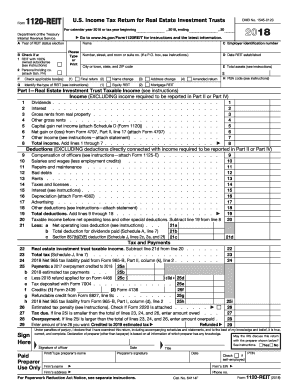
Ction B Check if a: 1 REIT with 100% owned subsidiaries (see instructions) 2 Personal holding co. (attach Sch. PH) Please Type or Print , 2018, ending OMB No. 1545-0123 2018 , 20 Go to www.irs.gov/Form1120REIT for instructions and the latest information. Name C Employer identification number Number, street, and room or suite no. (If a P.O. box, see instructions.) D Date REIT established City or town, state, and ZIP code E Total assets (see instructions) $ F Check applicable bo.

This website is not affiliated with IRS

How it works

  1. Open form

    Open form follow the instructions

  2. Easily sign form

    Easily sign the form with your finger

  3. Share form

    Send filled & signed form or save

How to fill out the IRS 1120-REIT online

The IRS 1120-REIT form is crucial for Real Estate Investment Trusts to report their income, deductions, and other relevant tax information. This guide will provide you with clear, step-by-step instructions on how to complete the form online effectively.

Follow the steps to accurately complete the IRS 1120-REIT online.

  1. Click ‘Get Form’ button to access the IRS 1120-REIT form and open it in your preferred editing tool.
  2. Enter the name of the REIT in the designated field, ensuring to include the correct tax year related to the filing. Fill in the Employer Identification Number (EIN) where prompted.
  3. Provide the address of the REIT, including number, street, room or suite number, city, state, and ZIP code.
  4. Indicate the date the REIT was established and provide the total assets amount as per the instructions.
  5. Check the applicable box to identify the type of REIT, including options for final return, name change, address change, etc.
  6. Fill out the income section of Part I, detailing all relevant income sources, including dividends, interest, and gross rents. Ensure to follow the calculations specified, adding lines as instructed.
  7. Complete the deductions section of Part I, listing all appropriate deductions such as compensation of officers and salaries.
  8. After calculating taxable income, enter the relevant information for taxes on net income from foreclosure property in Part II and any prohibited transaction income in Part IV as needed.
  9. Complete the Schedule A section for deductions related to dividends paid, ensuring all entries are totaled correctly.
  10. Finally, review all sections for accuracy, save your changes, and download or print the completed form for submission.

Take action now and complete your IRS 1120-REIT form online to ensure compliance and avoid potential penalties.

Get form

Experience a faster way to fill out and sign forms on the web. Access the most extensive library of templates available.

Related content

About Form 1120-REIT, U.S. Income Tax Return for...
Mar 28, 2025 — Information about Form 1120-REIT, U.S. Income Tax Return for Real Estate...
Learn more
Instructions for Form 1120-REIT, U.S. income tax...
Instructions for Form 1120-REIT, U.S. income tax return for real estate investment trusts...
Learn more
Instructions for Form 1125-E (Rev. October 2016)
Form 1125-E must be completed and attached to Form. 1120, 1120-C, 1120-F, 1120-RIC...
Learn more

Related links form

IRS 990 2019 IRS 4506 2019 IRS 1065 2019 IRS 8938 2019

Questions & Answers

Get answers to your most pressing questions about US Legal Forms API.

Contact support

REITs do not need to register with the SEC unless they are publicly traded, but they must meet IRS guidelines to retain their status. Registration may offer advantages, including increased transparency and access to capital. For those navigating the complexities of IRS 1120-REIT filings, consulting resources like US Legal Forms can provide valuable support.

While many REITs choose to register as corporations, it is not a strict requirement. A REIT can be structured as a trust and still retain its benefits. Understanding the implications of the IRS 1120-REIT form is essential, regardless of whether the REIT is organized as a corporation or another entity type.

REIT income typically gets reported on Schedule E of your personal tax return, specifically for passive income. It's essential to include all dividend information obtained from Form 1099-DIV to accurately report your earnings. If you file the IRS 1120-REIT form, you may need to consult a tax professional for the best guidance.

Yes, if you are operating a REIT, you are required to file IRS form 1120-REIT, which reports earnings and distributions. This form ensures that you meet your federal tax obligations and maintain your REIT status. Utilizing platforms like US Legal Forms can simplify this filing process, helping you avoid common pitfalls.

To qualify as a REIT, an entity must meet specific criteria set by the IRS, such as being primarily engaged in real estate investments and distributing at least 90% of its taxable income as dividends. It must also have a minimum of 100 shareholders and meet income and asset tests. Familiarizing yourself with IRS 1120-REIT is crucial for ensuring continued compliance.

An LLC can indeed own a REIT, offering flexibility in how it conducts business. However, it's essential to ensure that the REIT qualifies under IRS rules and maintains its status as a Real Estate Investment Trust. Understanding the nuances of IRS 1120-REIT filing can help LLCs manage their tax obligations effectively.

Yes, a REIT can be privately owned, which means it does not have to be publicly traded on a stock exchange. Private REITs often seek investment from a smaller group of accredited investors. Even privately owned REITs must comply with IRS regulations, including potential filing with the IRS 1120-REIT form depending on their corporate structure.

REITs operate under a unique tax structure that distinguishes them from traditional corporations, as long as they meet specific operational criteria. They are not subject to corporate income tax at the federal level due to their pass-through status. However, failure to comply can lead to corporate taxation, making it vital for REITs to understand how IRS Form 1120-REIT factors into their tax obligations.

REITs are generally not subject to corporate tax if they comply with IRS regulations, including the distribution of at least 90% of their taxable income. However, if a REIT fails to meet these requirements, it may be subject to regular corporate tax. Understanding this compliance is critical for REIT managers, especially when preparing IRS Form 1120-REIT.

A REIT is classified as a corporation for tax purposes but operates under special tax rules that differ from standard corporations. This classification allows REITs to benefit from favorable tax treatment, provided they adhere to specific distribution requirements. For those managing REITs, completing IRS Form 1120-REIT is a key step in ensuring compliance with these tax classifications.

Get This Form Now!

Use professional pre-built templates to fill in and sign documents online faster. Get access to thousands of forms.
If you believe that this page should be taken down, please follow our DMCA take down processhere.
Get IRS 1120-REIT
  • Adoption
  • Bankruptcy
  • Contractors
  • Divorce
  • Home Sales
  • Employment
  • Identity Theft
  • Incorporation
  • Landlord Tenant
  • Living Trust
  • Name Change
  • Personal Planning
  • Small Business
  • Wills & Estates
  • Packages A-Z
  • Affidavits
  • Bankruptcy
  • Bill of Sale
  • Corporate - LLC
  • Divorce
  • Employment
  • Identity Theft
  • Internet Technology
  • Landlord Tenant
  • Living Wills
  • Name Change
  • Power of Attorney
  • Real Estate
  • Small Estates
  • Wills
  • All Forms
  • Forms A-Z
  • Other Templates
  • Legal Hub
  • About Us
  • Help Portal
  • Legal Resources
  • Blog
  • Affiliates
  • Contact Us
  • Delete My Account
  • Site Map
  • Industries
  • Forms in Spanish
  • Localized Forms
  • State-specific Forms
  • Forms Kit
  • Real Estate Handbook
  • All Guides
  • Notarize
  • Incorporation services
  • For Consumers
  • For Small Business
  • For Attorneys
  • USLegal
  • FormsPass
  • pdfFiller
  • signNow
  • altaFlow
  • DocHub
  • Instapage
Form Packages
  • Adoption
  • Bankruptcy
  • Contractors
  • Divorce
  • Home Sales
  • Employment
  • Identity Theft
  • Incorporation
  • Landlord Tenant
  • Living Trust
  • Name Change
  • Personal Planning
  • Small Business
  • Wills & Estates
  • Packages A-Z
Form Categories
  • Affidavits
  • Bankruptcy
  • Bill of Sale
  • Corporate - LLC
  • Divorce
  • Employment
  • Identity Theft
  • Internet Technology
  • Landlord Tenant
  • Living Wills
  • Name Change
  • Power of Attorney
  • Real Estate
  • Small Estates
  • Wills
  • All Forms
  • Forms A-Z
  • Other Templates
Customer Service
  • Legal Hub
  • About Us
  • Help Portal
  • Legal Resources
  • Blog
  • Affiliates
  • Contact Us
  • Delete My Account
  • Site Map
  • Industries
  • Forms in Spanish
  • Localized Forms
  • State-specific Forms
  • Forms Kit
Legal Guides
  • Real Estate Handbook
  • All Guides
Prepared for you
  • Notarize
  • Incorporation services
Our Customers
  • For Consumers
  • For Small Business
  • For Attorneys
Our Sites
  • USLegal
  • FormsPass
  • pdfFiller
  • signNow
  • altaFlow
  • DocHub
  • Instapage
Social Media
Call us now toll free:
+1 833 426 79 33
As seen in:
© Copyright 1999-2026 airSlate Legal Forms, Inc. 17 Station Street, Ste. 203, Brookline, MA 02445
  • Your Privacy Choices
  • Terms of Service
  • Privacy Notice
  • Content Takedown Policy
  • Bug Bounty Program
IRS 1120-REIT
This form is available in several versions.
Select the version you need from the drop-down list below.
2020 IRS 1120-REIT
Select form
  • 2020 IRS 1120-REIT
  • 2019 IRS 1120-REIT
  • 2018 IRS 1120-REIT
  • 2017 IRS 1120-REIT
  • 2016 IRS 1120-REIT
  • 2015 IRS 1120-REIT
Select form