Loading
Form preview
  • US Legal Forms
  • Other Templates
  • Tax Forms
  • Executive Department Treasury IRS Forms
  • Irs 1120-reit 2016

Get Irs 1120-reit 2016

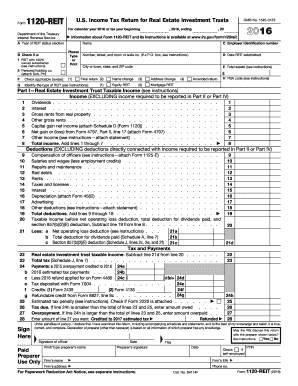
Ructions) , 20 Information about Form 1120-REIT and its instructions is available at www.irs.gov/form1120reit. A Year of REIT status election B Check if a: 1 REIT with 100% , 2016, ending OMB No. 1545-0123 Please Type or Print 2 Personal holding co. (attach Sch. PH) 2016 Name C Employer identification number Number, street, and room or suite no. (If a P.O. box, see instructions.) D Date REIT established City or town, state, and ZIP code E Total assets (see instructions) $ (1) Fin.

This website is not affiliated with IRS

How it works

  1. Open form

    Open form follow the instructions

  2. Easily sign form

    Easily sign the form with your finger

  3. Share form

    Send filled & signed form or save

How to fill out the IRS 1120-REIT online

The IRS 1120-REIT is the U.S. Income Tax Return for Real Estate Investment Trusts. This guide will assist users in completing the form online with clear instructions for each section and field, ensuring compliance with IRS requirements.

Follow the steps to successfully complete the IRS 1120-REIT online.

  1. Click ‘Get Form’ button to obtain the form and open it for editing.
  2. Fill out the basic information. Enter the name, employer identification number, and address of the REIT. Ensure correctness and completeness of this information.
  3. Specify the REIT status election year and any applicable changes such as name, address, or if this is a final return.
  4. Complete Part I by reporting the income generated by the REIT. Ensure to accurately list all relevant income sources including dividends, interest, and gross rents.
  5. Move to the deductions section in Part I. List all allowable deductions related to your activities as a REIT, such as compensation of officers and interest paid.
  6. Determine taxable income by subtracting total deductions from the total income reported. Accurately calculate the final taxable income.
  7. Complete the tax and payments section to determine the total tax due or refund expected in relation to the taxes paid and overpayment credits.
  8. Sign and date the form, ensuring that all information is true and correct. If applicable, include the preparer’s details.
  9. Review all entries for accuracy. After confirming correctness, you can save your changes, download, print, or share the form as needed.

Start completing your IRS 1120-REIT online today to ensure timely and accurate filing.

Get form

Experience a faster way to fill out and sign forms on the web. Access the most extensive library of templates available.

Related content

About Form 1120-REIT, U.S. Income Tax Return for...
Mar 28, 2025 — Information about Form 1120-REIT, U.S. Income Tax Return for Real Estate...
Learn more
Instructions for Form 1120-REIT, U.S. income tax...
Instructions for Form 1120-REIT, U.S. income tax return for real estate investment trusts...
Learn more
Instructions for Form 1125-E (Rev. October 2016)
Form 1125-E must be completed and attached to Form. 1120, 1120-C, 1120-F, 1120-RIC...
Learn more

Related links form

IRS 8889 2019 IRS 1120S - Schedule M-3 2019 IRS 8867 2019 IRS 8801 2019

Questions & Answers

Get answers to your most pressing questions about US Legal Forms API.

Contact support

Yes, if you operate a REIT, you must file IRS Form 1120-REIT annually. This form reports the income, gains, losses, and deductions of the REIT while ensuring compliance with tax laws. It also allows the REIT to benefit from certain tax exemptions, making it essential for entities looking to maintain their status and obligations.

REIT dividends should be reported on your individual tax return, specifically on Form 1040, where you include them in your total income. More precisely, any dividend information received via Form 1099-DIV must be entered accurately. Consulting IRS 1120-REIT can provide additional insights into how dividends and distributions impact your overall tax obligations.

Yes, for the IRS to classify an entity as a REIT, it generally must be structured as a corporation, trust, or association. This structure allows the REIT to make distributions that are not taxed at the corporate level, benefitting shareholders. Knowing this is crucial when navigating IRS 1120-REIT compliance and the benefits that come from this status.

REIT dividends can qualify for the Section 199A deduction, which allows a deduction of up to 20% on qualified business income. This section applies to pass-through entities, including REITs. Therefore, individuals receiving dividends should consult IRS 1120-REIT and related IRS guidelines to maximize tax benefits associated with these dividends.

To report REIT income, you will typically use Schedule E of your Form 1040. This schedule allows you to declare any income derived from your investment in a REIT. Be sure to reference forms like IRS 1120-REIT for guidance on the reported income details, especially if you are a shareholder with specific dividends.

REIT dividends are classified as ordinary income and are reported on Form 1099-DIV. The REIT must provide this form to its shareholders, indicating the amount received. Additionally, the information should align with details provided on IRS 1120-REIT, reflecting the entity's tax obligations and distribution of dividends to investors.

To qualify as a REIT, specific conditions must be met, such as having at least 75% of total assets in real estate and deriving at least 75% of gross income from real estate-related sources. Additionally, a REIT must distribute at least 90% of its taxable income to shareholders. Following IRS 1120-REIT criteria ensures compliance and tax advantages.

Yes, a REIT can be privately owned, which is known as a private REIT. Unlike publicly traded REITs, private REITs do not list shares on a stock exchange, allowing for more controlled management of assets. It is essential, however, for private REITs to adhere to IRS 1120-REIT rules to maintain tax advantages.

Yes, an LLC can own all or part of a REIT. However, the LLC must meet certain requirements that qualify it under the IRS 1120-REIT structure. This ownership option provides flexibility for investors who wish to manage their real estate investments through different business entities.

Yes, Real Estate Investment Trusts (REITs) must be registered, typically with the Securities and Exchange Commission (SEC). This registration ensures compliance with various regulatory requirements, which helps protect investors. By obtaining the correct registration, a REIT can benefit from certain tax advantages under the IRS 1120-REIT guidelines.

Get This Form Now!

Use professional pre-built templates to fill in and sign documents online faster. Get access to thousands of forms.
If you believe that this page should be taken down, please follow our DMCA take down processhere.
Get IRS 1120-REIT
  • Adoption
  • Bankruptcy
  • Contractors
  • Divorce
  • Home Sales
  • Employment
  • Identity Theft
  • Incorporation
  • Landlord Tenant
  • Living Trust
  • Name Change
  • Personal Planning
  • Small Business
  • Wills & Estates
  • Packages A-Z
  • Affidavits
  • Bankruptcy
  • Bill of Sale
  • Corporate - LLC
  • Divorce
  • Employment
  • Identity Theft
  • Internet Technology
  • Landlord Tenant
  • Living Wills
  • Name Change
  • Power of Attorney
  • Real Estate
  • Small Estates
  • Wills
  • All Forms
  • Forms A-Z
  • Other Templates
  • Legal Hub
  • About Us
  • Help Portal
  • Legal Resources
  • Blog
  • Affiliates
  • Contact Us
  • Delete My Account
  • Site Map
  • Industries
  • Forms in Spanish
  • Localized Forms
  • State-specific Forms
  • Forms Kit
  • Real Estate Handbook
  • All Guides
  • Notarize
  • Incorporation services
  • For Consumers
  • For Small Business
  • For Attorneys
  • USLegal
  • FormsPass
  • pdfFiller
  • signNow
  • altaFlow
  • DocHub
  • Instapage
Form Packages
  • Adoption
  • Bankruptcy
  • Contractors
  • Divorce
  • Home Sales
  • Employment
  • Identity Theft
  • Incorporation
  • Landlord Tenant
  • Living Trust
  • Name Change
  • Personal Planning
  • Small Business
  • Wills & Estates
  • Packages A-Z
Form Categories
  • Affidavits
  • Bankruptcy
  • Bill of Sale
  • Corporate - LLC
  • Divorce
  • Employment
  • Identity Theft
  • Internet Technology
  • Landlord Tenant
  • Living Wills
  • Name Change
  • Power of Attorney
  • Real Estate
  • Small Estates
  • Wills
  • All Forms
  • Forms A-Z
  • Other Templates
Customer Service
  • Legal Hub
  • About Us
  • Help Portal
  • Legal Resources
  • Blog
  • Affiliates
  • Contact Us
  • Delete My Account
  • Site Map
  • Industries
  • Forms in Spanish
  • Localized Forms
  • State-specific Forms
  • Forms Kit
Legal Guides
  • Real Estate Handbook
  • All Guides
Prepared for you
  • Notarize
  • Incorporation services
Our Customers
  • For Consumers
  • For Small Business
  • For Attorneys
Our Sites
  • USLegal
  • FormsPass
  • pdfFiller
  • signNow
  • altaFlow
  • DocHub
  • Instapage
Social Media
Call us now toll free:
+1 833 426 79 33
As seen in:
© Copyright 1999-2026 airSlate Legal Forms, Inc. 17 Station Street, Ste. 203, Brookline, MA 02445
  • Your Privacy Choices
  • Terms of Service
  • Privacy Notice
  • Content Takedown Policy
  • Bug Bounty Program
IRS 1120-REIT
This form is available in several versions.
Select the version you need from the drop-down list below.
2020 IRS 1120-REIT
Select form
  • 2020 IRS 1120-REIT
  • 2019 IRS 1120-REIT
  • 2018 IRS 1120-REIT
  • 2017 IRS 1120-REIT
  • 2016 IRS 1120-REIT
  • 2015 IRS 1120-REIT
Select form