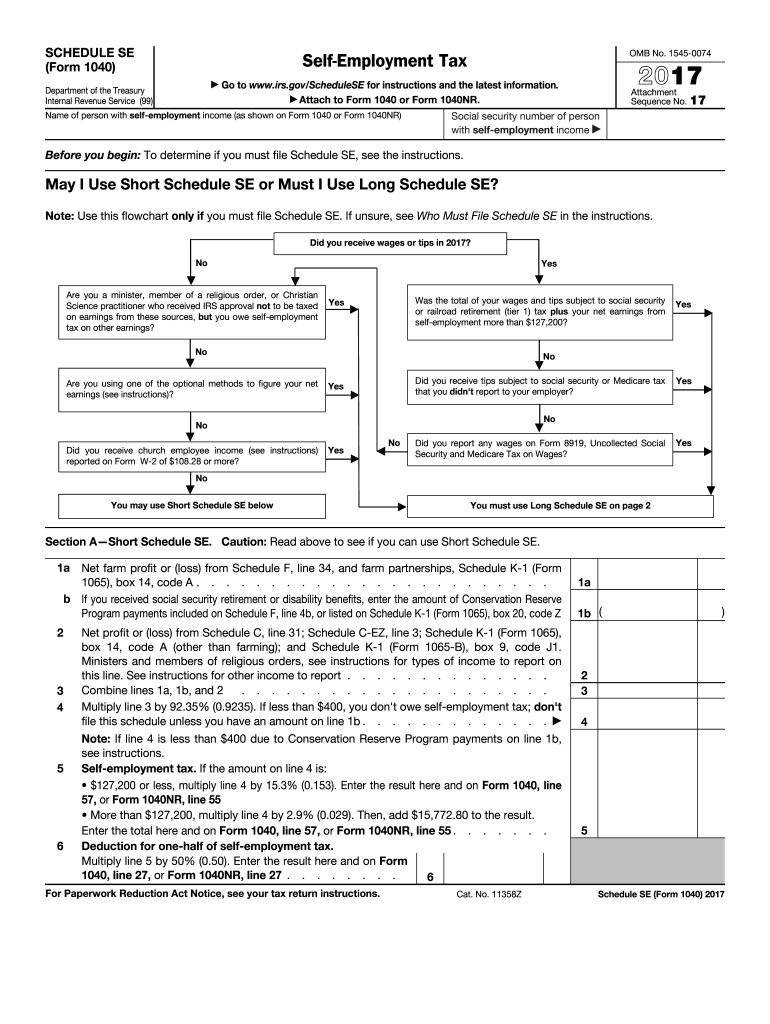
Social security number of person with self-employment income Section B Long Schedule SE Part I Self-Employment Tax Note: If your only income subject to self-employment tax is church employee income, see instructions. Also see instructions for the definition of church employee income. A If you are a minister, member of a religious order, or Christian Science practitioner and you filed Form 4361, but you had $400 or more of other net earnings from self-employment, check here and continue wi.
Loading

Open form follow the instructions

Easily sign the form with your finger

Send filled & signed form or save
How to fill out the IRS 1040 - Schedule SE online
This guide provides a comprehensive overview of how to fill out the IRS 1040 - Schedule SE form online. With clear instructions and supportive language, users of all experience levels can navigate this important tax document with ease.
Follow the steps to complete your Schedule SE efficiently.
- Click ‘Get Form’ button to obtain the form and open it in the editor.
- Provide your name as shown on Form 1040 or Form 1040NR in the designated field for the person with self-employment income.
- Enter your social security number in the specified field.
- Determine if you need to use Short Schedule SE or Long Schedule SE by reviewing the flowchart provided. Follow the path based on your specific income circumstances.
- For Short Schedule SE, enter the net farm profit or loss from Schedule F or relevant forms in line 1a and any applicable conservation payments in line 1b.
- Input your net profit or loss from self-employment sources on line 2 and combine the relevant totals in line 3.
- Multiply the amount on line 3 by 92.35% and complete line 4 based on the calculated result. If applicable, proceed to calculate self-employment tax on line 5.
- For Long Schedule SE, follow similar steps in Part I, ensuring you document all types of income accurately.
Complete your IRS 1040 - Schedule SE online and ensure accurate tax filing.
Experience a faster way to fill out and sign forms on the web. Access the most extensive library of templates available.
Related content
Results 1 - 74 of 74 - Form 1040 (Schedule SE), Self-Employment Tax, 2017. Inst 1040...
Lawrence Red OwlSimulation 1: Completing Form W-4 ... 14A: Using Form 1099-INT to Complete...
User Manual: 1040. ... Form 1040 2017 (99) Department of the Treasury—Internal Revenue...
Get answers to your most pressing questions about US Legal Forms API.
Where do I put self-employment income?
You put self-employment income on IRS 1040 using Schedule C for detailed reporting of income. After determining your net earnings, you will also fill out Schedule SE to calculate the self-employment tax owed. This dual approach effectively captures your earnings and ensures compliance with tax regulations. Services like US Legal Forms can help streamline this documentation.
How do I add self-employment income to my tax return?
To add self-employment income to your tax return, complete Schedule C to report your earnings and expenses. Next, transfer the net income figure to IRS 1040 - Schedule SE to calculate any applicable self-employment tax. This systematic approach ensures you accurately reflect your income on your tax return. US Legal Forms can assist you with templates that simplify this integration process.
How do I calculate my SE tax?
To calculate your self-employment (SE) tax, begin by determining your net earnings on Schedule C. Then, transfer this amount to Schedule SE, which has the formulas to compute your tax. Generally, the SE tax rate is 15.3% on the net earnings, but check current guidelines for accurate calculations. US Legal Forms provides resources to guide you through this calculation effectively.
Where to report self-employment income on 1040?
You report self-employment income on IRS 1040 using Schedule C to detail your earnings. Subsequently, use Schedule SE to calculate your self-employment tax based on the net income reported in Schedule C. This method accurately reflects your earnings and tax liabilities. Utilizing US Legal Forms can streamline this process and provide clarity on your reporting responsibilities.
Where does Schedule SE go on 1040?
Schedule SE accompanies your IRS 1040 form, typically as a supporting document. After filling out Schedule C for self-employment income, you will complete Schedule SE to figure out your self-employment tax. Attach both schedules when submitting your tax return to maintain clarity and ensure compliance. Platforms like US Legal Forms offer templates and resources to make this process smoother.
How do I record self-employment income?
You record self-employment income on IRS 1040 - Schedule C. List your income sources and subtract any business-related expenses to determine your net earnings. Following this, transfer the net earnings to Schedule SE to calculate your self-employment tax. Using US Legal Forms can guide you through the necessary paperwork and ensure proper record-keeping.
Where is self-employment income reported on 1040?
Self-employment income is reported on the IRS 1040 - Schedule SE and Schedule C. Schedule C captures detailed income and expenses related to your business, while Schedule SE calculates your self-employment tax. It's important to ensure all information is accurate as it directly affects your tax obligations. By organizing your income and expenses through US Legal Forms, you can simplify this process significantly.
How do you enter exempt notary income?
To enter exempt notary income on the IRS 1040 - Schedule SE, you must first identify the income as non-taxable. You will document this income on your Schedule C, using the appropriate line to denote it as exempt. It is essential to maintain thorough records to support your claim of exempt status. Utilizing platforms like US Legal Forms can help you efficiently manage your notary income documentation.
What is the maximum income for optional methods?
The maximum income for optional methods on the IRS 1040 - Schedule SE varies annually. These methods allow self-employed individuals to calculate their SE tax based on an estimated amount rather than actual income, but there's an income cap. Reviewing IRS guidelines each year is essential to stay compliant and optimize your filings.
How to calculate Social Security tax?
Calculating Social Security tax involves using your wages or income where applicable. For self-employed individuals, you would calculate this through the IRS 1040 - Schedule SE, which includes the Social Security portion of the SE tax. This ensures you properly account for your contributions toward Social Security.
Use professional pre-built templates to fill in and sign documents online faster. Get access to thousands of forms.
If you believe that this page should be taken down, please follow our DMCA take down process here.
This form is available in several versions. Select the version you need from the drop-down list below.