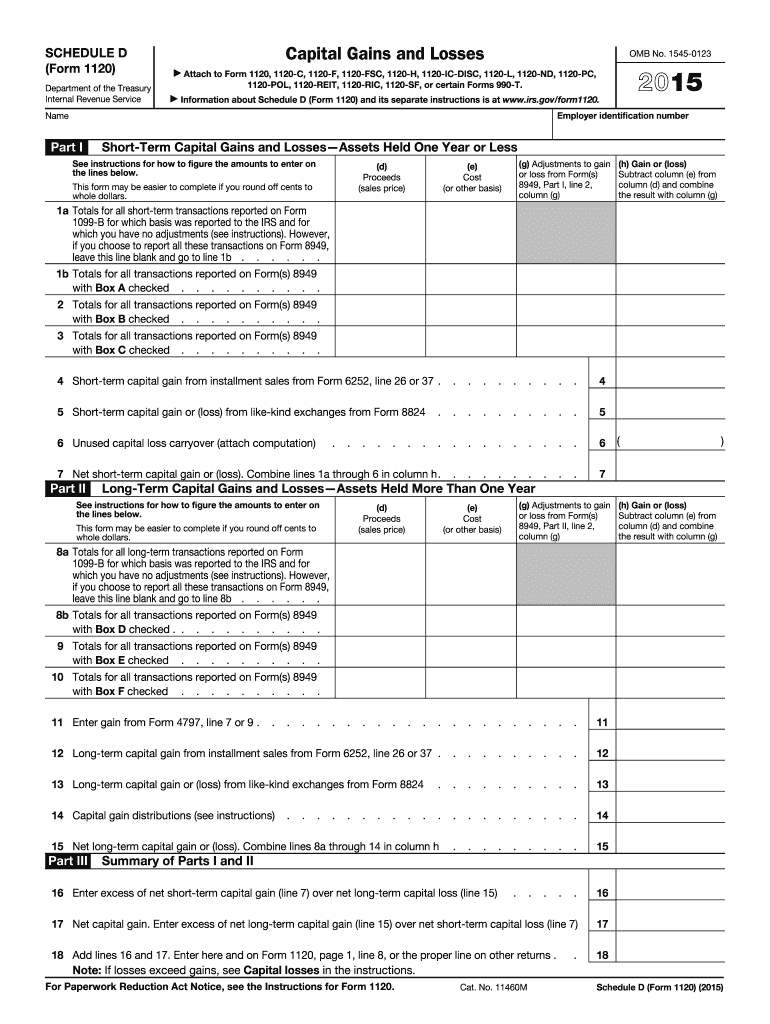
120-L, 1120-ND, 1120-PC, 1120-POL, 1120-REIT, 1120-RIC, 1120-SF, or certain Forms 990-T. Information about Schedule D (Form 1120) and its separate instructions is at www.irs.gov/form1120. Employer identification number Name Part I Short-Term Capital Gains and Losses Assets Held One Year or Less See instructions for how to figure the amounts to enter on the lines below. (d) Proceeds (sales price) This form may be easier to complete if you round off cents to whole dollars. (g) Adjus.
Loading

Open form follow the instructions

Easily sign the form with your finger

Send filled & signed form or save
How to fill out the IRS 1120 - Schedule D online
Filling out the IRS 1120 - Schedule D is essential for reporting your corporation's capital gains and losses. This guide will provide a clear, step-by-step process for completing the form online, ensuring you accurately report your financial activity.
Follow the steps to fill out your IRS 1120 - Schedule D online effectively.
- Press the ‘Get Form’ button to access the IRS 1120 - Schedule D form and open it in your preferred online editing tool.
- On the first section, enter your employer identification number and name. This information ensures that your form is correctly identified.
- Proceed to Part I, where you will report short-term capital gains and losses. Enter your proceeds (sales price) in column (d) and your cost (or other basis) in column (e).
- Calculate the gain or loss for each transaction by subtracting the cost in column (e) from the proceeds in column (d) and add any adjustments in column (g). Record the result in column (h).
- For each line item (1a to 6), ensure all short-term transactions are accurately reported according to the corresponding forms and instructions.
- Move to Part II, where long-term capital gains and losses are to be entered. Repeat the process of entering proceeds, cost, and calculating gain or loss, just as you did in Part I.
- Once you have filled out all relevant sections, review the totals in column (h) for both short-term and long-term transactions.
- In Part III, enter the summary of net short-term and long-term capital gains and losses as required by the instructions.
- Finally, after thoroughly reviewing your entries, save your changes, and download, print, or share the completed form as needed.
Start filling out your IRS 1120 - Schedule D online today to ensure accurate capital gains and losses reporting.
Experience a faster way to fill out and sign forms on the web. Access the most extensive library of templates available.
Related content
See instructions for how to figure the amounts to enter on the lines below. This form may...
Schedule D should be used by a taxpayer who files either Forms 1120, 1120-A...
Jan 31, 2012 — However, you may want to complete certain Form 1120 schedules, such as...
Get answers to your most pressing questions about US Legal Forms API.
Can I file 1120 myself?
Yes, you can file IRS 1120 - Schedule D yourself, but it requires a solid understanding of tax laws and regulations. Many business owners choose to tackle their own tax filings to save costs, but it can become complicated, especially with capital gains reporting. Using a reputable platform, like US Legal Forms, can provide the necessary resources and guidance to ensure accurate completion of your tax forms. Ultimately, if you feel unsure, consulting a tax professional could provide added peace of mind.
What is the difference between Schedule D and 4797?
The primary difference between IRS 1120 - Schedule D and Form 4797 lies in the types of transactions they report. Schedule D focuses on capital gains and losses, while Form 4797 deals specifically with the sale of business property and certain assets used in a trade or business. Depending on your unique financial circumstances, you may need to utilize both forms to give a complete picture to the IRS. Therefore, understanding which form applies to your situation is essential for proper compliance.
What is a Schedule D on 1120?
IRS 1120 - Schedule D serves as a form for corporations to report capital gains and losses from the sale of assets, including stocks, bonds, and property. This form helps determine how much tax a corporation might owe based on these transactions. Completing Schedule D is essential for corporations that have capital gains or losses, as it provides the IRS with necessary information regarding asset exchanges. Thus, understanding how to utilize this form is crucial for accurate tax filing.
Do I have to file a Schedule D if I sold my house?
If you sold your house, you may need to file IRS 1120 - Schedule D if it results in a taxable gain. Generally, you can exclude a certain amount of your profit if you meet specific criteria, such as owning and living in the home for a certain period. However, if your gain exceeds the exclusion limit, Schedule D becomes necessary to report and calculate your tax obligation. Always keep in mind, consulting a tax professional can help clarify your specific situation.
What is the $3000 capital loss rule?
The $3000 capital loss rule allows individual taxpayers to use their capital losses to offset other income up to $3,000 per year. This rule is particularly relevant for Schedule D filings, as it enables taxpayers to reduce their taxable income when they have experienced capital losses. Although this rule applies primarily to individual taxpayers, understanding it can be beneficial for corporations when computing losses reported on the IRS 1120 - Schedule D.
What is the Schedule D of 1120?
The Schedule D of Form 1120 is a supplementary form specifically designed to report capital gains and losses for corporations. It provides a detailed account of transactions involving capital assets, which is essential for calculating a corporation's overall tax liability. By accurately completing the IRS 1120 - Schedule D, businesses ensure compliance with IRS requirements and avoid potential pitfalls.
How do I get to Schedule D on TurboTax?
To find Schedule D on TurboTax, start by navigating to the 'Investments' section within your return. From there, TurboTax will guide you through reporting any capital gains or losses, and it will automatically generate the IRS 1120 - Schedule D when necessary. This makes it simple for users to ensure they accurately report transactions in a user-friendly manner.
Where do I get my Schedule D?
You can obtain Schedule D directly from the IRS website or through various tax preparation software like TurboTax. These platforms often provide the necessary forms and guidance for correctly completing the IRS 1120 - Schedule D. If you need further assistance, consider using US Legal Forms, which houses a comprehensive library of legal forms to help streamline the tax preparation process.
Who sends Schedule D?
Schedule D is submitted by corporations that file Form 1120, including C corporations and S corporations. It is necessary for any business that has engaged in selling capital assets within the tax year. Thus, if your corporation has incurred any capital gains or losses, you will need to include the IRS 1120 - Schedule D with your tax return.
What is Schedule D form used for?
The Schedule D form is used to report capital gains and losses for businesses filing IRS Form 1120. This form details the sales, exchanges, or dispositions of capital assets and determines tax liabilities. When completing the IRS 1120 - Schedule D, businesses can account for both short-term and long-term gains, which is vital for effective tax planning.
Use professional pre-built templates to fill in and sign documents online faster. Get access to thousands of forms.
If you believe that this page should be taken down, please follow our DMCA take down process here.
This form is available in several versions. Select the version you need from the drop-down list below.