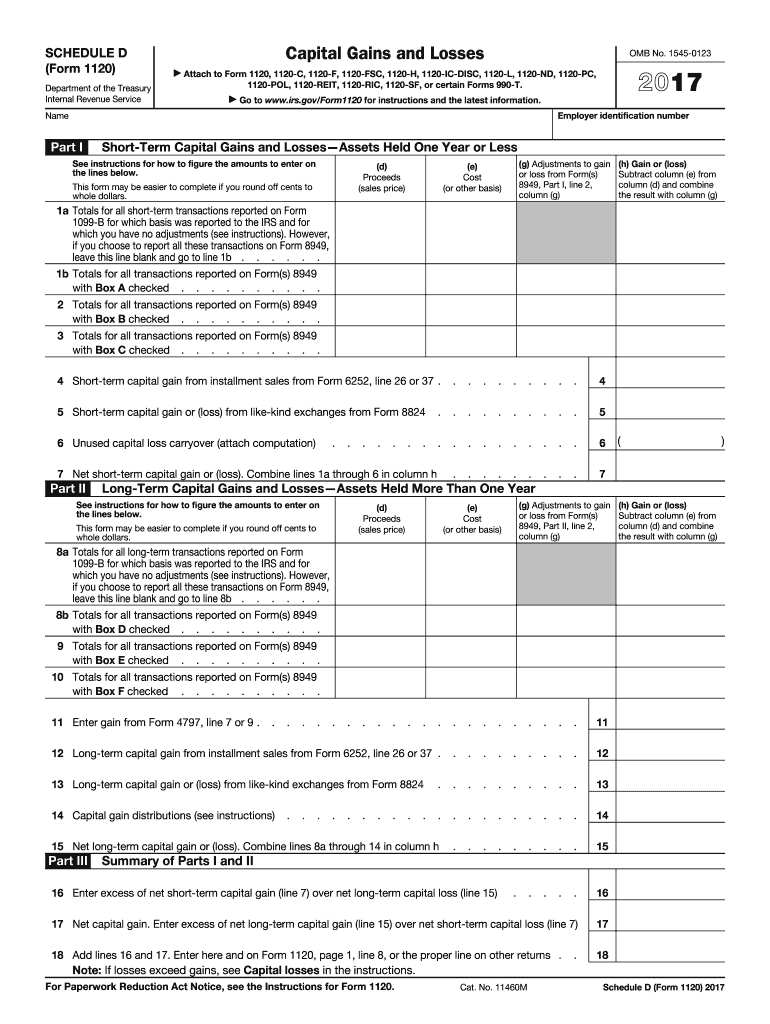
. . 16 17 Net capital gain. Enter excess of net long-term capital gain (line 15) over net short-term capital loss (line 7) 17 18 Add lines 16 and 17. Enter here and on Form 1120, page 1, line 8, or the proper line on other returns . 18 Part III . . . . . . . . . . . . . . . . . . . . . Summary of Parts I and II 16 Enter excess of net short-term capital gain (line 7) over net long-term capital loss (line 15) . Note: If losses exceed gains, see Capital losses in.
Loading

Open form follow the instructions

Easily sign the form with your finger

Send filled & signed form or save
How to fill out the IRS 1120 - Schedule D online
Understanding how to fill out the IRS 1120 - Schedule D online is essential for reporting capital gains and losses accurately. This guide will provide clear and step-by-step instructions tailored to users of all experience levels.
Follow the steps to complete the IRS 1120 - Schedule D online.
- Click ‘Get Form’ button to obtain the form and open it in the editor.
- Begin by entering your employer identification number and your name at the top of the form.
- Proceed to Part I, which focuses on short-term capital gains and losses for assets held for one year or less. Input the proceeds (sales price) in column (d) and the cost (or other basis) in column (e).
- Adjust the gain or loss from Form(s) 8949 in column (g), if applicable. Calculate the gain or loss by subtracting column (e) from column (d) and combining it with column (g) to fill in column (h).
- Complete lines 1a through 6 by providing totals from transactions reported on Form 1099-B or Form 8949, as directed. Ensure accurate reporting based on the provided boxes.
- Move to Part II for long-term capital gains and losses involving assets held for more than one year. Again, fill in the proceeds in column (d) and the cost in column (e).
- As in Part I, input adjustments in column (g) and calculate the gain or loss for column (h). Complete lines 8a through 14 by following the instructions on reporting from Form 1099-B or Form 8949.
- Calculate the net capital gain by determining the excess of net long-term capital gain over any net short-term capital loss. Enter this value in line 17.
- Summarize your results in Part III and ensure all calculations are accurate. Finally, add lines 16 and 17 and enter the total on Form 1120, page 1, line 8, or the appropriate line on other returns.
- After completing the form, review all entries for accuracy. Then, save your changes, download, print, or share the completed form as needed.
Take control of your financial reporting by completing the IRS 1120 - Schedule D online today!
Experience a faster way to fill out and sign forms on the web. Access the most extensive library of templates available.
Related content
See instructions for how to figure the amounts to enter on the lines below. This form may...
Schedule D should be used by a taxpayer who files either Forms 1120, 1120-A...
Jan 31, 2012 — However, you may want to complete certain Form 1120 schedules, such as...
Get answers to your most pressing questions about US Legal Forms API.
Should I file form 8949 or schedule D?
Whether to file Form 8949 or Schedule D depends on your situation. Typically, you must use Form 8949 to report each capital transaction before summarizing on IRS 1120 - Schedule D. This structured approach helps provide clarity in your financial reporting and ensures that the IRS can assess your filings accurately.
How do I enter Schedule D TurboTax?
To enter Schedule D in TurboTax, go to the 'Wages and Income' section, and begin by inputting your capital gains and losses. You will see a guide through the IRS 1120 - Schedule D questions, which helps you report your financial information accurately. TurboTax makes it easier to follow a step-by-step process for filing.
What to put in box 14 category TurboTax?
In TurboTax, box 14 requires you to categorize your capital gain distributions. For IRS 1120 - Schedule D, select the appropriate type of distribution, such as those from mutual funds or REITs. Using TurboTax simplifies this process, ensuring proper entries for optimal tax results.
How do I enter box D on TurboTax?
Entering information in box D on TurboTax requires you to navigate to the section for capital gains and losses. On your IRS 1120 - Schedule D, you'll provide details about the transactions that belong there. Follow the prompts on TurboTax to ensure you're accurately reporting your data.
What is a Schedule D on 1120?
Schedule D on IRS Form 1120 provides a detailed report of capital gains and losses for corporations. This form is vital for businesses that engage in buying and selling assets, ensuring that all transactions are accounted for. Properly filling out Schedule D helps businesses optimize their tax obligations.
What are the instructions for Schedule D line 13?
Line 13 of IRS 1120 - Schedule D requires you to report your total capital gains from sales or exchanges of capital assets. You must calculate and enter your short-term and long-term gains separately. Accurate completion here can significantly affect your overall tax liability, so double-check your figures.
What is the difference between Schedule D and 4797?
Schedule D focuses on capital gains and losses for individuals and corporations, while Form 4797 is specifically for the sale of business property. When you prepare your IRS 1120 - Schedule D, you report transaction details relevant to stocks, bonds, and other investments. Understanding these differences ensures accurate tax reporting and compliance.
What is the $3000 capital loss rule?
The $3000 capital loss rule allows taxpayers to deduct up to $3000 of capital losses against their ordinary income on their IRS 1120 - Schedule D. If you have more than $3000 in losses, the remainder can be carried over to future tax years. This rule benefits many businesses by reducing their taxable income and providing relief in tough financial times.
Do I use Schedule D or form 4797?
Choosing between IRS 1120 - Schedule D and form 4797 depends on the nature of the asset sold. Use Schedule D for personal assets and investments, while form 4797 is appropriate for business-related property. If you're uncertain which to use, consider consulting a tax expert to ensure correct filing.
Who is required to file a Schedule D?
Individuals and corporations that sell capital assets are typically required to file IRS 1120 - Schedule D. This requirement includes anyone reporting gains from sales of stocks, bonds, or property. Knowing when you need to file this form can help you avoid penalties and keep your financial records in order.
Use professional pre-built templates to fill in and sign documents online faster. Get access to thousands of forms.
If you believe that this page should be taken down, please follow our DMCA take down process here.
This form is available in several versions. Select the version you need from the drop-down list below.