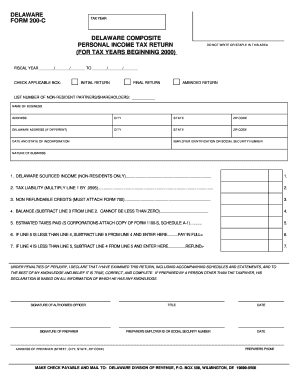
0-C. If one or more individuals choose not to file the Delaware Form 200-C, those individuals must file a Delaware Non-Resident Personal Income Tax Return, Form 200-02. Individuals that are included in the composite filing must not file an individual non-resident income tax return reporting the same income. The following limitations and conditions shall apply to those individuals included in the composite return: No tax credits other than non-refundable credits from Form 700 will be allowed.
Open form follow the instructions
Easily sign the form with your finger
Send filled & signed form or save
How to fill out the DE DoR 200-C online
Filling out the Delaware Composite Personal Income Tax Return (DE DoR 200-C) online can simplify the tax submission process for non-resident partners and shareholders. This guide will provide a comprehensive walkthrough of each section of the form to ensure accurate and efficient submission.
Follow the steps to complete your form online
- Click the ‘Get Form’ button to obtain the DE DoR 200-C and open it in the online editor.
- In the section labeled 'Fiscal Year,' input the applicable start and end dates for the tax year.
- Check the appropriate box indicating whether this is an initial return, a final return, or an amended return.
- List the total number of non-resident partners or shareholders in the specified field.
- Fill in the business name, address, city, state, and zip code of the entity filing the return. If the Delaware address is different, provide that information as well.
- Indicate the date and state of incorporation, followed by the employer identification number or social security number of the business.
- Describe the nature of the business in the provided section.
- For line 1, enter the total Delaware-sourced income for non-residents.
- Calculate the tax liability by multiplying the amount from line 1 by 0.0595, and enter that amount on line 2.
- If applicable, report any non-refundable credits, ensuring to attach Form 700 as required; enter the total on line 3.
- Subtract line 3 from line 2 to determine the balance, and record that on line 4. Remember, this cannot be less than zero.
- If estimated taxes have been paid, indicate that total on line 5, ensuring S corporations attach the relevant Form 1100-S, Schedule A-1.
- If line 5 is less than line 4, subtract line 5 from line 4 and enter the result on line 6 for payment due. Conversely, if line 4 is less than line 5, subtract line 4 from line 5 and report the refund on line 7.
- The form must be signed by an authorized officer and the preparer. Fill in all applicable fields for names, titles, and contact information.
- Once all information is complete, save your changes. You can then download, print, or share the form as needed.
Complete your DE DoR 200-C form online today for a seamless tax submission experience.
Experience a faster way to fill out and sign forms on the web. Access the most extensive library of templates available.
Related content
The Division of Revenue links for online filing options are available at...
by MCB Gazi · 2005 · Cited by 6 — A dor aguda é diferente da dor crônica e a...
O e-SUS AB é uma estratégia do Departamento de Atenção Básica (DAB) para reestruturar...
Get answers to your most pressing questions about US Legal Forms API.
Is Delaware a tax-friendly state for retirees?
Delaware is often considered a tax-friendly state for retirees due to its lack of sales tax and low property tax rates. Additionally, Social Security benefits are exempt from state taxes, which can significantly enhance retirement income. However, there are some taxes applicable to pension income and interest, so retirees should evaluate their specific financial situation. By utilizing resources such as the DE DoR 200-C and platforms like uslegalforms, retirees can maximize their tax benefits while navigating Delaware's tax landscape.
Who is required to file a Delaware tax return?
In Delaware, individuals must file a tax return if they earn income over a certain threshold or if they reside in the state. This includes both residents and non-residents earning income from Delaware sources. It is important to accurately determine your filing requirements, as filing a return using the DE DoR 200-C form can help ensure compliance. Utilizing tools and resources from uslegalforms can simplify your filing process and keep you informed about Delaware's tax laws.
What are the 9 states with no income tax?
The nine states that do not impose a personal income tax include Alaska, Florida, Nevada, New Hampshire, South Dakota, Tennessee, Texas, Washington, and Wyoming. Choosing to live in one of these states can offer significant savings on your income, allowing you to keep more of what you earn. However, each state has its own tax structure, so it is essential to evaluate how they manage other forms of taxation. When reviewing tax benefits, also consider the DE DoR 200-C for any out-of-state tax obligations you may face.
What is the withholding tax rate in Delaware?
The withholding tax rate in Delaware is typically set at a flat percentage based on your income level. Generally, this rate varies for residents and non-residents, with specific rates applied through the DE DoR 200-C. Understanding the withholding tax rate is crucial for accurate tax planning and compliance, as it impacts your overall tax burden. To ensure you meet your obligations, consider consulting resources or platforms like uslegalforms for assistance in navigating Delaware's tax requirements.
Where can I get tax forms in Delaware?
Tax forms in Delaware are readily available from the Delaware Division of Revenue offices, local government buildings, and libraries. You can also find them online through the official state websites. For convenience, using uslegalforms allows you to easily download and fill out the DE DoR 200-C form at your own pace.
Does the post office have state tax forms?
While some post offices carry federal tax forms, they may not always stock Delaware state tax forms. It is best to visit the Delaware Division of Revenue website or local offices to find the latest DE DoR 200-C forms. The uslegalforms platform provides a reliable alternative to quickly access state forms online without needing to visit a post office.
What is the penalty for filing taxes late in Delaware?
Filing taxes late in Delaware can result in penalties and interest on any unpaid tax amount. Typically, the penalty is 1% of the unpaid tax for each month the return is late, up to a maximum of 25%. To avoid these penalties, ensure you file your DE DoR 200-C in a timely manner, and leverage uslegalforms for easy submission.
Where to mail a Delaware tax return?
To mail your Delaware tax return, send it to the Delaware Division of Revenue, P.O. Box 8750, Wilmington, DE 19899. Make sure to check your specific form instructions, as some forms may have unique mailing addresses. If you choose to file using the uslegalforms platform, you can receive guidance on the mailing process as well.
Where can I pick up tax forms to fill out?
You can pick up tax forms at local Delaware Division of Revenue offices or download them directly from the DE DoR website. Additionally, many community libraries and post offices in Delaware carry these forms. Utilizing the uslegalforms platform can streamline the process, allowing you to easily access and complete the DE DoR 200-C form online.
Does Delaware allow composite tax returns?
Yes, Delaware permits composite tax returns, which streamline the filing process for non-resident partners in partnerships. This is especially advantageous for businesses operating across state lines. Understanding the criteria and requirements for submitting a composite return can save time and resources. The DE DoR 200-C is an important tool for navigating this process successfully.
Use professional pre-built templates to fill in and sign documents online faster. Get access to thousands of forms.
If you believe that this page should be taken down, please follow our DMCA take down process here.
This form is available in several versions. Select the version you need from the drop-down list below.