Jo, hermano). g. Otro (Especifique): Designaci n Escriba la letra anterior correspondiente (a - g) Jurisdicci n o N mero de Registro Nombre Firma Fecha Nota: Requisitos para ser representante: El(la) representante debe demostrar que: (A) ha observado una conducta adecuada en todo momento; (B) posee las calificaciones necesarias que le capaciten para proporcionar un servicio valioso a las personas; y (C) es competente en materias contributivas, de modo que.
Loading

Open form follow the instructions

Easily sign the form with your finger

Send filled & signed form or save
How to fill out the PR SC 2745 online
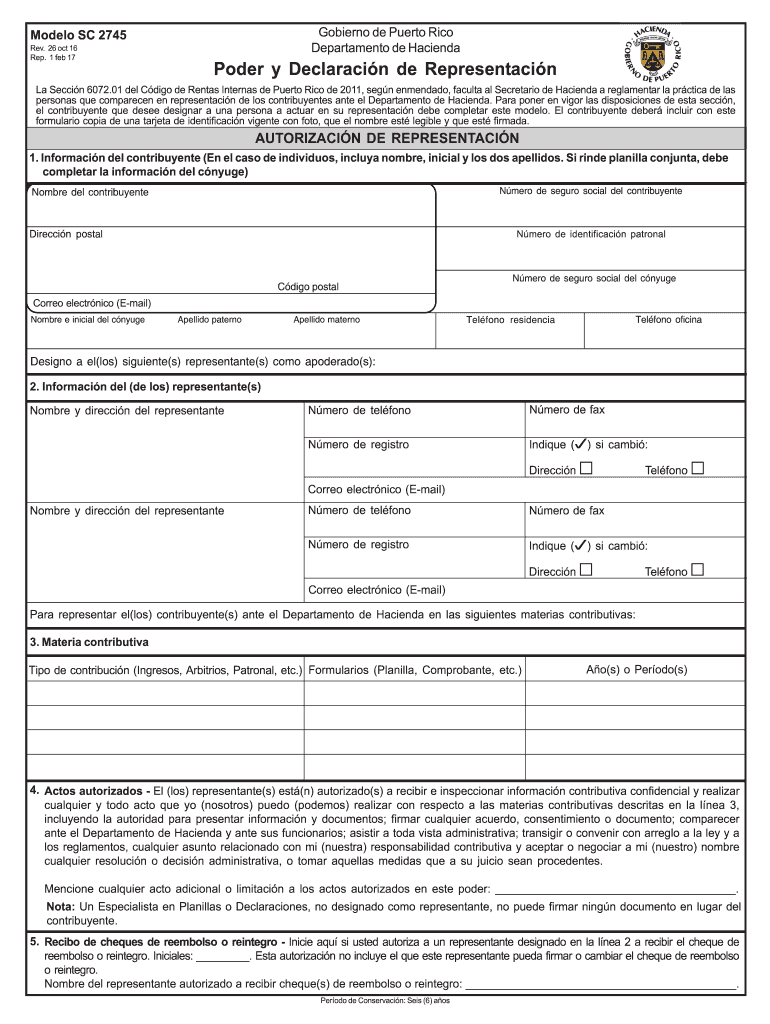
Filling out the PR SC 2745 form, also known as Poder y Declaración de Representación, is an important step for taxpayers in Puerto Rico who wish to designate a representative to act on their behalf in matters concerning the Department of Hacienda. This guide provides a comprehensive overview of how to complete this form online.
Follow the steps to complete the PR SC 2745 form online
- Click 'Get Form' button to access the PR SC 2745 form and open it in the designated editor.
- Provide the contributor's information. Include the contributor's full name, social security number, address, email, and phone numbers. If filing jointly, include the spouse's information.
- Enter the representative's information. List their name, address, phone number, fax number, and registration number. Indicate if any of their information has changed.
- Specify the tax matters for which the representative is authorized to act. This includes types of contributions and relevant forms or periods.
- In the authorization acts section, state any additional acts permitted to the representative. Include any limitations if applicable.
- If applicable, authorize the representative to receive refund checks by entering the representative's name and providing the necessary initials.
- Indicate how notifications and communications should be handled by marking your preferences. Choose whether the contributor or the representative will receive originals or copies.
- Review the revocation clause. By filing this form, all previous authorizations are revoked. If you do not wish to revoke any prior authorizations, indicate that clearly.
- Complete the validity and signature section. Both the contributor and spouse (if applicable) must sign and date this section to validate the form.
- Ensure all necessary identifications are attached, then save your changes. You may download, print, or share the completed form as needed.
Begin filling out the PR SC 2745 form online today to ensure your tax representation is properly authorized.
Experience a faster way to fill out and sign forms on the web. Access the most extensive library of templates available.
Related content
Número: Modelo SC 2745 / Form AS 2745 A ; Tipo de contribución:...
by SC Beneti · 2013 · Cited by 8 — Abstract - This work is focused on the...
The operating instructions are an integral part of the product and contain important in...
Get answers to your most pressing questions about US Legal Forms API.
Who qualifies for Puerto Rico tax exemption?
Individuals and businesses may qualify for Puerto Rico tax exemptions based on residency status and specific activities within the territory. To benefit from these exemptions under PR SC 2745, you need to meet certain requirements, such as being a bona fide resident or operating a qualifying business. It's wise to review the criteria with a tax expert to fully leverage these opportunities.
What is Section 6041 of the Internal Revenue Code?
Section 6041 of the Internal Revenue Code mandates the reporting of payments made in the course of business if they exceed a specified threshold. This helps ensure federal tax compliance and record-keeping for business entities. If you operate a business in Puerto Rico, understanding this regulation is important, particularly in relation to PR SC 2745.
What is the Act 1 2011 in Puerto Rico?
Act 1 of 2011 in Puerto Rico introduced significant tax reforms aimed at enhancing the local economy and making Puerto Rico an attractive place for business. It focuses on reducing the overall tax burden for individuals and corporations while promoting compliance and transparency. Understanding this act is crucial for navigating the benefits of PR SC 2745 as it relates to business operations.
What is Section 6072.01 of the Puerto Rico Internal Revenue Code of 2011?
Section 6072.01 of the Puerto Rico Internal Revenue Code of 2011 establishes specific tax incentives for businesses operating within Puerto Rico. This section aims to encourage investment, job creation, and economic growth in various sectors. Familiarizing yourself with these provisions can help you maximize your tax benefits under PR SC 2745.
How long do I have to live in Puerto Rico to avoid capital gains tax?
To avoid capital gains tax under PR SC 2745, you typically need to be a bona fide resident of Puerto Rico for at least 183 days during the taxable year. It's important to maintain a principal residence in Puerto Rico and establish connections to the community. Consider consulting with a tax professional who understands Puerto Rico's unique tax landscape to ensure compliance.
What is the withholding tax in Puerto Rico for non-residents?
The withholding tax in Puerto Rico for non-residents varies based on specific income streams, as dictated by PR SC 2745. For earnings like dividends and interest, the withholding rate may typically be around 15-30%. Understanding these rates is vital for financial planning and compliance. To make the process easier, consider utilizing US Legal Forms, which provides clear guidance and tools tailored for non-residents.
What is the non-resident withholding tax?
The non-resident withholding tax refers to the amount deducted at the source from income earned by non-residents in Puerto Rico under PR SC 2745. This tax applies to various income types, including wages, rents, and royalties. The rates may differ based on the income category, and compliance is essential to avoid penalties. Seeking guidance from US Legal Forms can assist in correctly calculating and remitting these taxes.
What is the withholding for non-residents in Puerto Rico?
The withholding tax for non-residents in Puerto Rico varies depending on the nature of the income, following PR SC 2745 guidelines. Generally, for services provided, the withholding rate can be around 30%, while for dividends, interest, and certain other incomes, it may differ. It's critical to understand these distinctions to avoid potential issues. You can find detailed information and assistance on platforms like US Legal Forms.
How to file PR taxes?
Filing PR taxes as a non-resident involves several steps guided by PR SC 2745. First, gather all necessary documents, including income records and any relevant forms. You then need to complete the appropriate tax forms, which may differ based on your income type. To simplify the process, consider leveraging US Legal Forms, which offers resources and templates tailored for non-residents.
What is the tax rate for non-residents?
The tax rate for non-residents in Puerto Rico under PR SC 2745 can vary based on the type of income earned. Generally, non-residents face a withholding tax rate that could range from 15% to 30%. It's essential to review the specific income type to determine the exact rate applicable. For personalized assistance, consider using US Legal Forms to navigate the tax filing process smoothly.
Use professional pre-built templates to fill in and sign documents online faster. Get access to thousands of forms.
If you believe that this page should be taken down, please follow our DMCA take down process here.