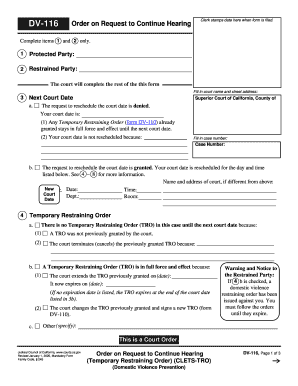
E this form Fill in court name and street address: 3 Next Court Date a. Superior Court of California, County of The request to reschedule the court date is denied. Your court date is: (1) Any Temporary Restraining Order (form DV-110) already granted stays in full force and effect until the next court date. (2) Your court date is not rescheduled because: Fill in case number: Case Number: b. The request to reschedule the court date is granted. Your court date is rescheduled for the day and.
Open form follow the instructions
Easily sign the form with your finger
Send filled & signed form or save
How to fill out the CA DV-116 online
The CA DV-116 form is essential for requesting to continue a hearing related to a domestic violence restraining order. This guide provides clear and step-by-step instructions to help users complete the form accurately and efficiently.
Follow the steps to fill out the CA DV-116 form correctly.
- Press the ‘Get Form’ button to access the CA DV-116 online and open it in the editor.
- In the first two fields, enter the respective information for the protected party and the restrained party.
- Fill in the court name and street address associated with your case.
- Provide the case number that is relevant to your situation.
- Indicate the next court date and specify if the request to reschedule that court date is denied or granted, along with the details of the new date and time if applicable.
- Detail the reasons for requesting a rescheduling of the court date, checking the appropriate box based on your situation.
- Clearly indicate whether the request to reschedule was made by the protected party or the restrained party, following the instructions given in this section.
- If required, specify how the documents will be served to the other parties involved in the case.
- Finalize the document by ensuring all sections are completed accurately, and review your entries for accuracy.
- Once done, you may save your changes, download, print, or share the completed form as needed.
Complete your documents online to ensure accuracy and efficiency.
Experience a faster way to fill out and sign forms on the web. Access the most extensive library of templates available.
Related content
3 Next Court Date a. The request to reschedule the court date is denied. Your court date...
Form DV-116 Notice of New Hearing and Order on Reissuance. Actions. Title: California...
Natural source zone depletion (NSZD) is the loss of LNAPL from the subsurface. Measurement...
Get answers to your most pressing questions about US Legal Forms API.
What is the difference between a restraining order and a harassment order?
A restraining order generally addresses domestic violence situations involving intimate partners or family members, while a harassment order pertains to unwanted and aggressive behavior from another individual. Each order has a specific intent, but both offer legal protection. Using the CA DV-116 can effectively address domestic violence issues, ensuring your safety and peace of mind.
What's the difference between a restraining order and a PPO?
A restraining order typically refers to various orders protecting individuals from abuse or harassment, while a Personal Protection Order (PPO) is a specific term often used in different jurisdictions. Both aim to provide safety, but the CA DV-116 focuses specifically on domestic violence situations. Understanding these distinctions can help you seek the right protection.
What is a dv116?
The term 'dv116' refers to the Domestic Violence Restraining Order application form used in California. This form is crucial for individuals seeking protection from someone who has caused them harm. By completing the CA DV-116, victims take a significant step toward ensuring their safety and access to legal remedy.
Should I get a restraining order against my ex?
If you feel threatened or unsafe due to past experiences with your ex, seeking a restraining order may be a prudent step. A restraining order can provide legal protections and peace of mind. You can use the CA DV-116 form to initiate this process and ensure your safety against any potential threats.
What happens if a victim violates their own restraining order?
If a victim violates their own restraining order, they may face legal consequences, including potential arrest. Courts impose these orders to safeguard individuals from harm, so violating an order can complicate legal protections. It’s important to understand the significance of the CA DV-116 and adhere to its guidelines.
What is a DV 116?
116, or Domestic Violence Restraining Order application form, is a legal document used in California. It allows individuals to formally request a restraining order against someone who has committed domestic violence. By filling out the C116, victims can seek necessary protections to ensure their safety and wellbeing.
What is the most common restraining order?
The most common restraining order in California is a Domestic Violence Restraining Order. This type of order addresses situations where there is a history of physical or emotional abuse between partners or family members. The CA DV-116 is specifically designed for this purpose, providing essential protections to those in need.
What is a standard family law restraining order in California?
A standard family law restraining order in California protects individuals from harassment or abuse by a family member or intimate partner. This legal document imposes certain restrictions on the abuser, which may include staying away from the victim, their home, or work. The CA DV-116 form is often used in these situations to apply for such an order, ensuring the victim's safety.
How to get a domestic violence case dismissed in California?
To get a domestic violence case dismissed in California, victims can request a dismissal from the court, which typically requires clear justification. Demonstrating changed circumstances and submitting evidence, such as a CA DV-116 form, can support your request. You may also want to consult an attorney to navigate the legal landscape effectively.
Can charges be dropped if the victim doesn't show?
If a victim does not show up to court, it can impact the case significantly. In many instances, a judge may dismiss the charges due to lack of evidence or testimony. Utilizing a CA DV-116 form can help clarify intentions and provide the court with necessary context regarding victim cooperation.
Use professional pre-built templates to fill in and sign documents online faster. Get access to thousands of forms.
If you believe that this page should be taken down, please follow our DMCA take down process here.
This form is available in several versions. Select the version you need from the drop-down list below.