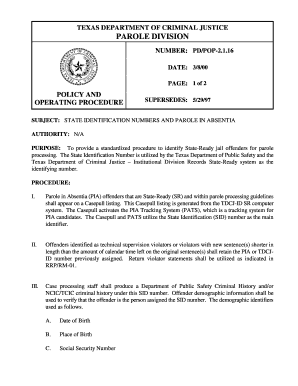
TEXAS DEPARTMENT OF CRIMINAL JUSTICE PAROLE DIVISION NUMBER PD/POP-2. 1. 16 DATE 3/8/00 PAGE 1 of 2 POLICY AND OPERATING PROCEDURE SUPERSEDES 5/29/97 SUBJECT STATE IDENTIFICATION NUMBERS AND PAROLE IN ABSENTIA AUTHORITY N/A PURPOSE To provide a standardized procedure to identify State-Ready jail offenders for parole processing. The State Identification Number is utilized by the Texas Department of Public Safety and the Texas Department of Criminal Justice Institutional Division Records State-Rea.

How it works
  • Open form

    Open form follow the instructions

  • Easily sign form

    Easily sign the form with your finger

  • Share form

    Send filled & signed form or save

How to use or fill out the TX PD/POP-2.1.16 online

This guide provides a detailed walkthrough for filling out the TX PD/POP-2.1.16 form online. By following the instructions, users can ensure accurate completion for effective processing.

Follow the steps to fill out the TX PD/POP-2.1.16 form online:

  1. Press the ‘Get Form’ button to access the TX PD/POP-2.1.16 form online.
  2. Review the purpose section of the form to understand how the State Identification Number is used in parole processing.
  3. Fill in the required information in the offender demographic information area, ensuring to include date of birth, place of birth, and social security number.
  4. Continue to complete sections for common arrests, present offense arrests, and additional identifiers, such as race, sex, weight, height, hair color, eye color, FBI number, alias name, and driver's license number.
  5. Check all entries for accuracy and completeness to minimize delays in processing.
  6. Once completed, users can save changes, download a copy of the form, print it for their records, or share it as needed.

Complete the TX PD/POP-2.1.16 form online today for efficient processing.

Get form

Experience a faster way to fill out and sign forms on the web. Access the most extensive library of templates available.

Related content

PD/POP-02.01.16 parole policy

PURPOSE: To provide a standardized procedure to identify State-Ready jail offenders for...

Learn more
Multiple Reference Active Noise Control...

by Y Tu · 1997 · Cited by 18 — It can be shown that equation (2.1.16) still holds when...

Learn more
Singer/USA

This document contains singers who have been active or are active in the United States and...

Learn more
Questions & Answers

Get answers to your most pressing questions about US Legal Forms API.

Contact support

What makes you eligible for parole?

A criminal offender becomes eligible for parole according to the type of sentence received from the court. ... If an offender is serving a life sentence or a term or terms of 30 years or more he or she will become eligible for parole after 10 years.

These terms may include compliance with all court orders, regular reporting to a probation officer or court, home searches, weapon prohibition, restriction from leaving the county or state, and drug and alcohol prohibition or restriction. Some probation conditions are tailored to the crime committed.

Types of Parole and Probation Violations Some of the most common parole and probation violations include: Committing a new crime. Refusing or failing a drug test. Failing to report to a parole or probation officer.

Common parole conditions include: reporting regularly to a supervising officer. living within a defined area and not leaving without permission.

Under the parole system, an inmate may be released from custody before the sentence has been completely served. ... Parole conditions are certain rules that are to be followed by a person when he/she is released from prison on parole. Parole conditions may include both standard and general conditions.

A person on parole is still serving their sentence, but they are allowed to live on the outside, provided they follow specific rules. The rules for parole change from state to state, behavior of the inmate, and the severity of the charge. behavior on parole can determine if the sentence is reduced.

Parole is conditional freedom for a prison inmate. The prisoner (called a "parolee") gets out from behind bars, but has to live up to a series of responsibilities. A parolee who doesn't follow the rules risks going back into custody.

Answer: The recall date is an approximate date for when an offender will be reviewed. *Offenders are reviewed a month prior to their recall dates.*

Parole eligibility date is when you are unext eligible to enter the parole review process. It is not the date a decision will be made, nor even the date of the IPO interview. Typically a decision is made withiun a few weeks of that date.

For a 4 year sentence you will do 2 years before having a chance at parole. Anyone doing a sentence over 70 years will have a chance at parole after 35 years, unless of course they have a LWOP. The third category is everything else: dui, theft, fraud, most drug offenses, etc.

Get This Form Now!

Use professional pre-built templates to fill in and sign documents online faster. Get access to thousands of forms.

If you believe that this page should be taken down, please follow our DMCA take down process here.

Get TX PD/POP-2.1.16