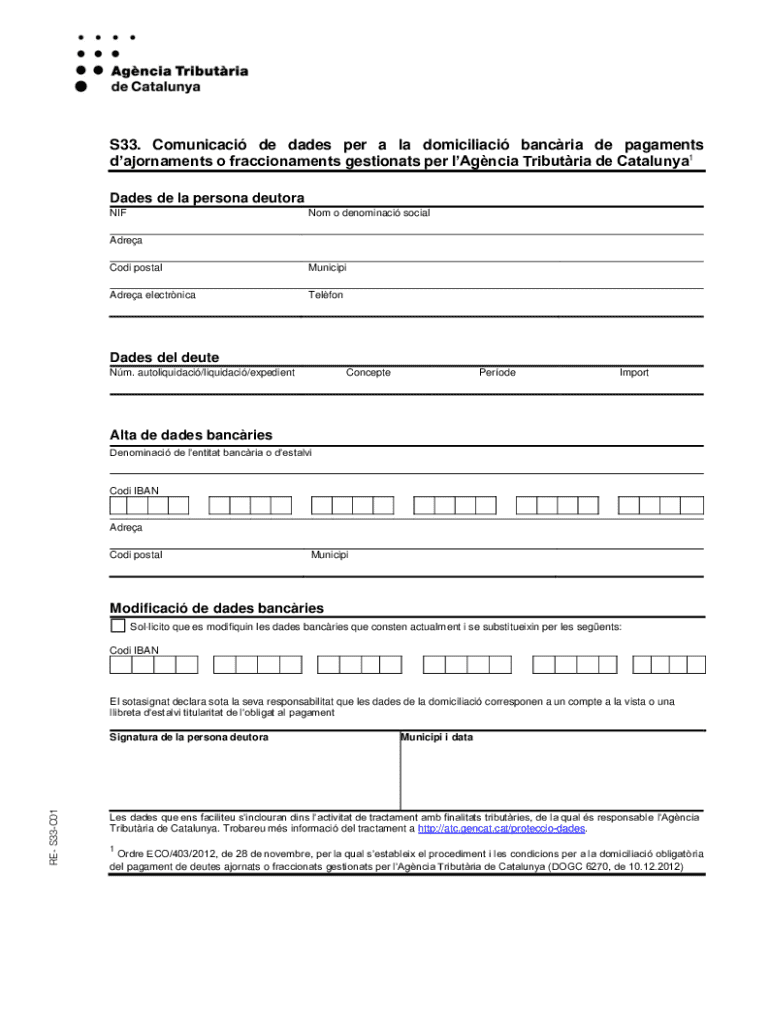
Denominaci social Adre a Codi postal Municipi Adre a electr nica Tel fon Dades del deute N m. autoliquidaci /liquidaci /expedient Concepte Per ode Import Alta de dades banc ries Denominaci de l entitat banc ria o d estalvi Codi IBAN Adre a Codi postal Municipi Modificaci de dades banc ries Sol licito que es modifiquin les dades banc ries que consten actualment i se substitueixin per les seg ents: Codi IBAN El sotasignat declara sota la seva responsabilitat.
Loading

Open form follow the instructions

Easily sign the form with your finger

Send filled & signed form or save
How to fill out the 2018 ES ATC S33 online
The 2018 ES ATC S33 form is essential for communicating banking details for the settlement of deferred or installment payments managed by the Agència Tributària de Catalunya. This guide provides clear, step-by-step instructions to assist users in completing the form accurately and efficiently online.
Follow the steps to effectively complete the 2018 ES ATC S33 form.
- Press the ‘Get Form’ button to access the form and open it in your preferred online editor. This will allow you to initiate the filling process.
- In the 'Dades de la persona deutora' section, provide the necessary personal details. Enter your NIF (tax identification number), name or social denomination, address, postal code, municipality, email address, and telephone number.
- Next, move to the 'Dades del deute' section where you will need to fill out information regarding the debt. This includes the autoliquidation number, the concept of the debt, the relevant period, and the amount due.
- Proceed to the 'Alta de dades bancàries' section. Here, enter the name of your banking institution and your IBAN code. Additionally, provide the corresponding address, postal code, and municipality of the bank.
- If you need to modify existing banking details, indicate your request in the 'Modificació de dades bancàries' section. Provide the new IBAN code that will replace the previous information.
- Acknowledge the declaration regarding the responsibility for the provided bank details by signing in the appropriate area. Include your municipality and the date of signing.
- Once you've filled out all sections accurately, be sure to save your changes. You can then download, print, or share the completed form as needed.
Complete your 2018 ES ATC S33 form online today for efficient processing.
Experience a faster way to fill out and sign forms on the web. Access the most extensive library of templates available.
Related content
by N Dordevic · 2025 · Cited by 1 — Extensive modulation of the circulating blood...
by F Kunzi · 2011 · Cited by 30 — ADS"B is a technology where avionics onboard the...
Sep 6, 2024 — • MRC: 15+ zóna ATC és ár alapú piacösszekapcsolásban. •...
Get answers to your most pressing questions about US Legal Forms API.
How to activate ELT Cessna 172?
Activation of the ELT in a Cessna 172 involves identifying the ELT unit, often found behind the rear seat, and turning the switch to the 'ON' position. It’s essential to perform this action before takeoff as a precaution. Ensuring you activate the ELT aligns with the emergency protocols emphasized in the 2018 ES ATC S33, thereby enhancing safety measures.
How to activate ELT Cessna?
To activate the ELT in a Cessna, locate the ELT control panel, usually near the cockpit, and switch it to the 'EMERGENCY' mode. Refer to your Cessna’s pilot operating handbook for specific instructions related to your model. This activation process plays a critical role in aligning with safety standards highlighted in the 2018 ES ATC S33.
How do I turn on ELT?
Turning on the ELT is usually straightforward: locate the device switch and toggle it to the 'ON' position. Ensure the ELT is in a position where it can transmit effectively. For those utilizing the 2018 ES ATC S33, turning on the ELT as part of your pre-flight checklist is essential for preparedness in emergencies.
How is an ELT activated?
An ELT can be activated manually or automatically; manual activation involves turning on the device, while automatic activation occurs during a significant impact or crash. Make sure to familiarize yourself with your unit's specific activation process. Understanding this process is key when operating systems like the 2018 ES ATC S33, enhancing overall flight safety.
How to determine if ELT has been activated?
To determine if the ELT, or Emergency Locator Transmitter, has been activated, check the indicator light on the device. If it's illuminated, the ELT is transmitting. Additionally, performing routine maintenance checks as part of your aircraft’s inspections, especially in relation to the 2018 ES ATC S33, ensures readiness in emergencies.
What does AO OTA stand for?
AO OTA refers to 'Aircraft Operations - Other Than Aerial Application.' This term is crucial for understanding regulatory compliance and operational guidelines related to various aircraft activities. Notably, in the context of the 2018 ES ATC S33, it helps flyers grasp the regulatory landscape better, ensuring safer operations.
What does AO mean in fractures?
In the context of fractures, AO stands for 'Arbeitsgemeinschaft für Osteosynthesefragen,' translating to 'Association for the Study of Internal Fixation' in English. This organization created the AO classification systems for better fracture treatment and management. The 2018 ES ATC S33 aligns with AO standards, making it a key resource for clinicians.
What is the Muller AO classification of fractures?
The Muller AO classification is a detailed system that categorizes fractures based on anatomic features and injury mechanisms. The 2018 ES ATC S33 has refined this system, providing clearer guidelines for healthcare professionals. Using this classification standard enhances communication and ensures that all patients receive consistent and effective fracture management.
What are the classification of rib fractures according to AO?
According to the AO classification, rib fractures are categorized based on whether they are categorized as stable or unstable, along with the extent of the fracture. The 2018 ES ATC S33 emphasizes understanding these classifications for optimal management of rib injuries. This knowledge helps healthcare providers anticipate complications and implement effective treatment strategies.
What is the classification of a rib fracture?
A rib fracture can be classified based on its pattern, size, and location within the rib cage. The 2018 ES ATC S33 provides guidelines that help healthcare professionals categorize these fractures accurately. It is vital to know the classification to determine the appropriate treatment plan and to monitor healing effectively.
Use professional pre-built templates to fill in and sign documents online faster. Get access to thousands of forms.
If you believe that this page should be taken down, please follow our DMCA take down process here.