Inent to the business in which the seller deals. In order for good faith to be established, all of the following conditions must be met: a. The buyer must present the certificate prior to or at the time of the purchase of the property. b. The certificate must contain no statement or entry which the seller knows, or has reason to know, is false or misleading. c. The certificate is on an exemption form issued by the Vermont Department of Taxes or a form with substantially identical language. d.
Loading

Open form follow the instructions

Easily sign the form with your finger

Send filled & signed form or save
How to fill out the VT DoT S-3 online
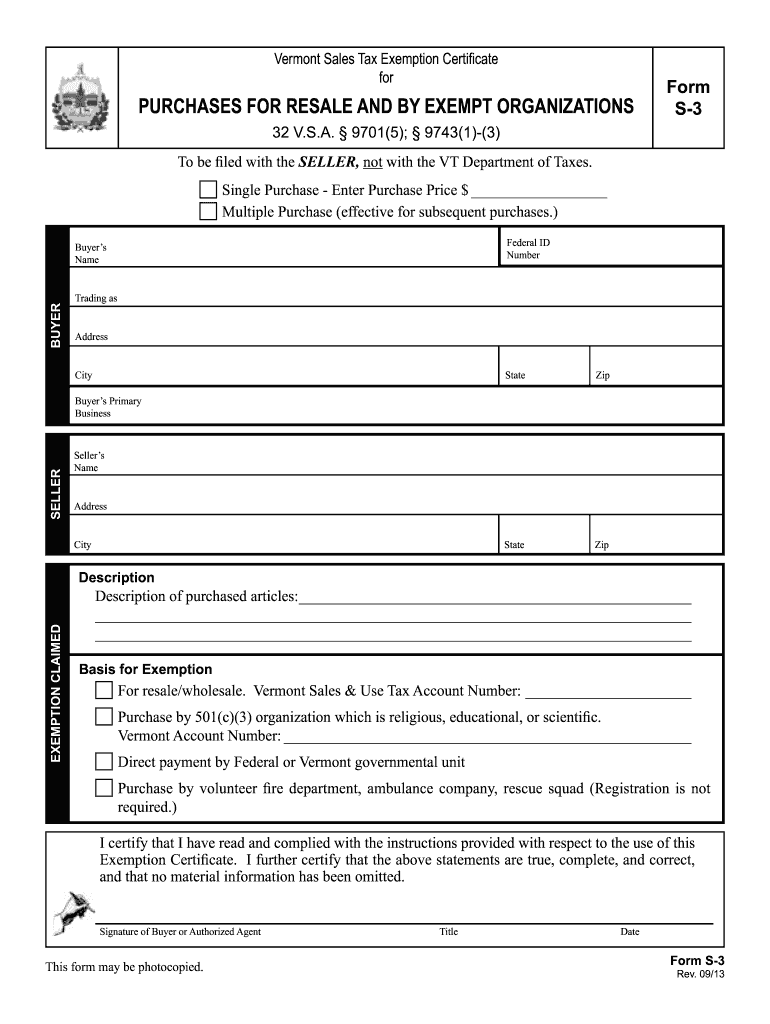
The Vermont Sales Tax Exemption Certificate, also known as Form S-3, is essential for individuals and organizations looking to make tax-exempt purchases in the state of Vermont. This guide provides comprehensive instructions on how to fill out the form online, ensuring accurate completion and compliance with associated regulations.
Follow the steps to complete the VT DoT S-3 online effectively.
- Click 'Get Form' button to obtain the form and open it in the editor.
- Indicate whether the purchase is a single purchase or a multiple purchase by checking the corresponding box. For a single purchase, enter the purchase price in the specified field. If selecting multiple purchases, this exemption will apply to subsequent purchases.
- Fill in the federal ID number if applicable, followed by the buyer's information including their name, any trading name, complete address, city, state, and zip code.
- Next, provide the seller's details including the seller's name and address, similar to the buyer's information format.
- In the exemption claimed section, describe the purchased articles in detail, ensuring clarity about the items being exempted.
- Select the appropriate basis for exemption by checking one of the options provided: for resale, purchase by a 501(c)(3) organization, direct payment by government units, or purchase by a volunteer fire department, ambulance company, or rescue squad.
- If claiming exemption for resale, include the Vermont Sales and Use Tax account number. If applicable, enter the Vermont account number for organizations.
- Certify the accuracy of all entries by signing the form, including the title and date. Ensure that all required fields are completed before proceeding.
- Once all sections are filled out correctly, save changes to the document. You can then download, print, or share the completed form as needed.
Complete your VT DoT S-3 form online today for a streamlined tax exemption process.
Experience a faster way to fill out and sign forms on the web. Access the most extensive library of templates available.
Related content
Health Benefits Eligibility and Enrollment Rule, Nonfinancial Eligibility Requirements...
by F YAIk · 1998 · Cited by 56 — We introduce and demonstrate a novel operating mode...
WARNING: TO PREVENT FIRE OR SHOCK, DO NOT EXPOSE THIS UNIT TO RAIN OR MOISTURE. DO NOT USE...
Get answers to your most pressing questions about US Legal Forms API.
What is VT sales tax?
VT sales tax is the tax imposed on sales of goods and services in Vermont. Currently, the state has a base sales tax rate that applies to most transactions. Understanding sales tax is vital for businesses to ensure compliance and proper financial planning. For comprehensive details on VT sales tax, looking at resources like the VT DoT S-3 can provide clarity and thorough guidance.
How often do you have to file sales tax in Vermont?
In Vermont, the frequency of filing sales tax returns depends on your business's sales volume. Some businesses might file monthly, while others may file quarterly or annually. Staying on top of your filing schedule is crucial to maintain compliance and avoid penalties. You can consult the VT DoT S-3 for specifics on filing frequencies that apply to your situation.
Do I need a resale certificate for every state?
Typically, yes, you will need a resale certificate for each state where you conduct business. Each state has its own rules and requirements regarding resale certificates, which can add complexity to your operations. It is important to understand the varying regulations to avoid compliance issues. Consider using resources like VT DoT S-3 and uslegalforms to manage these requirements efficiently.
Is Vermont an SST state?
Yes, Vermont is a member of the Streamlined Sales and Use Tax Agreement (SST). This membership aims to simplify tax administration for businesses operating in multiple states. Being an SST state means Vermont adheres to standardized procedures for sales tax, making it easier for retailers. Stay informed about how VT DoT S-3 relates to SST for added benefits.
Do Vermont sales tax exemption certificates expire?
Yes, Vermont sales tax exemption certificates can expire. Typically, these certificates remain valid for a set period, after which you may need to renew or replace them. Regularly checking the validity is essential to ensure compliance with local tax regulations. You can reference the VT DoT S-3 for specific guidelines on expiration and renewal.
Which states don't accept out of state resale certificates?
Some states do not accept out of state resale certificates, and it's vital to stay informed. For example, states like California and New York have specific requirements that may restrict the use of out of state certificates. This can complicate transactions when you're dealing with cross-state sales. To ensure compliance, you may want to check the VT DoT S-3 or similar resources, and consider utilizing uslegalforms for clarity.
What is the minimum entity tax in Vermont?
The minimum entity tax in Vermont applies to corporations and passes a financial requirement on businesses to ensure they contribute to state revenues. This tax amount can vary, so checking the latest amount reported on the VT DoT S-3 is essential for compliance. To understand your obligations clearly, consult uslegalforms for comprehensive tax guidance and resources.
What is the form in 111 in Vermont?
The form 111 in Vermont generally refers to the Personal Income Tax Return form. This form is used by residents to report their income, deductions, and credits. The VT DoT S-3 is a critical tool in navigating what can be a complex filing process. You can simplify your experience further by using uslegalforms to access helpful templates and detailed instructions.
What is the household income for homestead declaration in Vermont?
Household income for homestead declaration in Vermont includes all sources of income for all members of your household. This amount influences the property tax rates you may qualify for. When using the VT DoT S-3, ensure that you accurately report your household income to gain the benefits available. If uncertain, uslegalforms offers resources that can clarify income reporting requirements.
What is the VT Form 113?
The VT Form 113 is specifically for property owners filing for the homestead declaration. This form plays an essential role in determining your property tax obligations. By using the VT DoT S-3, you can ensure your homestead declaration is filed correctly. To further simplify your filing, consider exploring uslegalforms for step-by-step guidance.
Use professional pre-built templates to fill in and sign documents online faster. Get access to thousands of forms.
If you believe that this page should be taken down, please follow our DMCA take down process here.