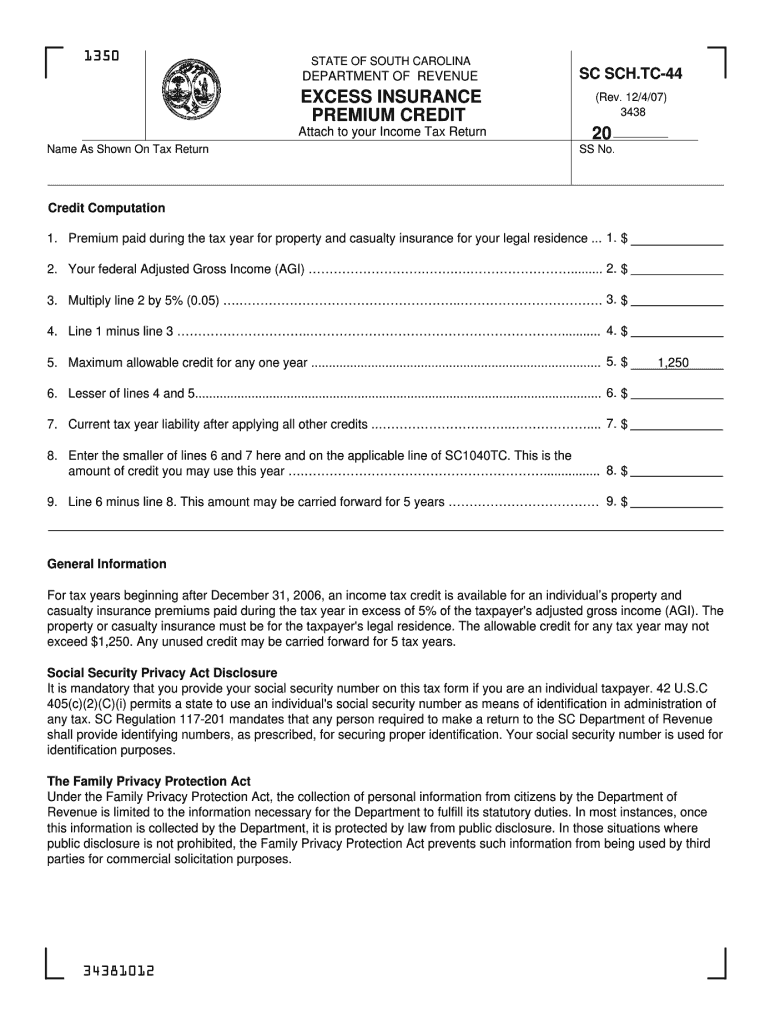
STATE OF SOUTH CAROLINA DEPARTMENT OF REVENUE SC SCH. TC-44 EXCESS INSURANCE PREMIUM CREDIT Rev. 12/4/07 Attach to your Income Tax Return Name As Shown On Tax Return SS No. Credit Computation 1. Premium paid during the tax year for property and casualty insurance for your legal residence. 1. 2. Your federal Adjusted Gross Income AGI. 2. 3. Multiply line 2 by 5 0. 05. 3. 4. Line 1 minus line 3. 4. 5. Maximum allowable credit for any one year. 5. 6. Lesser of lines 4 and 5. 6. 7. Current tax year .
Loading

Open form follow the instructions

Easily sign the form with your finger

Send filled & signed form or save
How to fill out the SC DoR TC-44 online
The SC DoR TC-44 form is essential for claiming the excess insurance premium credit in South Carolina. This guide provides clear, step-by-step instructions on how to accurately complete this form online, ensuring you can maximize your tax benefits.
Follow the steps to complete the SC DoR TC-44 form online effectively.
- Select the ‘Get Form’ button to retrieve the SC DoR TC-44 form and open it in your preferred online interface.
- Begin by entering your name exactly as it appears on your tax return in the designated field.
- Input your Social Security number (SSN) in the specified area, as it is necessary for identification purposes.
- Move to the credit computation section. Enter the total amount of property and casualty insurance premiums paid during the tax year for your legal residence in Line 1.
- Next, provide your federal Adjusted Gross Income (AGI) in Line 2 to calculate your credit.
- Calculate 5% of your AGI by multiplying the amount from Line 2 by 0.05 and write the result in Line 3.
- Subtract the amount in Line 3 from Line 1 and record the result in Line 4.
- Enter the maximum allowable credit of $1,250 in Line 5, as this is the annual limit for the credit.
- Identify the lesser amount between Lines 4 and 5 and input this value in Line 6.
- Next, provide your current tax year liability after applying all other credits in Line 7.
- In Line 8, enter the smaller of the amounts on Lines 6 and 7. This is the credit amount you can utilize this year.
- Finally, subtract the amount in Line 8 from Line 6 and indicate the result in Line 9. This amount may be carried forward for up to five years.
- Once all sections of the form are completed, review your entries for accuracy. You can then choose to save your changes, download, print, or share the completed form as needed.
Ensure your eligibility for the excess insurance premium credit by completing the SC DoR TC-44 form online today.
Experience a faster way to fill out and sign forms on the web. Access the most extensive library of templates available.
Related content
Jul 31, 2019 — The excess insurance premium credit is for premiums paid for property and...
by CE Rochitte · 2012 — O método clássico para obtenção de imagens das artérias...
AVISO DE SEGURANÇA. Apenas pessoal qualificado deve instalar e realizar a manutenção no...
Get answers to your most pressing questions about US Legal Forms API.
Who must file SC1040?
You must file SC1040 if you are a resident or part-year resident of South Carolina and your income meets the specified thresholds set by the state. Additionally, if you have any income derived from South Carolina sources, filing is necessary. You can refer to the SC DoR TC-44 for comprehensive guidelines on your requirements.
What is the 44% capital gain exclusion in SC?
The 44% capital gain exclusion in South Carolina allows taxpayers to exclude a portion of their capital gains from state taxation. This exclusion can significantly reduce your taxable income, benefiting those who sell certain assets. For detailed insights and eligibility criteria, the SC DoR TC-44 serves as a valuable resource.
Who doesn't have to file a 1040?
Certain individuals, such as those with income below the filing threshold or those who meet specific criteria, may not need to file a federal 1040 form. This includes some qualifying dependents and taxpayers who earn minimal income. Understanding these exceptions is crucial, so referencing the SC DoR TC-44 may assist you in your decision-making.
Do I have to file a Pennsylvania non-resident tax return?
If you earned income in Pennsylvania but do not live there, you may need to file a non-resident tax return. This requirement applies if you have Pennsylvania-source income that meets the filing threshold. Check resources related to the SC DoR TC-44 for further details if you find yourself in this situation.
Who must file federal 1040?
Individuals must file a federal 1040 form if their income exceeds a certain level or if they meet specific filing requirements based on age or dependency status. This includes wages, self-employment income, and certain investment earnings. The SC DoR TC-44 can help clarify these requirements to ensure you stay compliant.
Can I file my South Carolina taxes online?
Yes, you can file your South Carolina taxes online. The South Carolina Department of Revenue (SC DoR) offers a user-friendly platform to assist you in electronic filing. Utilizing their online services can save you time and ensure that your return is submitted accurately. Check out our resources on how to navigate the SC DoR TC-44 for seamless online filing.
What is the exemption limit for capital gain?
The exemption limit for capital gain in South Carolina can vary based on the type of asset you sell and your overall taxable income. For individuals, utilizing the SC DoR TC-44 can provide clear guidelines on how much of your capital gains can be exempted. Staying informed about these limits aids in effective financial management and tax planning.
What is the capital gains rate in South Carolina?
The capital gains rate in South Carolina generally mirrors the state's income tax rates, which means it can vary based on your income level. Understanding the nuances of these rates is essential when planning your tax strategy. Utilizing the SC DoR TC-44 form can help clarify how capital gains are taxed in your specific situation.
What is the excess insurance premium credit in SC?
The excess insurance premium credit is a tax benefit available to certain taxpayers in South Carolina who have made excess premium payments. This credit helps offset insurance costs, making it more affordable for residents. Referencing the SC DoR TC-44 will guide you through the process of determining your eligibility and claiming this credit.
What is the capital gain exclusion rule?
The capital gain exclusion rule allows taxpayers to exclude certain capital gains from their taxable income. In South Carolina, this rule is essential for individuals selling their primary residence. By utilizing the SC DoR TC-44, you can determine how these exclusions apply to your situation and potentially reduce your tax liability.
Use professional pre-built templates to fill in and sign documents online faster. Get access to thousands of forms.
If you believe that this page should be taken down, please follow our DMCA take down process here.
This form is available in several versions. Select the version you need from the drop-down list below.