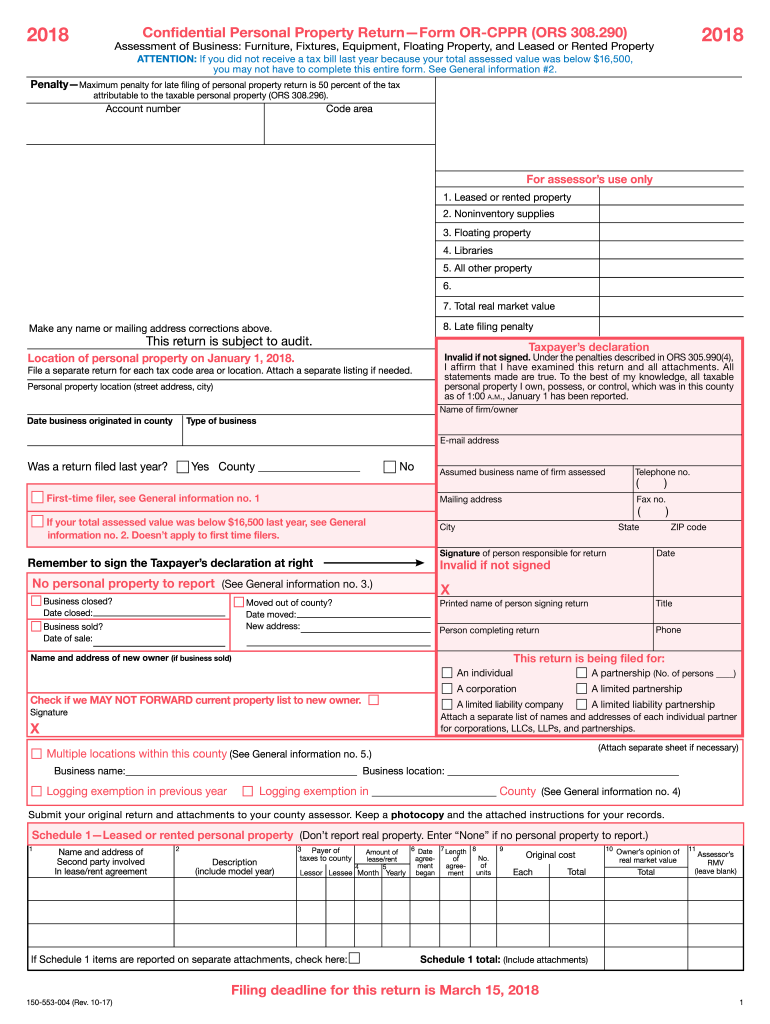
If you did not receive a tax bill last year because your total assessed value was below $16,500, you may not have to complete this entire form. See General information #2. Penalty Maximum penalty for late filing of personal property return is 50 percent of the tax attributable to the taxable personal property (ORS 308.296). Account number Clear this page Code area For assessor s use only 1. Leased or rented property 2. Noninventory supplies 3. Floating property 4. Libraries 5. All other.
Loading

Open form follow the instructions

Easily sign the form with your finger

Send filled & signed form or save
How to use or fill out the OR OR-CPPR online
The Confidential Personal Property Return (OR OR-CPPR) is an essential form for individuals and businesses to report personal property for tax purposes. This guide provides clear and comprehensive instructions on how to complete the form online to ensure compliance and avoid penalties.
Follow the steps to effectively complete the OR OR-CPPR online.
- Click ‘Get Form’ button to obtain the OR OR-CPPR and open it in your editor.
- Begin by entering your account number and code area at the top of the form. Ensure that you make any necessary corrections to your name or mailing address.
- Proceed to fill out the sections pertaining to your business. Include the type of business, the date it originated in the county, and the mailing address. Make sure to indicate whether you filed a return last year.
- Complete the schedules applicable to your situation. Schedule 1 is for leased or rented personal property; Schedule 2 is for noninventory supplies; Schedule 3 is for floating property; Schedule 4 is for professional libraries; and Schedule 5 is for all other taxable personal property.
- Review all information entered for accuracy and completeness. Remember to sign the Taxpayer’s declaration. Confirm that you include all necessary attachments, especially if required by the schedules.
- Submit your completed return and any attachments to your county assessor. It's advisable to keep a photocopy of the return and instructions for your records.
Complete your OR OR-CPPR online today to ensure compliance and avoid penalties.
Experience a faster way to fill out and sign forms on the web. Access the most extensive library of templates available.
Related content
Confidential Personal Property Return—Form OR-CPPR (ORS 308.290). 2025...
Community Behavioral Health Clinics Improve Rural Access to Mental Health Services in...
May 15, 2019 — Poster Presentation at Center for Pharmaceutical. Processing Research...
Get answers to your most pressing questions about US Legal Forms API.
What is an example of personal property?
An example of personal property includes office equipment like computers, furniture, and machinery used in a business setting. These items are distinct from real property, such as land or buildings. Properly classifying and reporting personal property is essential for meeting OR OR-CPPR requirements, and using tools like USLegalForms can simplify the process of declaration.
What is a commercial personal property rendition form?
A commercial personal property rendition form is a document that businesses use to report their personal property to tax authorities. This form requires detailed information about the types and values of assets owned by the business. Filing this form accurately helps ensure compliance with the OR OR-CPPR while also accurately reflecting the business's tax obligations.
What is a business personal property tax example?
An example of a business personal property tax includes taxes assessed on equipment, inventory, and furniture owned by a business. These items are considered personal property and are subject to local tax jurisdiction. Understanding how these items are assessed can aid businesses in adhering to the OR OR-CPPR compliance requirements and help in budgeting for taxes.
What do you need in order to fill out your tax return?
To fill out your tax return, you need various documents including your W-2 or 1099 forms, proof of any deductible expenses, and documents related to other income. Additionally, you'll want to gather information about your dependents and any relevant tax credits. Being organized and prepared makes the process smoother, particularly when following the OR OR-CPPR guidelines.
What does rendition mean in taxes?
In the context of taxes, rendition involves the submission of a detailed declaration of personal property to local taxing authorities. This document is used to determine the property tax owed based on the assessed value. Knowing how rendition functions simplifies tax planning and filing, especially when aligned with the regulations of the OR OR-CPPR framework.
What does rendition mean in business?
In business, rendition refers to the act of reporting personal property to tax authorities. This process ensures that businesses provide accurate assessments of their assets, which is crucial for tax calculations. Understanding the concept of rendition is vital for compliance with the OR OR-CPPR tax requirements, as it helps businesses avoid misunderstandings and potential penalties.
How to fill out Form 7202?
To fill out Form 7202, start by gathering your financial records and identifying the eligible wages for the employee retention credit. Then, complete the form by accurately entering the necessary information about your business and qualifying expenses, ensuring you maintain compliance with the OR OR-CPPR guidelines. If you encounter any difficulties, you may want to consider using platforms like USLegalForms, which offer straightforward instructions and templates tailored for your needs.
How to file taxes for a small business owner?
Filing taxes as a small business owner involves collecting your financial documents and completing the necessary tax forms. Start by determining your business structure, as this impacts your tax obligations. Knowing whether to file as a sole proprietorship, partnership, or corporation is essential for the OR OR-CPPR process. Platforms like uslegalforms can simplify this task by providing tailored guidance to ensure you meet all filing requirements.
Do I have to file a Florida tangible property tax return?
Yes, if you own tangible personal property in Florida, you must file a tangible property tax return. This includes items such as equipment, tools, and furniture used in your business operations. The filing process is typically due by April 1 each year, so timely submissions are essential. Leveraging the services of uslegalforms can facilitate your compliance with the OR OR-CPPR requirements seamlessly.
Who is required to file a tangible personal property tax return?
Generally, businesses that own tangible personal property are required to file a tangible personal property tax return. This requirement often applies to business equipment, machinery, and furniture. Each state has its own rules regarding exemptions, so verifying your local regulations is important. Ensuring compliance with OR OR-CPPR is crucial in avoiding fines and maintaining your business's good standing.
Use professional pre-built templates to fill in and sign documents online faster. Get access to thousands of forms.
If you believe that this page should be taken down, please follow our DMCA take down process here.
This form is available in several versions. Select the version you need from the drop-down list below.