Date This declaration is valid until (shall not be more than three years). If no expiration date is given, this declaration will expire one year after the date that it is signed. Declaration of Representative Under penalties of perjury, I declare that: I am not currently under suspension or disbarment from practice within the state of Ohio or any other jurisdiction; I am aware of the regulations governing my practice in Ohio and the penalties for false or fraudulent statements provid.
Loading

Open form follow the instructions

Easily sign the form with your finger

Send filled & signed form or save
How to fill out the OH TBOR 1 online
The OH TBOR 1 form is essential for individuals or businesses authorizing a representative to act on their behalf in tax matters. This guide provides a comprehensive overview to help users complete the form accurately and efficiently online.
Follow the steps to fill out the OH TBOR 1 form online successfully.
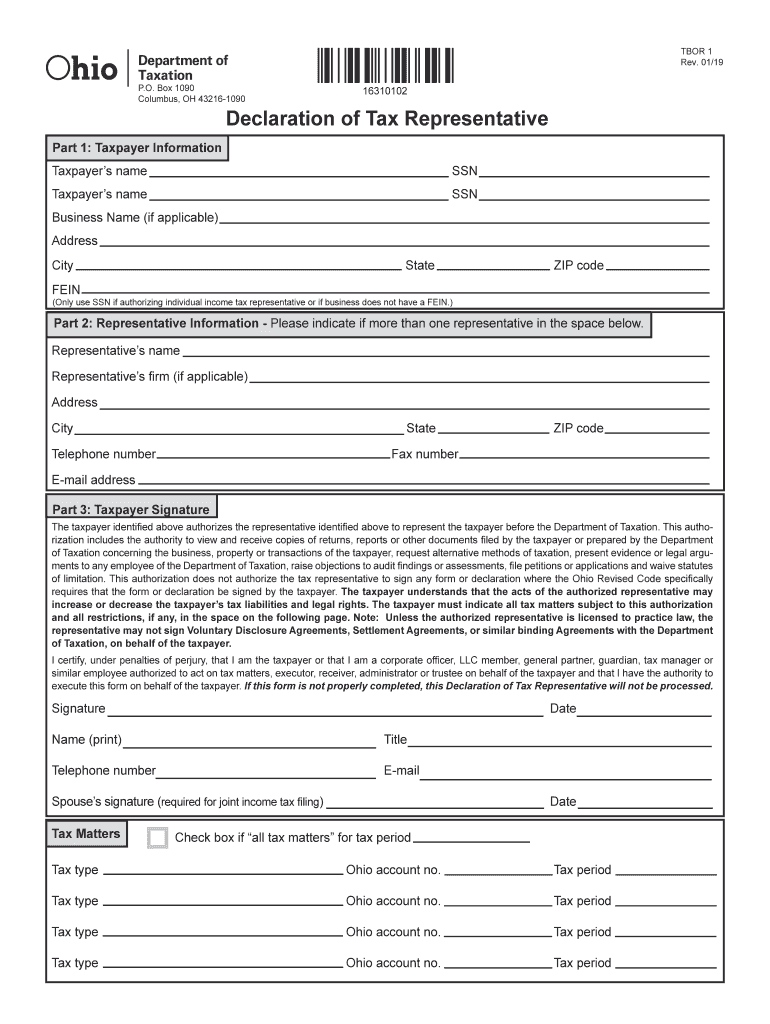
- Press the ‘Get Form’ button to access the OH TBOR 1 form and open it in the editor.
- In Part 1, enter the taxpayer’s name, Social Security Number (SSN), business name (if applicable), address, city, state, ZIP code, and Federal Employer Identification Number (FEIN). Only provide the SSN if authorizing an individual income tax representative or if there is no FEIN.
- In Part 2, provide the representative’s name, firm (if applicable), address, city, state, telephone number, ZIP code, fax number, and email address. If there are multiple representatives, indicate this in the space provided.
- Part 3 requires the taxpayer's signature, confirming they authorize the named representative to act on their behalf before the Department of Taxation. Ensure the signature is dated, and print the name and title of the signer.
- Include the spouse’s signature if filing jointly, and specify all tax matters related to this authorization in the provided space. Indicate if the authorization covers 'all tax matters' for the specified periods and types.
- Provide any restrictions on the declaration, including an expiration date not exceeding three years. If no date is given, the declaration will remain valid for one year.
- In the section for the declaration of the representative, check appropriate boxes to identify the representative’s qualifications and provide the necessary information.
- Upon completion, save the changes. Users may download, print, or share the form as needed.
Complete your forms online for an efficient and simplified process.
Experience a faster way to fill out and sign forms on the web. Access the most extensive library of templates available.
Related content
*Mail: P.O. Box 1090, Columbus, OH 43216-1090. E-mail: TBOR1@tax.state.oh.us. Fax: (206)...
(1) "ST AR Application for Sales/Use Tax Refund," revised May 2016. (2) "TBOR 1...
All single cycle instructions except for program branches which are two cycle. •...
Get answers to your most pressing questions about US Legal Forms API.
What is an Ohio TBOR 1?
The Ohio TBOR 1 is a vital tax form that allows residents to clarify their withholding exemptions for state income taxes. It acts as a guide for taxpayers to determine the right amount to withhold based on their personal financial situation. Make sure to understand the OH TBOR 1 as it impacts your tax liabilities significantly and can help you manage your financial planning effectively.
How to answer 'Are you exempt from withholding'?
To answer the question 'Are you exempt from withholding?', reflect on your previous year's tax status and current financial scenario. If you qualify under the OH TBOR 1 criteria, and have no tax liability expected, then the answer could be 'yes.' However, it's crucial to ensure that you meet all eligibility requirements before providing your response.
How many exemptions should I withhold?
Determining how many exemptions to withhold depends primarily on your financial situation, including dependents and deductions. Many people refer to the OH TBOR 1 to help clarify their options based on their income level. It's essential to strike a balance that minimizes your tax burden while avoiding an end-of-year tax bill.
How should I fill out my tax withholding form?
When filling out your tax withholding form, carefully review your current financial status, including all sources of income. The OH TBOR 1 will guide you on how to determine the right amount to withhold based on your personal circumstances. Ensure that all fields are accurately filled and submit it promptly to avoid any tax complications.
How to fill out a withholding allowance form?
Begin filling out a withholding allowance form by reviewing your financial situation, including adjustments for deductions and dependents. The OH TBOR 1 can provide crucial insights into how many allowances you can claim. After completing your form, provide it to your employer to adjust your withholding accordingly.
How to fill out a tax exemption?
Filling out a tax exemption requires you to gather essential information, such as your income level and any qualifying deductions. Use the OH TBOR 1 as a reference to evaluate your eligibility for specific exemptions. Follow the instructions carefully on the form, and submit it to the appropriate tax authority to reduce your taxable income.
How to fill out a withholding exemption form?
To fill out a withholding exemption form, start by locating the form aimed specifically at your state’s requirements. Ensure you have your personal details ready, including your Social Security number and filing status. For Ohio, you must reference the OH TBOR 1 guidelines to determine your appropriate exemptions. Once completed, submit your form to your employer for processing.
Why would the Ohio Department of Taxation send me a letter?
The Ohio Department of Taxation might send you a letter for various reasons, including clarifications on tax filings, reminders of payments due, or updates on your account status. These letters serve as a method to communicate vital information that could impact your financial obligations. Staying informed through these communications is essential for managing your tax responsibilities.
Why am I getting a certified letter from the Ohio Department of Taxation?
Receiving a certified letter from the Ohio Department of Taxation often indicates that there are pressing financial matters that need your attention. This letter could inform you of discrepancies in your tax filings or outstanding taxes owed. Engaging in a timely manner can help mitigate any potential legal or financial consequences related to these issues.
Why would I get a certified letter from the Ohio Department of Taxation?
You might receive a certified letter from the Ohio Department of Taxation due to unresolved tax issues, upcoming audits, or if you owe taxes. This method of communication emphasizes the urgency and importance of the contents of the letter. It's crucial to respond swiftly to these letters to maintain compliance and avoid further penalties.
Use professional pre-built templates to fill in and sign documents online faster. Get access to thousands of forms.
If you believe that this page should be taken down, please follow our DMCA take down process here.
This form is available in several versions. Select the version you need from the drop-down list below.