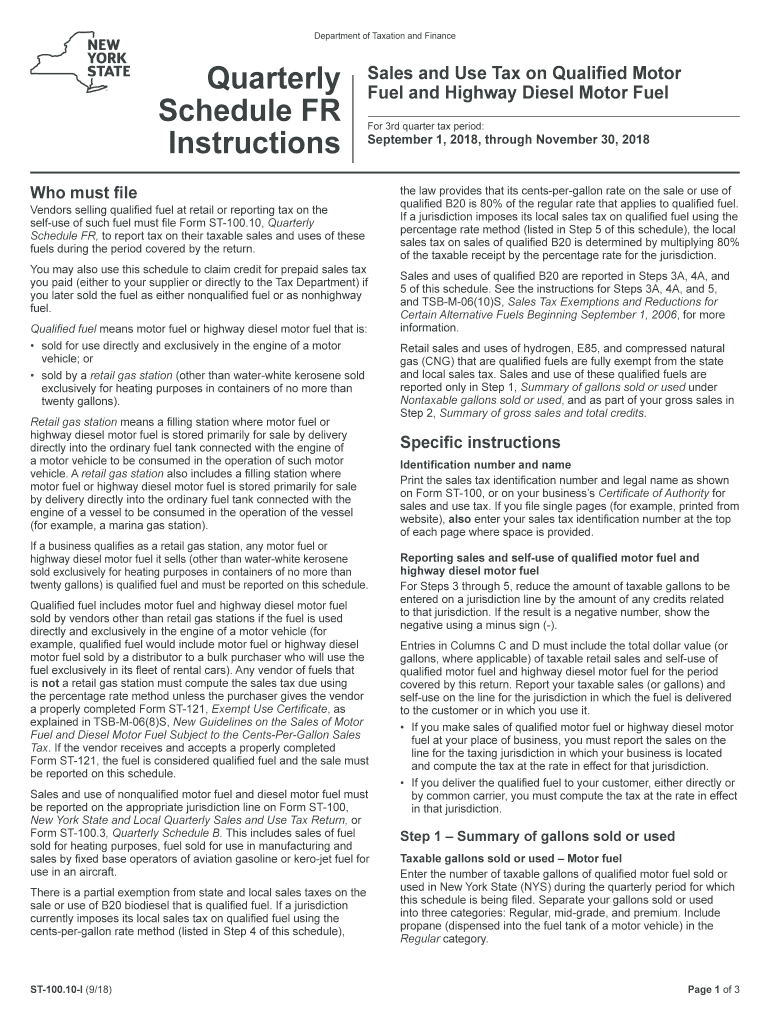
Vember 30, 2018 Who must file Vendors selling qualified fuel at retail or reporting tax on the self use of such fuel must file Form ST 100.10, Quarterly Schedule FR, to report tax on their taxable sales and uses of these fuels during the period covered by the return. You may also use this schedule to claim credit for prepaid sales tax you paid (either to your supplier or directly to the Tax Department) if you later sold the fuel as either nonqualified fuel or as nonhighway fuel. Qualif.
Loading

Open form follow the instructions

Easily sign the form with your finger

Send filled & signed form or save
How to fill out the NY DTF ST-100.10-I online
The NY DTF ST-100.10-I is a crucial form for vendors selling qualified motor fuel at retail or reporting tax on the self-use of such fuel. Filling it out correctly ensures compliance with New York State tax regulations for the specified quarterly period.
Follow the steps to effectively complete the form.
- Press the ‘Get Form’ button to obtain the form and open it in your preferred online editor.
- Identify yourself by entering your sales tax identification number and legal name as displayed on Form ST-100 or your business’s Certificate of Authority for sales and use tax.
- In Step 1, summarize the gallons sold or used by entering numbers into the appropriate categories: Regular, mid-grade, and premium motor fuel. Make sure to include any propane dispensed into the fuel tank of a motor vehicle in the Regular category.
- Continue to Step 2, where you will provide the total dollar amount of gross sales made for all types of qualified motor fuel and highway diesel motor fuel, ensuring to include exempt sales in this calculation.
- Proceed to Step 3, where you will calculate the New York State/MCTD tax by entering the total number of gallons sold or removed from inventory for qualified motor fuel and highway diesel motor fuel.
- In Step 4, calculate local sales tax by jurisdiction using the cents-per-gallon rate method. Enter the total number of gallons sold or removed and apply the local sales tax rate.
- Move to Step 5 to calculate local sales tax by jurisdiction using the percentage rate. Report taxable sales and self-use amounts according to the current local sales tax percentage.
- In Step 6, you will calculate tax adjustments, taking into account any credits for prepaid sales tax and any refunds you have requested.
- Lastly, complete Step 7 if you sold or used any fuel that is not qualified fuel, and file the completed Form ST-100.10 along with Form ST-100 by the due date.
- Once all fields are filled accurately, save your changes, and proceed to download, print, or share the completed form as needed.
Complete your documents online today to ensure timely and accurate filing.
Experience a faster way to fill out and sign forms on the web. Access the most extensive library of templates available.
Related content
May 27, 2025 — Quarterly filer forms (Form ST-100 series) 1st quarter: March 1, 2025...
by FG Garcia · 1995 — In June of 199514, the formula was changed to represent a...
Get answers to your most pressing questions about US Legal Forms API.
Do I have to file an estate tax return in NY?
Yes, filing an estate tax return in New York is required if the estate exceeds the established threshold. The appropriate form to file is the NY DTF ST-100.10-I. To ensure accuracy and compliance, consider using tools and resources designed to help you navigate New York’s estate tax landscape, such as those offered by uslegalforms.
Do I have to file a tax return for an estate account?
Yes, if the estate generates income or meets the threshold for New York estate tax, filing a tax return is necessary. The NY DTF ST-100.10-I form must be submitted to report estate tax liabilities. It's advisable to keep thorough records and consult with a tax expert to navigate this process effectively.
What triggers an estate tax return?
An estate tax return is triggered when the total value of an estate exceeds the New York threshold of $6.11 million. Additionally, certain types of transfers or unique situations may also necessitate filing the NY DTF ST-100.10-I form. It’s crucial to assess the estate's value carefully and consult with tax professionals to ensure compliance.
What is the threshold for NY estate tax?
As of 2023, the threshold for New York estate tax is $6.11 million. If the value of the estate exceeds this amount, filing the NY DTF ST-100.10-I is necessary. This threshold allows estates below this value to avoid tax obligations, simplifying the process for smaller estates.
What is ST100?
ST100 refers to the New York State DTF ST-100.10-I form, which is used for reporting estate tax related to the transfer of assets. This form helps ensure compliance with New York estate tax laws and facilitates the calculation of taxes owed. Understanding the ST100 form is essential for anyone managing an estate in New York.
Does New York State require e-file?
Yes, New York State requires many taxpayers to e-file their returns, including the NY DTF ST-100.10-I form. E-filing is generally faster and more secure, allowing for quicker processing of your estate tax return. Using e-filing can also help reduce errors, as the software often provides helpful prompts and checks.
What are the sales tax quarters in NY?
In New York, the sales tax quarters align with the calendar year, split into four segments. Each quarter consists of three months – thus, January to March, April to June, July to September, and October to December. Utilizing the NY DTF ST-100.10-I can simplify reporting across these quarters.
What is a NY city tax warrant?
A NY city tax warrant is a legal document issued to collect unpaid taxes owed to New York City. This warrant allows the city to take enforcement actions, including garnishing wages or seizing property. Understanding your tax responsibilities, including those related to the NY DTF ST-100.10-I, helps prevent such issues.
What is a ST-100?
The ST-100 is a sales tax return form required by New York for reporting sales tax collected by businesses. This form allows businesses to detail their tax liabilities and make remittances to the state. Ensuring accurate completion of the NY DTF ST-100.10-I is crucial for avoiding penalties.
What is NYC Department of Finance transfer tax?
The NYC Department of Finance transfer tax is a tax imposed on the transfer of real property within New York City. This tax applies to the sale of real estate and is typically assessed at the time of the sale. Understanding your obligations, including those related to the NY DTF ST-100.10-I, is essential for property transactions.
Use professional pre-built templates to fill in and sign documents online faster. Get access to thousands of forms.
If you believe that this page should be taken down, please follow our DMCA take down process here.
This form is available in several versions. Select the version you need from the drop-down list below.