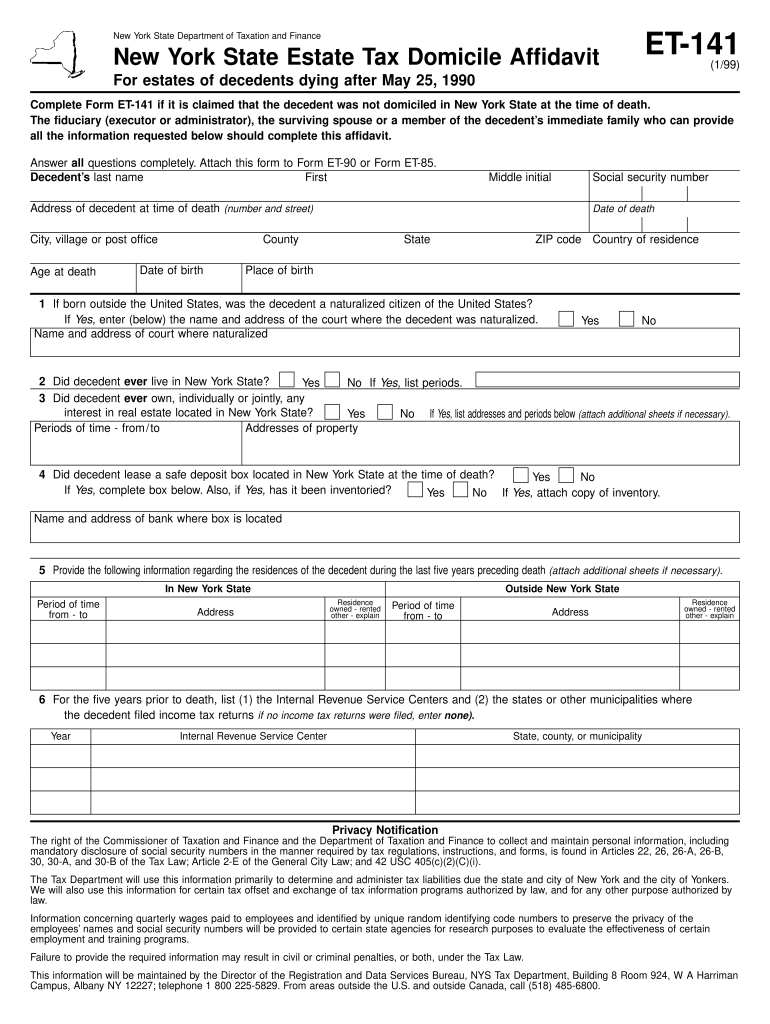
E provided to certain state agencies for research purposes to evaluate the effectiveness of certain employment and training programs. Failure to provide the required information may result in civil or criminal penalties, or both, under the Tax Law. This information will be maintained by the Director of the Registration and Data Services Bureau, NYS Tax Department, Building 8 Room 924, W A Harriman Campus, Albany NY 12227; telephone 1 800 225-5829. From areas outside the U.S. and outside Canada,.
Loading

Open form follow the instructions

Easily sign the form with your finger

Send filled & signed form or save
How to fill out the NY DTF ET-141 online
The New York State Department of Taxation and Finance requires the completion of Form ET-141 for estates claiming that the decedent was not domiciled in New York State at the time of death. This guide will provide you with comprehensive instructions on how to fill out this form accurately and effectively online.
Follow the steps to complete the NY DTF ET-141 online.
- Use the ‘Get Form’ button to access the online version of the form and open it in your web browser.
- Begin by entering the decedent's last name, first name, and middle initial in the appropriate fields. This information is crucial for identifying the estate.
- Fill in the social security number of the decedent to ensure accurate records are kept.
- Next, provide the address of the decedent at the time of death, including the number and street, city or village, state, ZIP code, and country of residence.
- List the age at death, date of death, date of birth, and place of birth. This data helps establish the timeline of the decedent's life.
- Indicate whether the decedent was a naturalized citizen if born outside the United States. If yes, enter the name and address of the court where the decedent was naturalized.
- Answer the question regarding whether the decedent ever lived in New York State. If yes, document the periods of residence.
- Indicate if the decedent owned any real estate in New York State, providing addresses and periods of ownership as necessary.
- State whether the decedent leased a safe deposit box in New York State at the time of death. If yes, complete the supplementary box with bank details.
- Provide information about the decedent's residences over the last five years, noting periods of time and whether they were owned or rented.
- List any IRS Centers and states where the decedent filed income tax returns for the five years prior to death.
- Include details about the states where the decedent was registered to vote in the last five years.
- Document any employment or business activities, detailing periods of engagement in New York State and outside of it.
- Answer questions about any legal proceedings or licenses held by the decedent during their lifetime.
- Provide any additional information that supports the claim that the decedent was not domiciled in New York State.
- Finally, complete the applicant’s information section, including the relationship to the decedent, and ensure all statements are accurate. Sign and date the form.
- After completing all sections, save changes, and utilize options to download, print, or share the completed form as required.
Begin the process of completing your documents online today.
Experience a faster way to fill out and sign forms on the web. Access the most extensive library of templates available.
Related content
Oct 2, 2024 — ET-141, Instructions on form, New York State Estate Tax Domicile Affidavit...
by GB Born · Cited by 82 — The New York Convention. 141 obligations enforceable in...
This manual provides information essential for persons who have the responsibility to...
Get answers to your most pressing questions about US Legal Forms API.
Do all estates have to file form 706?
Not all estates must file Form 706, also known as the Federal Estate Tax Return. Filing is required only if the gross estate exceeds the federal threshold, currently set at $12.92 million. However, New York estate tax rules differ, so the NY DTF ET-141 may clarify whether you need to file.
Do I have to file an estate tax return in NY?
Yes, you must file an estate tax return in New York if the estate's value exceeds the state's estate tax threshold. This process involves using Form ET-706 to report the value and taxes owed. Make sure to check if the NY DTF ET-141 applies to your situation for an accurate understanding of your tax obligations.
Do I need to file an estate tax return in NY?
In New York, you generally need to file an estate tax return if the estate exceeds a certain value, which is currently set at $6.58 million. Filing is done using Form ET-706, and there may be applicable exemptions. The NY DTF ET-141 may also be relevant in determining tax liabilities.
Do I have to file a NY nonresident return?
Yes, if you are a nonresident earning income from New York sources, you must file a New York nonresident tax return. Specifically, you would complete Form IT-203 for this purpose. It’s crucial to understand your tax obligations, and utilizing the NY DTF ET-141 can help clarify your filing requirements.
Do I have to file a tax return for an estate account?
Filing a tax return for an estate account is necessary if the estate generates income. If the estate earns more than $600 during the tax year, you must file a return. The IRS requires Form 1041 to report this income, and the NY DTF ET-141 may also apply in certain situations.
Where can I get NYS tax forms?
You can access NYS tax forms directly from the New York Department of Taxation and Finance website. They provide downloadable forms and instructions for various tax needs, including those for the DTF ET-141. Additionally, local post offices or tax assistance centers may carry physical copies of these forms. Being familiar with where to find and submit these forms will streamline your tax processes.
How long does it take to get a certificate of authority in NY?
The time it takes to obtain a certificate of authority in New York can vary, but you can generally expect a processing time of approximately two to four weeks. It is essential to submit all required documentation accurately to avoid delays. Once issued, this certificate enables you to collect sales tax and carry out business activities legally. Ensure you maintain good standing with your DTF ET-141 submissions for smooth operations.
How do I get a New York State withholding account number?
You can get a New York State withholding account number by registering your business with the New York Department of Taxation and Finance online or via mail. You will need to complete the proper application, which often asks for basic information about your business. Once your application is processed, you will receive your withholding account number. This number is crucial for accurate completion of the DTF ET-141.
How do I find my state withholding number?
You can find your state withholding number on your tax registration certificate or your previous tax filings with the New York Department of Taxation and Finance. If you cannot locate it, you may call their office for assistance. Additionally, if you've registered for payroll services, your provider might have this number available. Keeping a record of your DTF ET-141 submission is also helpful for future reference.
Who provides a tax clearance certificate?
A tax clearance certificate is provided by the tax authority of your state, such as the New York Department of Taxation and Finance. You can request this certificate after filing your taxes and settling any outstanding obligations. It serves as proof that your business has complied with state tax regulations. Having this certificate is beneficial when processing forms like the DTF ET-141.
Use professional pre-built templates to fill in and sign documents online faster. Get access to thousands of forms.
If you believe that this page should be taken down, please follow our DMCA take down process here.
This form is available in several versions. Select the version you need from the drop-down list below.