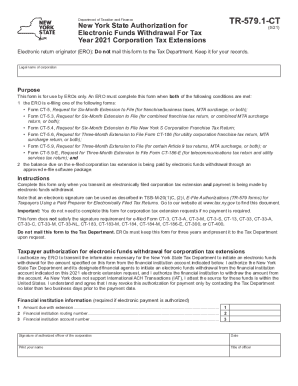
: Do not mail this form to the Tax Department. Keep it for your records. Legal name of corporation Purpose This form is for use by EROs only. An ERO must complete this form when both of the following conditions are met: 1 the ERO is e-filing one of the following forms: Form CT-5, Request for Six-Month Extension to File (for franchise/business taxes, MTA surcharge, or both); Form CT-5.3, Request for Six-Month Extension to File (for combined franchise tax return, or combined MTA surcha.
Open form follow the instructions
Easily sign the form with your finger
Send filled & signed form or save
How to fill out the NY TR-579.1-CT online
Filling out the NY TR-579.1-CT is essential for electronic return originators (EROs) handling corporation tax extensions in New York. This guide provides a clear, step-by-step process to successfully complete the form online, ensuring you meet all requirements and accurately provide necessary information.
Follow the steps to complete the NY TR-579.1-CT form online.
- Click the ‘Get Form’ button to acquire the form, which will open it in the editing interface.
- Provide the legal name of the corporation in the designated field at the top of the form, ensuring accuracy to avoid processing delays.
- Indicate whether your organization is e-filing any of the specified forms listed within the instructions. This determines the necessity of completing the remainder of the form.
- Enter the amount due with the extension in the specified field. This should reflect the total amount for which the electronic funds withdrawal is authorized.
- Fill in the financial institution routing number. This is necessary for the transaction to initiate correctly.
- Input the financial institution account number from which the funds will be withdrawn. Ensure this information is accurate for successful processing.
- Have an authorized officer of the corporation sign and date the form in the designated signature section to validate the authorization for electronic funds withdrawal.
- Print the name and title of the signing officer to confirm their role within the organization.
- Once the form is completed, you can save any changes made to the document, download it for your records, or share it with relevant parties as necessary.
Complete your documents online with confidence and ensure timely filing of your corporation tax extensions.
Experience a faster way to fill out and sign forms on the web. Access the most extensive library of templates available.
Related content
Nov 7, 2019 - TR-579.1-CT, New York State Authorization for Electronic Funds ... For...
†Carl Sandburg, “Notes for Preface,” in Harvest Poems (New York: Harcourt ..... In A...
... 0.0585, 0.1372, CD5 antigen-like precursor (SP-alpha) (CT-2) (IgM-associated peptide)...
Get answers to your most pressing questions about US Legal Forms API.
What is CT 2210?
CT-2210. Underpayment of Estimated Income Tax by Individuals, Trusts, and Estates.
Are you claiming full exemption from federal tax withholding?
Claiming Exemption from Withholding. You can claim an exemption from tax withholding if you had no income tax liability last year and expect the same this year. Submit a new W-4 to your payroll contact to claim the exemption, and federal income tax will not be withheld from your wages.
Does CT tax military pay?
TAXABILITY OF MILITARY PAY FOR RESIDENTS: If you are a Connecticut resident, your military pay or your military pension is subject to Connecticut income tax. Your military pay or pension is taxable on your Connecticut return in the same way that is it taxable on your federal return.
What is the Msrra exemption?
The MSRRA also exempts non-business personal property (most often automobiles) from taxation in the non-domiciliary State when the property is titled in the spouse's name or jointly with the spouse and SM. ... The MSRRA should make it easier for the spouse to vote in the domiciliary State by absentee ballot.
What is Msrra exemption CT?
Effective January 1, 2016. Withholding Codes (Form CT-W4) Married Filing Jointly. Withholding Code. Our expected combined annual gross income is less than or equal to $24,000 or I am claiming exemption under the Military Spouses Residency Relief Act (MSRRA) * and no withholding is necessary.
Do I have to file state taxes if I had no income?
Income requirements Even if you earned income last year, if it falls below the IRS minimum you don't have to file a tax return. ... If you have no income, however, you aren't obligated to file.
What determines residency in CT?
A part-year resident's total income during his or her period of residency and his or her Connecticut source income during his period of nonresidency are subject to Connecticut income tax. (Connecticut source income of a nonresident is defined in the instructions to Form CT-1040NR/PY.) ... That is your CT source income.
What is taxable income in CT?
Connecticut Median Household Income If you are single or married and filing separately, the tax rate is 3% for those who make $10,000 or less in taxable income; 5% for up to $50,000; 5.5% for up to $100,000; 6% for up to $200,000; 6.5% for up to $250,000; 6.9% for up to $500,000 and 6.99% for over $500,000.
When can you file CT state taxes?
Connecticut Income Taxes and CT State Tax Forms. Connecticut State Income Tax Return forms for Tax Year 2018 (Jan. 1 - Dec. 31, 2018) can be e-Filed in conjunction with an IRS Income Tax Return until October 15, 2019. In January 2020, you can e-File Tax Year 2019.
Do I have to file state taxes in Connecticut?
You must file a Connecticut income tax return if your gross income for the taxable year exceeds: $12,000 and you are married filing separately; $15,000 and you are filing single; $19,000 and you are filing head of household; or.
Use professional pre-built templates to fill in and sign documents online faster. Get access to thousands of forms.
If you believe that this page should be taken down, please follow our DMCA take down process here.
This form is available in several versions. Select the version you need from the drop-down list below.