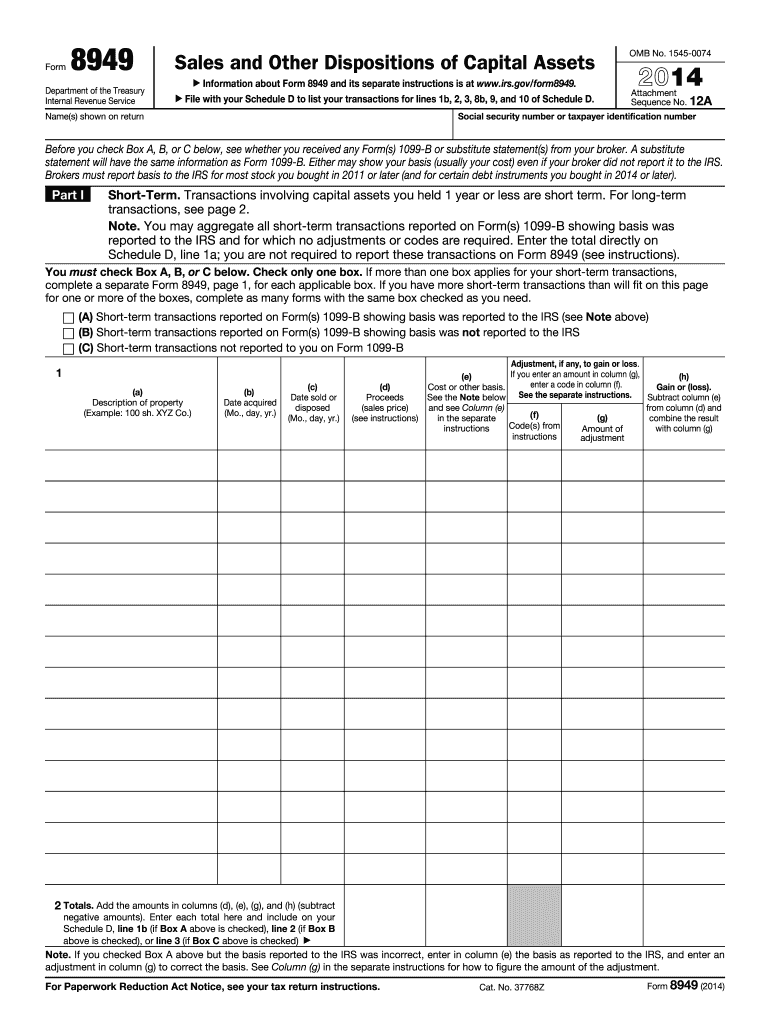
Return. Name and SSN or taxpayer identification no. not required if shown on other side Page 2 Social security number or taxpayer identification number Before you check Box D, E, or F below, see whether you received any Form(s) 1099-B or substitute statement(s) from your broker. A substitute statement will have the same information as Form 1099-B. Either may show your basis (usually your cost) even if your broker did not report it to the IRS. Brokers must report basis to the IRS for most stoc.
Loading

Open form follow the instructions

Easily sign the form with your finger

Send filled & signed form or save
How to fill out the IRS 8949 online
The IRS 8949 form is essential for reporting sales and other dispositions of capital assets. This guide provides comprehensive, step-by-step instructions to help users complete the form accurately and efficiently online.
Follow the steps to fill out the IRS 8949 online.
- Use the ‘Get Form’ button to access the IRS 8949 form and open it within your online editor.
- Enter your social security number or taxpayer identification number in the designated field at the top of the form.
- Provide your name and the names of any partners as shown on your tax return.
- Determine which box to check (A, B, or C) for your short-term transactions, depending on whether you received a Form 1099-B or a substitute statement from your broker.
- For each short-term transaction, complete the following fields: (a) Description of property, (b) Date acquired, (c) Date sold or disposed, (d) Proceeds, (e) Cost or other basis, (f) Code(s) for adjustments, and (g) Adjustment amount.
- Total the amounts in columns (d), (e), (g), and (h) and enter these totals in the appropriate lines of your Schedule D, as indicated on the form.
- Repeat steps 4-6 for long-term transactions, checking Box D, E, or F as applicable.
- If necessary, adjust any basis reported incorrectly, entering the reported basis in column (e) and the adjustment in column (g) for correction.
- Once all sections are completed, save your changes, and download, print, or share your form as needed.
Complete your IRS 8949 form online today to ensure accurate reporting of your capital asset transactions.
Experience a faster way to fill out and sign forms on the web. Access the most extensive library of templates available.
Related content
Jan 23, 2025 — Use Form 8949 to reconcile amounts that were reported to you and the IRS...
Mar 8, 2024 — A taxpayer who sells cryptocurrency owned for more than one year must file...
Form 1099-CAP is sent when a corporation's stock has a change in control or capital...
Get answers to your most pressing questions about US Legal Forms API.
Do I have to report the sale of inherited property to the IRS?
Yes, you must report the sale of inherited property to the IRS. It is essential to complete IRS form 8949 for your sale transactions to comply with tax regulations. Proper reporting helps ensure that you accurately capture any gains or losses, reducing the risk of potential audits.
Is selling inherited property considered income?
Selling inherited property is not considered regular income; rather, it is seen as a capital transaction. You must report any gains from the sale on IRS form 8949. Generally, the gain is calculated based on the step-up in basis, which means you may avoid taxation on any appreciation that occurred during the deceased owner's lifetime.
What is the IRS form 8949 for?
IRS form 8949 is used for reporting capital gains and losses from sales of investments, including inherited property. This form separates sales based on whether you held the asset long-term or short-term. By completing form 8949, you provide the IRS with a detailed account of your transactions, helping ensure accuracy in your tax reporting.
Does TurboTax automatically file the 8949?
TurboTax does offer features to help you file IRS form 8949 automatically, but it depends on how you input your information. By accurately entering your transactions, TurboTax calculates and fills out form 8949 for you. This can simplify your filing process, ensuring you comply with tax laws when reporting capital gains from sales.
Do you get a 1099 when you sell an inherited house?
When you sell an inherited house, you generally do not receive a 1099 form, as the sale of inherited property is not classified as ordinary income. Instead, your responsibility is to report the sale on IRS form 8949. This form will help you detail the sale and any gains or losses based on the step-up in basis at inheritance.
Should I use Schedule D or form 8949?
When reporting capital gains and losses, you will typically need to use both Schedule D and IRS form 8949. Form 8949 details individual sales, while Schedule D summarizes your overall capital gains and losses. Make sure to report each sale accurately on form 8949 to provide an accurate snapshot of your transactions, before summarizing with Schedule D.
How are capital gain distributions reported?
Capital gain distributions are typically reported on your Form 1099-DIV, which you receive from your investment firm. You will then summarize these gains on the IRS 8949 form and include them on Schedule D. This reporting method allows the IRS to track your taxable investment income accurately. Using platforms like US Legal Forms can simplify the reporting process and ensure compliance.
Who is not required to file Schedule D?
Certain taxpayers may not need to file Schedule D, such as those who only have capital gains distributions reported on their Form 1099-DIV. If your capital gains fall below a specific threshold or if you have no transactions to report, you may be exempt from filing this schedule. However, clarity on these requirements is essential, and consulting with resources from US Legal Forms can assist in determining your obligations.
Is Schedule D required for capital gain distributions?
Yes, Schedule D is essential for reporting capital gain distributions. This form provides a comprehensive overview of your capital transactions and is designed to complement the IRS 8949 form. By using these forms together, you ensure that all your capital gains are reported correctly, enhancing your tax return's accuracy. Our platform can guide you through completing these forms efficiently.
Do I have to report form 8949 on my tax return?
Absolutely, you must include the IRS 8949 form with your tax return. It serves as a detailed record of your capital gains and losses, which are vital for calculating your overall tax liability. By submitting this form, you contribute to an accurate filing, which can help in avoiding audits and penalties. Remember, the IRS requires proper documentation for all reported income.
Use professional pre-built templates to fill in and sign documents online faster. Get access to thousands of forms.
If you believe that this page should be taken down, please follow our DMCA take down process here.
This form is available in several versions. Select the version you need from the drop-down list below.