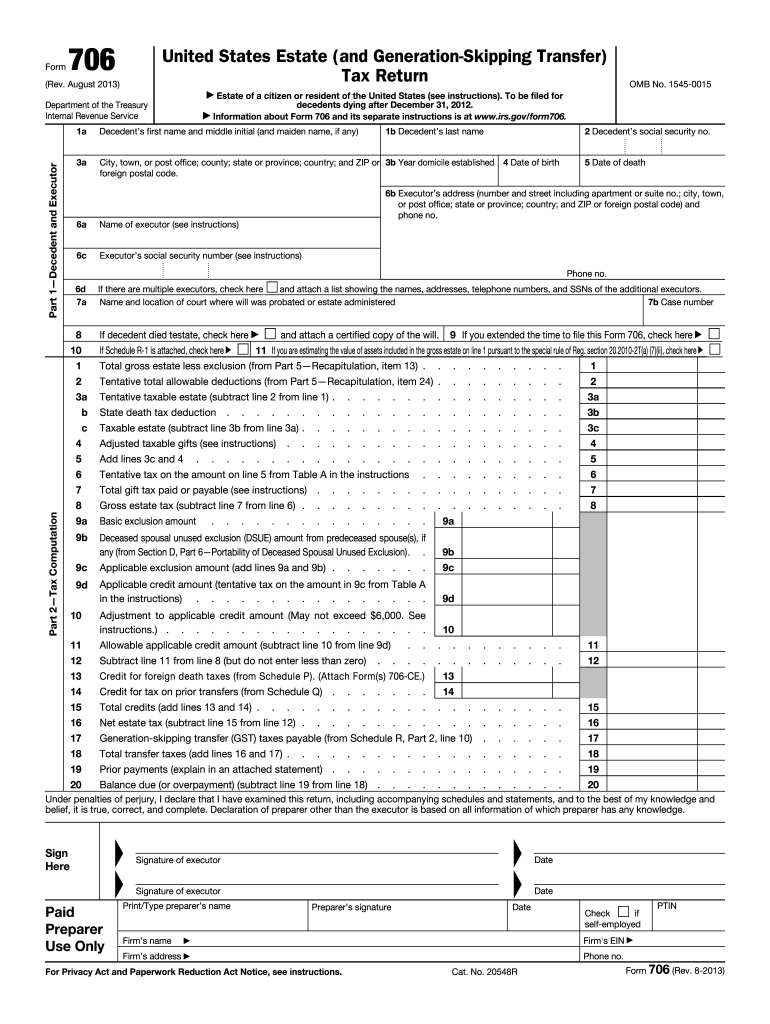
. . . . . . . . . . . 9d 11 Adjustment to applicable credit amount (May not exceed $6,000. See instructions.) . . . . . . . . . . . . . . . . . . Allowable applicable credit amount (subtract line 10 from line 9d) . . . . . . . . . 11 12 13 14 15 16 17 Subtract line 11 from line 8 (but do not enter less than zero) . . . . . . . Credit for foreign death taxes (from Schedule P). (Attach Form(s) 706-CE.) 13 Credit for tax on prior transfers (from Schedule Q) . . . . . . . 14 Total cr.

Open form follow the instructions

Easily sign the form with your finger

Send filled & signed form or save
How to fill out the IRS 706 online
Filing the IRS 706, also known as the United States Estate (and Generation-Skipping Transfer) Tax Return, can seem daunting, but this guide will support you through each step of filling it out online. This guide aims to provide clear and concise instructions to assist users with varying levels of experience.
Follow the steps to complete the IRS 706 online.
- Click ‘Get Form’ button to obtain the form and open it in the editor.
- Begin by entering the decedent's information in Part 1. Complete fields including first name, last name, Social Security number, date of birth, and date of death. Ensure accuracy as these are essential for tax computation.
- Provide information about the executor, including their name, address, and Social Security number in the specified fields. If there are multiple executors, indicate this by checking the corresponding box.
- In Part 2, compute the estate tax by completing the relevant calculations. Enter the total gross estate value, tentative deductions, and applicable exclusions.
- Proceed to Part 3 where elections by the executor are outlined. Select applicable options such as alternate or special-use valuation by checking 'Yes' or 'No' as required.
- Move to Part 4, which contains general information about the decedent and their estate. Attach necessary documents such as the death certificate as stated in the instructions.
- Continue filling out the Recapitulation in Part 5. You will summarize the total gross estate and deductions, which will incorporate inputs from various schedules.
- Complete Schedule A through Schedule O as needed, providing detailed information about real estate, stocks, gifts, and other relevant sections.
- Finally, review all entered information for accuracy. Save your changes, then download, print, or share the completed form as required.
Start your online filing today and ensure a smooth submission process for the IRS 706.
Experience a faster way to fill out and sign forms on the web. Access the most extensive library of templates available.
Related content
May 23, 2025 — The executor of a decedent's estate uses Form 706 to figure the estate...
They are allowable as an income tax deduction on Form 1041, U.S. Income Tax Return for...
Form 706 to transfers taking effect at applicable.) If you filed gift tax returns for...
Get answers to your most pressing questions about US Legal Forms API.
What assets are not subject to estate tax?
Certain assets are exempt from the estate tax, including life insurance proceeds if the surviving spouse is the beneficiary and assets in a qualified retirement plan. Additionally, any gifts made during the decedent's lifetime that fall under annual exclusions are also typically excluded. Understanding the intricacies of these tax regulations is essential for effective estate planning.
What should be attached to form 706?
When filing the IRS 706, you must attach several documents including a complete inventory of the estate, appraisals of property, and the decedent's death certificate. It is crucial to include any relevant documents that demonstrate the value of the estate to minimize complications during the review process. Platforms like US Legal Forms can help guide you through this.
Do I have to report the sale of inherited property to the IRS?
Yes, the sale of inherited property must be reported to the IRS, but you may benefit from a step-up in basis. This means that the property’s value is adjusted to its fair market value on the date of inheritance, potentially lowering your tax liability. Be sure to keep thorough records of the sale for accurate reporting.
What are the filing requirements for form 706?
Form 706 is required when an estate has a gross value that surpasses the IRS threshold for exemption. Executors must ensure the form is accurately completed and submitted to the IRS within nine months after the decedent’s death. Utilizing platforms like US Legal Forms can help create and manage these documents effectively.
What is the exemption amount for form 706?
As of now, the IRS 706 exemption amount is $12.06 million. This means estates valued below this limit are not subject to federal estate tax. It’s essential to keep updated with IRS regulations, as this exemption can change due to legislative adjustments.
What are the IRS rules for surviving spouse after death?
The IRS allows a surviving spouse to receive significant benefits regarding the estate. For instance, if the estate is substantial, the surviving spouse can take advantage of the unlimited marital deduction, meaning they do not owe taxes on property transferred to them. This provision is beneficial for the surviving spouse and can ease financial burdens during a challenging time.
What are the filing requirements for the estate tax return 706?
The IRS 706 must be filed for estates exceeding a certain value, which as of now is $12.06 million. If the estate meets this threshold, it requires the executor to file the return within nine months of the decedent's death. Extensions may be available if you need additional time to gather necessary documentation.
Who prepares Form 706?
Typically, an attorney, accountant, or the estate executor prepares Form 706. This preparation requires detailed knowledge of estate laws and the specific financial situation of the deceased. To streamline this task, consider using resources such as US Legal Forms, which provide templates and guidance to simplify the process of preparing IRS Form 706 efficiently.
Who is responsible for filing Form 706?
The executor or personal representative of the estate is responsible for filing Form 706. This individual must ensure all necessary information is reported accurately and submitted in a timely manner. This role can be complex, so seeking assistance from legal or tax professionals, or leveraging tools from US Legal Forms, may ease the process. They can guide you in meeting your filing obligations.
Who must file IRS Form 706?
IRS Form 706 must be filed by the executor if the estate exceeds a specific threshold. This form is required for estates in the U.S. that have a gross value surpassing the estate tax exemption limit. Understanding the parameters of this obligation can be challenging, but services like US Legal Forms offer valuable resources to help you navigate these requirements effectively.
Use professional pre-built templates to fill in and sign documents online faster. Get access to thousands of forms.
If you believe that this page should be taken down, please follow our DMCA take down process here.
This form is available in several versions. Select the version you need from the drop-down list below.