Tions, places, amounts, dates, and the nature of any evidence or documentation (who, what, where, when, how). Include the names of other organizations, entities or persons that may be involved with the organization, providing EINs or SSNs, if available. 5. Submitter information: Provide your name, address, and business or occupation. Include your daytime telephone number, in case we wish to contact you. The acknowledgement letter will be sent to the address you provide. If you are concerned that.
Loading

Open form follow the instructions

Easily sign the form with your finger

Send filled & signed form or save
How to fill out the IRS 13909 online
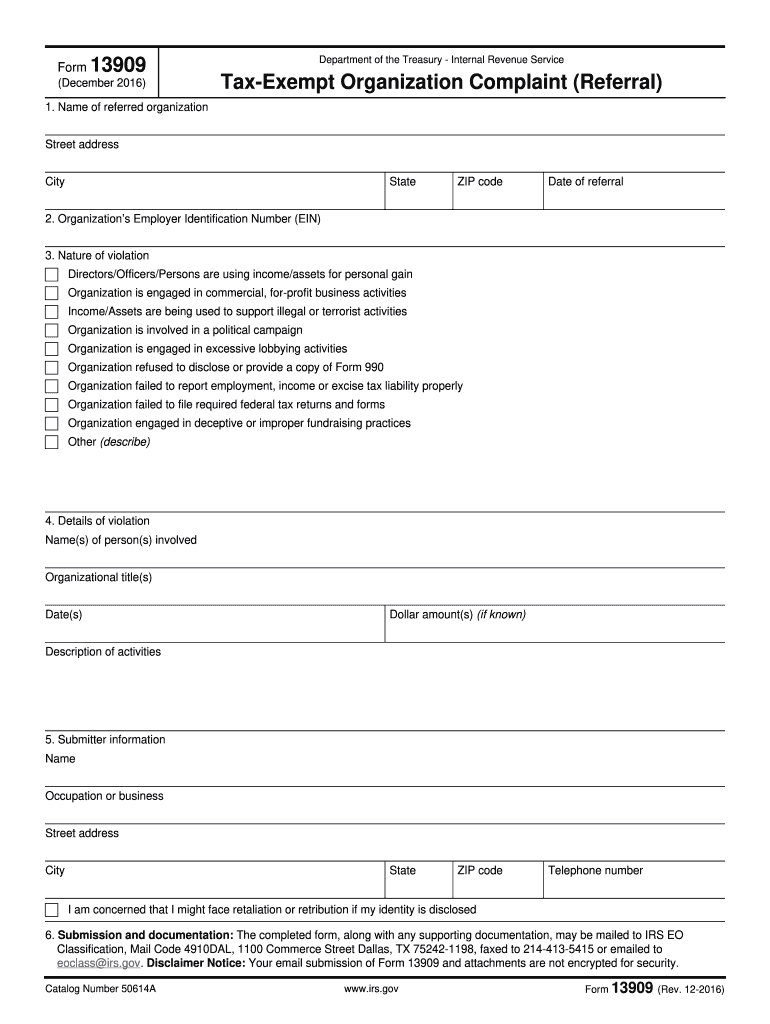
The IRS 13909 form, also known as the Tax-Exempt Organization Complaint (Referral), is used to report potential violations of federal tax laws by tax-exempt organizations. Filling out this form online is a streamlined process that allows individuals to report issues efficiently.
Follow the steps to complete the IRS 13909 form online
- Click ‘Get Form’ button to access the form and open it in your chosen online platform.
- Enter the name of the referred organization along with the street address, city, state, and ZIP code in the appropriate fields.
- Provide the organization’s Employer Identification Number (EIN). If this number is not available, you may include a state nonprofit corporation registration number, if applicable.
- Select the nature of the violation from the list provided. More than one option may be selected, or you can describe the issue under ‘Other’ if none of the descriptions apply.
- In the details of violation section, include specific information such as the names of individuals involved, their organizational titles, the dates of the alleged activities, dollar amounts if known, and a comprehensive description of the activities.
- Fill in your submitter information, which includes your name, occupation, address, city, state, ZIP code, and telephone number. If you are concerned about potential retaliation, check the corresponding box to protect your identity.
- Lastly, submit the completed form and any supporting documentation. You can choose to mail, fax, or email the form, ensuring to include a cover letter describing any additional documentation.
Complete your IRS 13909 form online today to report any compliant issues efficiently.
Experience a faster way to fill out and sign forms on the web. Access the most extensive library of templates available.
Related content
Form 13909 is used to submit a complaint about tax-exempt organizations. The IRS uses the...
A fourth form, Form 13909, Tax-Exempt Organization Complaint, will launch later this fall...
Feb 10, 2021 — 13,909. 15,247. Finance lease liabilities. 237. 256. 310. 516. Total...
Get answers to your most pressing questions about US Legal Forms API.
What does the IRS consider hardship?
The IRS considers hardship as situations where taxpayers struggle to meet their tax obligations due to significant life changes or financial crises. Factors include loss of income, medical emergencies, or other emergencies that place a strain on financial resources. Recognizing these factors can assist in obtaining necessary relief under IRS 13909.
What is a hardship to get a tax refund?
A hardship for getting a tax refund may involve financial distress due to a delay in receiving the refund or complications with the filing process. If you face significant challenges that hinder your access to funds, it's essential to communicate this to the IRS. Filing under IRS 13909 can also highlight issues of financial concern.
What is a hardship for IRS?
A hardship for the IRS generally refers to circumstances that impede a taxpayer's ability to fulfill their tax obligations. This may include job loss, significant medical expenses, or natural disasters. Recognizing such hardships plays a vital role in discussions regarding tax payment plans or reductions under IRS 13909.
What qualifies as financial hardship?
Financial hardship may include situations where a person cannot meet basic living expenses due to unforeseen circumstances, like a loss of income or unexpected medical costs. Under IRS 13909, financial hardship may also impact tax obligations and payments. Understanding your situation can help you pursue relief more effectively.
What evidence does the IRS use for whistleblowers?
The IRS may collect various types of evidence from whistleblowers under IRS 13909, such as documents, witness statements, and financial records. Substantial evidence enhances the credibility of the complaint, which could lead to further investigation. Thus, providing as much detail and supporting information as possible is crucial.
How much does an IRS whistleblower get?
An IRS whistleblower can receive a monetary reward ranging from 15% to 30% of the amount collected from the target of their report. How much you receive under IRS 13909 largely depends on the amount collected and the quality of the information provided. Making a well-documented complaint can lead to significant rewards.
How much does a nonprofit need to make to file taxes?
Typically, a nonprofit organization must file taxes if it has gross receipts exceeding $50,000 annually. This applies even if they maintain tax-exempt status under IRS 13909. Nonprofits must file the appropriate forms to stay compliant with IRS regulations, ensuring continued exemption and public trust.
How do I file an IRS whistleblower complaint?
To file an IRS whistleblower complaint, you should complete Form 211, which is specifically designed for this purpose under IRS 13909. Ensure you provide detailed information about the misconduct and relevant evidence. After filling out the form, submit it directly to the IRS for processing and consideration.
What is considered a hardship reason?
A hardship reason generally refers to circumstances that significantly impair your ability to meet financial obligations. Examples include sudden job loss, medical emergencies, or natural disasters. In the context of IRS 13909, demonstrating financial hardship may support your case for relief or assistance from the IRS.
How long does it take for the IRS to investigate a whistleblower complaint?
The duration for the IRS to investigate a whistleblower complaint can vary significantly. Typically, investigations related to IRS 13909 may take months or even years, depending on case complexity and available evidence. The IRS works diligently to assess each complaint thoroughly, ensuring justice and compliance.
Use professional pre-built templates to fill in and sign documents online faster. Get access to thousands of forms.
If you believe that this page should be taken down, please follow our DMCA take down process here.