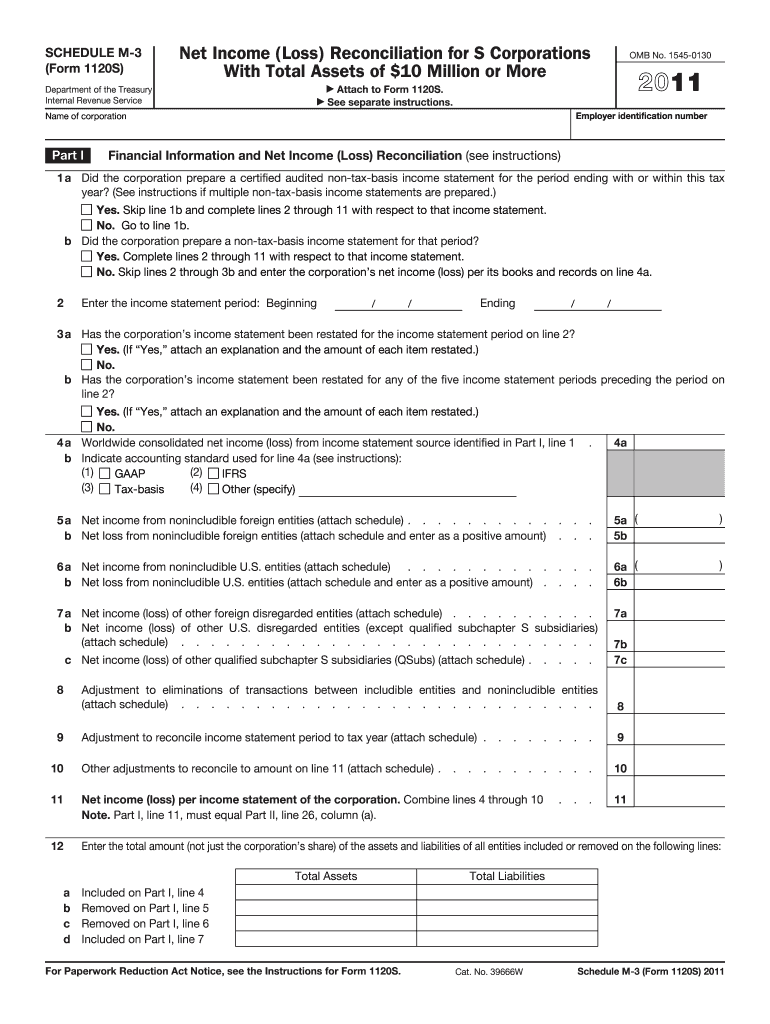
20S. See separate instructions. Employer identification number Name of corporation Part I OMB No. 1545-0130 Financial Information and Net Income (Loss) Reconciliation (see instructions) 1 a Did the corporation prepare a certified audited non-tax-basis income statement for the period ending with or within this tax year? (See instructions if multiple non-tax-basis income statements are prepared.) Yes. Skip line 1b and complete lines 2 through 11 with respect to that income statement.
Loading

Open form follow the instructions

Easily sign the form with your finger

Send filled & signed form or save
How to fill out the IRS 1120S - Schedule M-3 online
This guide provides step-by-step instructions on how to accurately complete the IRS 1120S - Schedule M-3 online. It is designed for users of all experience levels, ensuring that everyone can successfully navigate the form.
Follow the steps to complete the IRS 1120S - Schedule M-3 online with ease.
- Click ‘Get Form’ button to obtain the form and open it in your chosen digital platform.
- Enter the employer identification number and name of the corporation at the top of the form.
- In Part I, answer whether the corporation prepared a certified audited non-tax-basis income statement for the period. If 'Yes', skip to line 2 after providing the necessary details; if 'No', proceed to line 1b.
- For lines 2 and 3, provide the income statement period. If the income statement has been restated, note that and attach an explanation with the amounts adjusted.
- Complete lines 4 through 10, which involve detailing worldwide consolidated net income, net income from foreign entities, and any necessary adjustments to reconcile to the net income per the income statement.
- In Part II, start reconciling net income (loss) reported in the income statement with total income (loss) per tax return, noting any temporary and permanent differences.
- Proceed to Part III to reconcile the expense and deduction items, similar to Part II, detailing U.S. current income tax expenses and any other pertinent itemized deductions.
- After completing all sections, review the entire form for accuracy and ensure all necessary schedules and attachments are included as required.
- Finally, save your changes, and use the option to download, print, or share the form as needed.
Complete your IRS 1120S - Schedule M-3 online today for an efficient tax reporting process.
Experience a faster way to fill out and sign forms on the web. Access the most extensive library of templates available.
Related content
Part I. Financial Information and Net Income (Loss) Reconciliation (see instructions). 1a...
Dec 12, 2012 — No Schedule M-3 is required for taxpayers filing Form 1120-REIT, U.S...
Jan 31, 2012 — (Form 1120S) instead of Schedule M-1. Taxed. Return. See the separate...
Get answers to your most pressing questions about US Legal Forms API.
What is the Schedule L on 1120?
Schedule L on IRS Form 1120 provides a balance sheet for the corporation, detailing its assets, liabilities, and equity at the year’s end. This information is crucial for assessing the financial status of the corporation. By completing Schedule L accurately, businesses can ensure they present a clear picture of their financial health to the IRS and stakeholders alike. Utilizing resources like US Legal Forms can help navigate this process smoothly.
What is the difference between Schedule M-1 and M-3?
Schedule M-1 provides a simpler reconciliation between book income and taxable income for smaller businesses, while Schedule M-3 offers a detailed analysis for larger companies. Specifically, M-3 requires additional disclosures, making it suitable for corporations with total assets exceeding $10 million. Understanding the differences helps businesses select the appropriate schedule for IRS 1120S filings.
What is the best way to file 1120S?
The best way to file IRS 1120S is electronically, preferably using IRS-approved tax software. Digital filing often leads to faster processing times and reduces the likelihood of errors. You should also ensure that all required schedules, such as the IRS 1120S - Schedule M-3, are included to avoid delays. Platforms such as US Legal Forms can guide you through this process, making filing much easier.
What is Schedule M-3 on 1120L?
Schedule M-3 on IRS Form 1120L serves a similar purpose as it does for 1120S, helping organizations reconcile financial statements with tax reports. This schedule is utilized by life insurance companies to provide a detailed overview of differences between book income and taxable income. It's vital for compliance, as accurate reporting can prevent potential audits. Familiarizing yourself with these schedules can simplify your tax journey.
When was Schedule M-3 introduced?
Schedule M-3 was introduced in 2004 to establish a more comprehensive system for reconciling financial statements and tax returns. The IRS designed it to enhance transparency between corporations and the tax authority. Since its introduction, it has significantly impacted how businesses report their financial information for IRS 1120S. Keeping informed about these changes is crucial for businesses to stay compliant.
Who must file Schedule M-3 Part II?
Schedule M-3 Part II must be filed by S corporations that have total assets of $10 million or more at the end of the year. This part provides a deeper insight into the reconciliation of income and expenses as reported for financial and tax purposes. It is essential to accurately complete this section to maintain compliance with tax regulations. Utilizing platforms like US Legal Forms can streamline this filing process for you.
Is Schedule M-3 required for 1120S?
Yes, Schedule M-3 is required for certain corporations filing IRS 1120S. This schedule helps detail the differences between financial accounting and tax reporting, particularly for larger S corporations. If your business has total assets exceeding $10 million, you must file this schedule. Understanding these requirements helps ensure compliance and avoid penalties.
What is the purpose of Schedule M-1 on the corporate tax return?
The purpose of Schedule M-1 on the IRS 1120S is to reconcile the financial income reported on the books to the taxable income reported to the IRS. It identifies adjustments and differences, helping corporations clarify their tax obligations. While M-1 is useful, transitioning to Schedule M-3 allows for greater detail and insight into complex financial dealings.
When required to file M-3?
Businesses are required to file Schedule M-3 when their total assets surpass the $10 million threshold at the tax year's end. This filing ensures a detailed report of differences between financial and taxable income. By complying with this requirement, businesses can avoid potential scrutiny from tax authorities and simplify their reporting process.
What is the difference between M-1 and M-3 in 1065?
In the context of IRS 1065, M-1 and M-3 both play roles in the partnership tax return but differ in complexity. M-1 offers a brief reconciliation, while M-3 presents a more nuanced analysis of financial data. Businesses will benefit from understanding which schedule best fits their reporting needs, as M-3 can provide a deeper insight into their financial processes.
Use professional pre-built templates to fill in and sign documents online faster. Get access to thousands of forms.
If you believe that this page should be taken down, please follow our DMCA take down process here.
This form is available in several versions. Select the version you need from the drop-down list below.