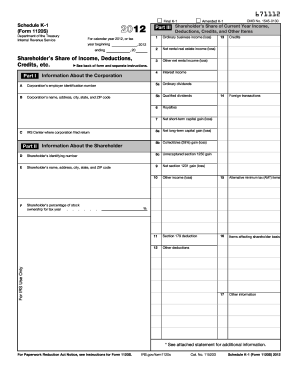
Ary business income (loss) 2 14 Foreign transactions Other net rental income (loss) 4 Credits Net rental real estate income (loss) 3 13 Interest income , 2012 , 20 Shareholder s Share of Income, Deductions, See back of form and separate instructions. Credits, etc. Part I OMB No. 1545-0130 Amended K-1 1 For calendar year 2012, or tax year beginning Final K-1 Information About the Corporation A Corporation s employer identification number 5a Ordinary dividends B Corp.
Open form follow the instructions
Easily sign the form with your finger
Send filled & signed form or save
How to fill out the IRS 1120S - Schedule K-1 online
This guide provides a clear and supportive approach to filling out the IRS 1120S - Schedule K-1 online. It aims to assist individuals with varying levels of experience in managing their tax documents effectively.
Follow the steps to fill out your IRS 1120S - Schedule K-1 online
- Click ‘Get Form’ button to access the IRS 1120S - Schedule K-1 form and open it in your online document editor.
- Begin with Part I, which includes information about the corporation. Enter the corporation’s employer identification number, name, address, and city, state, and ZIP code.
- Move to Part II, focusing on information about the shareholder. Input the shareholder’s identifying number and their name, address, city, state, and ZIP code.
- Proceed to Part III. Here, fill in the shareholder's share of current year income, deductions, credits, and other items, starting with ordinary business income or loss.
- For each relevant section, enter detailed figures as instructed, such as net rental real estate income, interest income, dividends, and any other applicable items.
- After completing all sections, review the form to ensure accuracy and completeness before final submission.
- Once verified, you can save your changes, download, print, or share the completed form, ensuring you keep a copy for your records.
Take the next step in your tax preparation by completing your documents online today.
Experience a faster way to fill out and sign forms on the web. Access the most extensive library of templates available.
Related content
Schedule K-1 (Form 1120-S) for 2024 reports a shareholder's share of income, deductions...
This list identifies the codes used on Schedule K-1 for all shareholders and provides...
Jan 31, 2012 — ... the. • Income reported on Schedule K,. 8918. comparable IRS...
Get answers to your most pressing questions about US Legal Forms API.
What is box 17 code v on 1120S K-1?
Box 17 code v on the IRS 1120S - Schedule K-1 refers to the amount of 'Other tax-exempt income'. This entry indicates additional income that does not incur federal income tax, and it must be reported on your tax return. Understanding this box is important for comprehending the overall impact of your K-1 on your tax situation.
Where are S-Corp distributions reported?
Corp distributions are reported in several places, primarily on the chedule K1 that shareholders receive. Additionally, shareholders must report these distributions on their individual tax returns. It's vital to understand both the reporting on the K1 and your personal tax forms to ensure accurate tax reporting.
Where are S Corp distributions reported on K1?
S Corp distributions are reported on Schedule K-1 in Box 16, specifically labeled as 'Other Information'. This box indicates the amount of distributions that shareholders receive during the tax year. Properly reflecting these distributions on your IRS 1120S - Schedule K-1 is crucial as it impacts your personal tax return and overall tax liability.
What is the best way to file 1120S?
The best way to file IRS Form 1120S involves gathering all necessary documentation, including financial statements and Schedule K-1s for your shareholders. You may choose to e-file for quicker processing and confirmation from the IRS. Additionally, using platforms like uslegalforms can streamline the preparation process and help you maintain compliance with all required regulations.
Are K-1 distributions considered income for an S-Corp?
1 distributions from an SCorporation are generally passed through to shareholders and reported on their personal tax returns. However, these distributions may not always be considered taxable income if they do not exceed the shareholder's basis in the SCorp. Be sure to review the details on your IRS 1120S Schedule 1 to determine any tax implications as it significantly affects your tax calculations.
How do I file a Schedule K-1 on my taxes?
To file your Schedule K-1 on your taxes, you first need to receive the K-1 form from your S-Corporation. You then report the information from this K-1 on your personal tax return, typically using Form 1040. It is important to incorporate any income, losses, and deductions indicated on the K-1 to accurately reflect your overall tax situation.
Does Schedule K-1 need to be filed with 1120S?
Yes, Schedule K-1 needs to be filed with IRS Form 1120S if your S-Corporation has income, deductions, or other items that need to be passed on to shareholders. This form helps to report each shareholder's share of these amounts for tax purposes. By accurately completing and submitting Schedule K-1 with 1120S, you ensure compliance with IRS regulations.
What is included on Schedule K-1 form 1120 S?
Schedule K-1 (Form 1120S) provides detailed information regarding the shareholder's share of income, deductions, credits, and other items. This information includes various types of income such as ordinary business income, rental income, and capital gains. Understanding each line is essential for accurate tax reporting and ensures you harness the benefits offered through your S Corporation.
Does a K1 show the percentage of ownership?
Yes, the K-1 form does display the owner's percentage of ownership in the S Corporation. This information is crucial, especially when it comes to allocating profits and losses among shareholders. By reviewing the IRS 1120S - Schedule K-1, you can establish your rightful share of the corporation's economic position.
How is K1 income from S Corp taxed?
1 income from an S Corporation is generally taxed at the individual owner's tax rate. Because S Corps pass their income directly to shareholders, the income is reported on the owners' personal tax returns. This passthrough taxation can result in favorable tax treatment; however, ensure you account for all other income sources when calculating your total tax liability.
Use professional pre-built templates to fill in and sign documents online faster. Get access to thousands of forms.
If you believe that this page should be taken down, please follow our DMCA take down process here.
This form is available in several versions. Select the version you need from the drop-down list below.