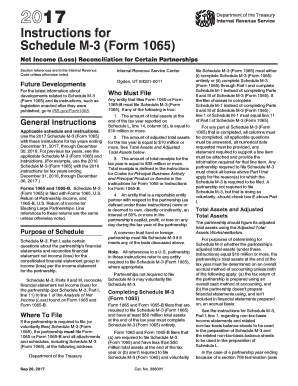
Code unless otherwise noted. Internal Revenue Service Center Future Developments Ogden, UT 84201-0011 For the latest information about developments related to Schedule M-3 (Form 1065) and its instructions, such as legislation enacted after they were published, go to IRS.gov/Form1065. General Instructions Applicable schedule and instructions. Use the 2017 Schedule M-3 (Form 1065) with these instructions for tax years ending December 31, 2017, through December 30, 2018. For previous tax year.
Open form follow the instructions
Easily sign the form with your finger
Send filled & signed form or save
How to fill out the IRS 1065 - Schedule M-3 Instructions online
Navigating the IRS 1065 - Schedule M-3 can be complex, but this guide aims to simplify the process by providing clear, step-by-step instructions for filling out the form online. Whether you are a partnership or simply assisting one, understanding this document is essential for accurate financial reporting.
Follow the steps to complete the IRS 1065 - Schedule M-3 Instructions online
- Use the ‘Get Form’ button to acquire the IRS 1065 - Schedule M-3 document and open it in your preferred editor.
- Familiarize yourself with the purpose of the form. Schedule M-3 is utilized to reconcile financial statement net income (loss) with the income (loss) reported on Form 1065 for certain partnerships.
- Identify if your partnership is required to file this schedule. Any partnership with total assets of $10 million or more at the end of the tax year, adjusted total assets of the same amount, or total receipts of $35 million or more must complete Schedule M-3.
- Begin filling out the form by entering details from the partnership’s financial statements. Pay attention to Part I where you will report financial statement types and net income (loss).
- Continue to Part II and III where reconciliation of net income (loss) with the amounts on Form 1065 occurs. Be precise with income and expense reporting, ensuring that any temporary or permanent differences are correctly categorized.
- Ensure all necessary attachments are included, such as supporting statements for any reported adjustments.
- Once all required entries are complete, save the changes made to the form. You can then download, print, or share the completed Schedule M-3.
Ready to get started? Fill out your IRS 1065 - Schedule M-3 online now for accurate reporting.
Experience a faster way to fill out and sign forms on the web. Access the most extensive library of templates available.
Related content
Dec 31, 2021 — Schedule M-3, Part I, asks certain questions about the partnership's...
Dec 12, 2012 — There is a unique separate Schedule M-3 for taxpayers required to file...
The partnership may be required to file Schedule M-3 (see instructions). 1. Net income...
Get answers to your most pressing questions about US Legal Forms API.
What is the difference between Schedule M-1 and M-3?
The key difference between Schedule M-1 and M-3 lies in their complexity and the assets reporting threshold. Schedule M-1 is generally simpler and applies to smaller partnerships, while M-3 is more detailed and caters to larger entities with total assets exceeding $10 million. By following the IRS 1065 - Schedule M-3 Instructions, you can ensure that you meet all relevant requirements based on your partnership's size.
Who must file Schedule M(3) 1120S?
Schedule M(3) is required for S corporations and partnerships that have total assets of $10 million or more. It offers detailed reconciliation of their income items, ensuring transparency and compliance. Understanding the specifics outlined in the IRS 1065 - Schedule M-3 Instructions is essential for fulfilling this requirement.
What happens if I don't file Form 1065?
Failing to file Form 1065 can result in significant penalties, including fines and interest charges on unpaid taxes. Additionally, if your partnership is required to file, you might face issues with the IRS that could complicate future filings. To avoid these consequences, adhere to the IRS 1065 - Schedule M-3 Instructions and file promptly.
What is the difference between M-1 and M-3 in 1065?
1 is a simpler schedule that reconciles financial statement income to taxable income, while 3 provides a more detailed breakdown for larger partnerships. 3 is required for partnerships with total assets of $10 million or more, reflecting more complex accounting. Understanding the difference is essential, as outlined in the IRS 1065 Schedule 3 Instructions, to ensure correct filings.
Can I fill out my own 1065?
Certainly, you can fill out your own 1065 as long as you understand the requirements and forms needed. However, using help from resources like USLegalForms can provide templates and guidance to streamline the process. To assist with accurate reporting, keep the IRS 1065 - Schedule M-3 Instructions handy.
Who must file M-3 Part II?
3 Part II must be filed by partnerships with total assets of $10 million or more and those that need detailed reporting of booktax differences. It ensures clear reporting of items affecting taxable income. To complete this correctly, refer to the IRS 1065 Schedule 3 Instructions for comprehensive guidelines.
Can I file 1065 myself?
Yes, you can file Form 1065 yourself if you feel confident in understanding the required documents and instructions. However, given the complexities involved, many choose to use platforms like USLegalForms for guidance. These resources can help simplify the process and ensure compliance with the IRS 1065 - Schedule M-3 Instructions.
Who must file Schedule M-2?
Schedule M-2 is required for partnerships that need to report the analysis of partners’ capital accounts. If your partnership has one or more partners and maintains capital accounts, you are likely obligated to file this schedule. Familiarizing yourself with the IRS 1065 - Schedule M-3 Instructions can guide you in filing Schedule M-2 accurately.
Can I file Form 1065 electronically?
Yes, you can file Form 1065 electronically through the IRS e-file system. This method is efficient and helps ensure that your submission is processed faster than paper filings. Utilizing the IRS 1065 - Schedule M-3 Instructions will assist you in preparing your forms correctly before e-filing.
Who must file Schedule M-3 Part II?
Schedule M-3 Part II is required for partnerships that have total assets of $10 million or more. This part provides detailed reconciliations of income or loss, converting financial statements to tax basis income. By following the IRS 1065 - Schedule M-3 Instructions, you can ensure accurate completion of Part II to comply with tax regulations.
Use professional pre-built templates to fill in and sign documents online faster. Get access to thousands of forms.
If you believe that this page should be taken down, please follow our DMCA take down process here.
This form is available in several versions. Select the version you need from the drop-down list below.