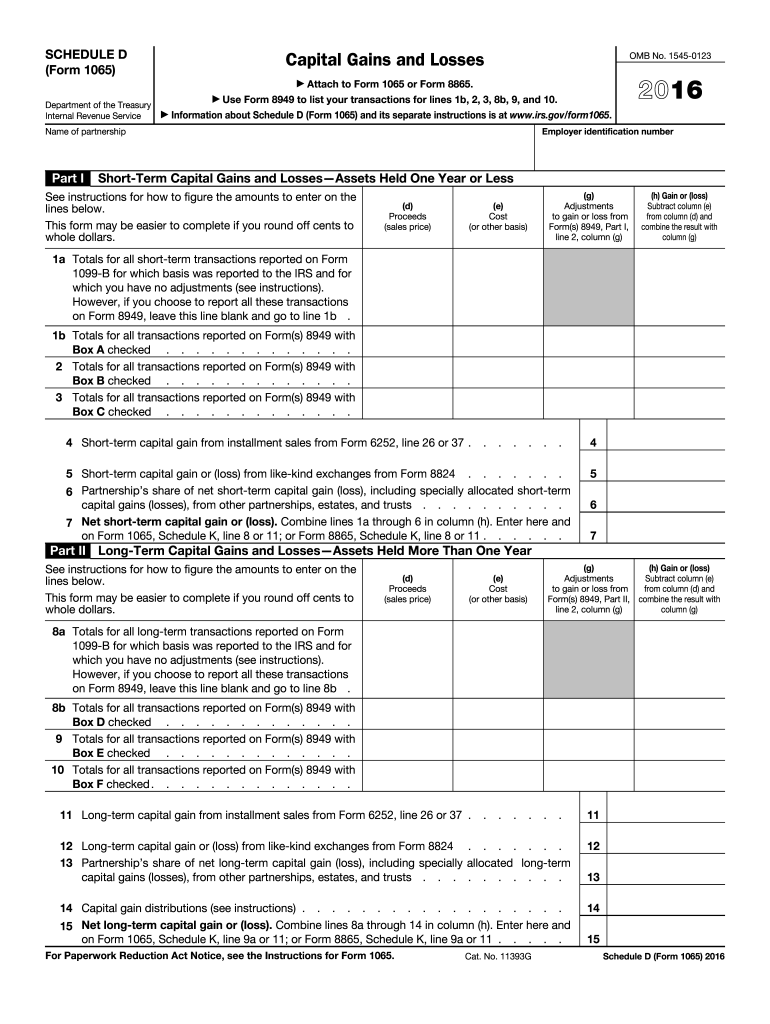
Asury Information about Schedule D (Form 1065) and its separate instructions is at www.irs.gov/form1065. Internal Revenue Service Employer identification number Name of partnership Part I 2016 Short-Term Capital Gains and Losses Assets Held One Year or Less See instructions for how to figure the amounts to enter on the lines below. This form may be easier to complete if you round off cents to whole dollars. (d) Proceeds (sales price) (g) Adjustments to gain or loss from Form(s).
Loading

Open form follow the instructions

Easily sign the form with your finger

Send filled & signed form or save
How to fill out the IRS 1065 - Schedule D online
Filling out the IRS 1065 - Schedule D can seem daunting, but with clear guidance, you can complete it accurately online. This form is crucial for reporting capital gains and losses for partnerships, and understanding its components will help simplify the process.
Follow the steps to complete the IRS 1065 - Schedule D online.
- Select the ‘Get Form’ button to download the IRS 1065 - Schedule D form and open it for editing.
- Begin with Part I to report short-term capital gains and losses. Gather the necessary information regarding your transactions. Use Form 8949 as needed for detailed reporting.
- Enter the proceeds from sales on line 1a if basis is reported. For all transactions reported on Form 8949 with Box A checked, enter totals on line 1b.
- For each subsequent line, input totals for transactions based on the appropriate Boxes B and C, ensuring accuracy in your calculations.
- Move to Part II for long-term capital gains and losses. Follow similar steps as Part I, ensuring to input totals for transactions as required.
- After entering all necessary data for both short-term and long-term sections, review all inputs for accuracy.
- Once completed, you can save your changes, download the filled form, print it, or share it as needed.
Start completing your IRS 1065 - Schedule D online to manage your tax obligations effectively.
Experience a faster way to fill out and sign forms on the web. Access the most extensive library of templates available.
Related content
Part I. Short-Term Capital Gains and Losses—Generally Assets Held One Year or Less (see...
Use Schedule D (Form 1065) to report sales or exchanges of capital assets, capital gain...
9 a Net long-term capital gain (loss) (attach Schedule D (Form 1065)) . . . . . . ....
Get answers to your most pressing questions about US Legal Forms API.
Who sends Schedule D?
Schedule D must be submitted to the IRS by the partnership that is filing Form 1065. This form is sent along with your partnership income tax return. Timely submission ensures compliance with tax obligations. For assistance in understanding the submission process, uslegalforms offers valuable resources.
Who issues Schedule D?
The Internal Revenue Service (IRS) issues Schedule D as part of Form 1065. As a governmental body, the IRS creates these forms to ensure accurate reporting of capital transactions. Partnerships must use this form to comply with federal tax regulations. Understanding its origins can highlight its importance in your tax filing.
Where can I get a Schedule D form?
To get a Schedule D form, visit the IRS website or consult your tax advisor. It is also available through various tax preparation software programs. Additionally, platforms like uslegalforms can provide downloadable versions for your convenience. This flexibility allows you to access what you need when you need it.
Where can I find my 1065 form?
Finding your 1065 form is straightforward. You can obtain it from your tax software, tax professional, or directly from the IRS website. Ensure you are accessing the correct form for the applicable tax year. Using uslegalforms may also enhance your search experience.
Where can I find the Schedule D form?
You can find the Schedule D form on the IRS website in the forms section. It is essential to ensure you have the correct year’s version, as forms can change annually. For ease, consider using uslegalforms, which provides easy access to current forms. This approach saves you time when searching.
What is the difference between Schedule D and Form 8949?
Schedule D and Form 8949 serve related purposes but differ in functionality. Schedule D summarizes capital gains and losses on IRS Form 1065, while Form 8949 details individual transactions. As a partnership, you must complete both forms for proper reporting. Understanding this distinction can simplify your tax filing process.
What is Schedule D Form 1065?
Schedule D Form 1065 is a tax form used by partnerships to report capital gains and losses. It provides a detailed record of the sale of assets and helps calculate the overall tax liability. This form offers transparency and keeps your records organized. For guidance on filling it out correctly, resources such as uslegalforms can assist you.
Where is Schedule D on the Tax Act?
Schedule D is typically located in the tax forms section of the IRS Tax Act. You can find it in the instructions for IRS Form 1065, which covers partnerships. This form helps you report capital gains and losses. Understanding its placement is crucial for accurate reporting.
Who is required to fill out Schedule D?
Taxpayers who realize capital gains or losses from selling securities must file Schedule D. This includes partnerships that complete the IRS 1065 tax form. To ensure compliance and accurate reporting, it's beneficial to utilize platforms like U.S. Legal Forms, which can assist with the completion of the IRS 1065 - Schedule D and other related forms.
What is Schedule D form used for?
Schedule D form is used to report capital gains and losses from the sale of investments. By detailing these transactions, it influences your overall tax liability. Including this information in your IRS 1065 - Schedule D filing helps you maintain accurate tax records and avoid any potential issues with the IRS.
Use professional pre-built templates to fill in and sign documents online faster. Get access to thousands of forms.
If you believe that this page should be taken down, please follow our DMCA take down process here.
This form is available in several versions. Select the version you need from the drop-down list below.