Loading
Form preview
  • US Legal Forms
  • Other Templates
  • Tax Forms
  • Executive Department Treasury IRS Forms
  • Irs 1041 - Schedule D 2018

Get Irs 1041 - Schedule D 2018

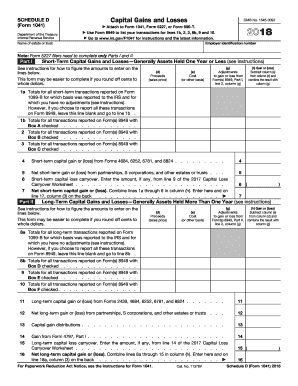
949 with Box E checked . . . . . . . . . . . . . 10 Totals for all transactions reported on Form(s) 8949 with Box F checked . . . . . . . . . . . . . . 11 Long-term capital gain or (loss) from Forms 2439, 4684, 6252, 6781, and 8824 . . . . 11 12 Net long-term gain or (loss) from partnerships, S corporations, and other estates or trusts . . . 12 13 Capital gain distributions . . . 13 14 15 Gain from Form 4797, Part I . . . . . . . . . . . . . . . . . . . . . . . . Long-term capit.

This website is not affiliated with IRS

How it works

  1. Open form

    Open form follow the instructions

  2. Easily sign form

    Easily sign the form with your finger

  3. Share form

    Send filled & signed form or save

How to fill out the IRS 1041 - Schedule D online

Filling out the IRS 1041 - Schedule D can seem daunting, but with clear guidance, you can navigate the process smoothly. This guide provides step-by-step instructions to assist you in completing the form accurately and efficiently.

Follow the steps to fill out the IRS 1041 - Schedule D online effectively.

  1. Click ‘Get Form’ button to access the form and open it in the editor.
  2. Begin by entering the employer identification number at the top of the form.
  3. Input the name of the estate or trust below the employer identification number.
  4. Move to Part I for short-term capital gains and losses. Report all relevant details regarding transactions held for one year or less.
  5. For each transaction, fill in the proceeds (sales price) in column (d) and the cost (or other basis) in column (e).
  6. Complete the adjustments to gain or loss from Form(s) 8949 in column (g).
  7. Calculate the gain or loss by subtracting column (e) from column (d) and adding the result to column (g). Input this amount in column (h).
  8. Repeat this process for the additional lines under Part I for all short-term transactions.
  9. Next, proceed to Part II for long-term capital gains and losses, following similar steps as in Part I.
  10. Ensure to record the totals in the specified lines for various types of transactions, referencing Form 8949 as needed.
  11. Conclude by completing Part III, summarizing the net gains or losses from Parts I and II.
  12. If applicable, address capital loss limitations in Part IV, ensuring to enter the necessary values.
  13. Finally, review your entries for accuracy and completeness before saving your changes, downloading, printing, or sharing the form.

Start completing your IRS 1041 - Schedule D online today for accurate tax reporting.

Get form

Experience a faster way to fill out and sign forms on the web. Access the most extensive library of templates available.

Related content

2024 Instructions for Schedule D (Form 1041)
Use Schedule D to report the following. • The overall capital gains and losses from...
Learn more
2012 Instructions for Schedule D (Form 1041)
Jan 22, 2013 — Purpose of Form. Use Schedule D (Form 1041) to report gains and losses...
Learn more
f1045--2017.pdf
19. Enter the loss, if any, from line 21 of your 2017 Schedule D (Form 1040). (Estates and...
Learn more

Related links form

IRS 5498-ESA 2013 IRS 5498-ESA 2012 IRS 5498-SA 2018 IRS 5498-SA 2017

Questions & Answers

Get answers to your most pressing questions about US Legal Forms API.

Contact support

The primary difference lies in the type of asset sold. IRS 1041 - Schedule D is for reporting capital gains and losses on personal assets, while Form 4797 is specifically for business property sales. Understanding these distinctions helps ensure that you use the appropriate form for tax reporting. Choosing the right form enables you to navigate your tax obligations efficiently and accurately.

If you sold your house and realized a capital gain, you generally need to file IRS 1041 - Schedule D to report that gain. This applies especially if the house was part of an estate or trust. Even if the sale was personal, proper reporting on Schedule D is crucial for tax accuracy. By filing this form, you ensure that all financial transactions are documented correctly.

Schedule D on IRS Form 1041 is specifically designed for estates and trusts to report any capital gains or losses from the sale of assets. This form provides a detailed account of transactions, helping to clarify how these sales affect the overall tax obligations of the estate. By properly completing Schedule D, you can gain insights into your financial standing. It ensures comprehensive reporting of estate activities, benefiting both trustees and beneficiaries.

Choosing between IRS 1041 - Schedule D and Form 4797 depends on the nature of your asset sale. If you sell personal property, you will likely use Schedule D to report any capital gains or losses. However, if you are dealing with business property, you should use Form 4797. It's essential to select the correct form to accurately reflect your financial activities and compliance with tax regulations.

Form 4797 refers to the Sale of Business Property, which is a separate report required when selling business assets. IRS 1041 - Schedule D may be used for reporting capital gains from personal assets, while Form 4797 addresses business-related sales. Understanding when to use each can help you manage your tax obligations effectively. By distinguishing between these forms, you can ensure proper reporting of your estate's activities.

Schedule D property tax is not directly related to a specific property tax but rather refers to the reporting of gains and losses associated with selling investment properties. When you sell a property, you report any capital gains on IRS 1041 - Schedule D. This reporting is crucial for understanding how the sale affects your estate’s tax obligations. Accurate reporting ensures compliance and aids in planning future investments.

The IRS 1041 - Schedule D form is used to report capital gains and losses from transactions involving securities or other assets. When you sell property, stocks, or bonds, Schedule D helps you determine the fiscal impact of those transactions. The form provides a clear view of your financial activities for accurate tax reporting. By using this form, you can ensure transparency in your estate’s financials.

Individuals or estates that report capital gains and losses typically need to fill out IRS 1041 - Schedule D. If you manage an estate or trust with investment transactions, this form is essential. It helps track the sale of assets and report the resulting gains or losses to the IRS. This requirement ensures you comply with tax regulations while managing your estate.

Yes, it is important to list every transaction on the IRS 1041 - Schedule D for accuracy and compliance. Each sale or exchange of capital assets must be reported, even if there are small gains or losses. This thoroughness helps provide a complete picture of your investment activities, which is crucial for your tax return. Consider utilizing US Legal Forms for an organized approach to track and report these transactions.

On the IRS 1041 - Schedule D, you should report all capital gains and losses from the sale of capital assets, including stocks, bonds, and real estate. This includes detailing short-term and long-term transactions, which impact your tax liabilities differently. Accurate reporting helps the IRS understand your investment activities and ensures you take advantage of potential tax benefits. Using tools like those on US Legal Forms can help keep your records organized.

Get This Form Now!

Use professional pre-built templates to fill in and sign documents online faster. Get access to thousands of forms.
If you believe that this page should be taken down, please follow our DMCA take down processhere.
Get IRS 1041 - Schedule D
  • Adoption
  • Bankruptcy
  • Contractors
  • Divorce
  • Home Sales
  • Employment
  • Identity Theft
  • Incorporation
  • Landlord Tenant
  • Living Trust
  • Name Change
  • Personal Planning
  • Small Business
  • Wills & Estates
  • Packages A-Z
  • Affidavits
  • Bankruptcy
  • Bill of Sale
  • Corporate - LLC
  • Divorce
  • Employment
  • Identity Theft
  • Internet Technology
  • Landlord Tenant
  • Living Wills
  • Name Change
  • Power of Attorney
  • Real Estate
  • Small Estates
  • Wills
  • All Forms
  • Forms A-Z
  • Other Templates
  • Legal Hub
  • About Us
  • Help Portal
  • Legal Resources
  • Blog
  • Affiliates
  • Contact Us
  • Delete My Account
  • Site Map
  • Industries
  • Forms in Spanish
  • Localized Forms
  • State-specific Forms
  • Forms Kit
  • Real Estate Handbook
  • All Guides
  • Notarize
  • Incorporation services
  • For Consumers
  • For Small Business
  • For Attorneys
  • USLegal
  • FormsPass
  • pdfFiller
  • signNow
  • altaFlow
  • DocHub
  • Instapage
Form Packages
  • Adoption
  • Bankruptcy
  • Contractors
  • Divorce
  • Home Sales
  • Employment
  • Identity Theft
  • Incorporation
  • Landlord Tenant
  • Living Trust
  • Name Change
  • Personal Planning
  • Small Business
  • Wills & Estates
  • Packages A-Z
Form Categories
  • Affidavits
  • Bankruptcy
  • Bill of Sale
  • Corporate - LLC
  • Divorce
  • Employment
  • Identity Theft
  • Internet Technology
  • Landlord Tenant
  • Living Wills
  • Name Change
  • Power of Attorney
  • Real Estate
  • Small Estates
  • Wills
  • All Forms
  • Forms A-Z
  • Other Templates
Customer Service
  • Legal Hub
  • About Us
  • Help Portal
  • Legal Resources
  • Blog
  • Affiliates
  • Contact Us
  • Delete My Account
  • Site Map
  • Industries
  • Forms in Spanish
  • Localized Forms
  • State-specific Forms
  • Forms Kit
Legal Guides
  • Real Estate Handbook
  • All Guides
Prepared for you
  • Notarize
  • Incorporation services
Our Customers
  • For Consumers
  • For Small Business
  • For Attorneys
Our Sites
  • USLegal
  • FormsPass
  • pdfFiller
  • signNow
  • altaFlow
  • DocHub
  • Instapage
Social Media
Call us now toll free:
+1 833 426 79 33
As seen in:
© Copyright 1999-2026 airSlate Legal Forms, Inc. 17 Station Street, Suite 303, Brookline, MA 02445
  • Your Privacy Choices
  • Terms of Service
  • Privacy Notice
  • Content Takedown Policy
  • Bug Bounty Program
IRS 1041 - Schedule D
This form is available in several versions.
Select the version you need from the drop-down list below.
2022 IRS 1041 - Schedule D
Select form
  • 2022 IRS 1041 - Schedule D
  • 2020 IRS 1041 - Schedule D
  • 2019 IRS 1041 - Schedule D
  • 2018 IRS 1041 - Schedule D
  • 2017 IRS 1041 - Schedule D
  • 2016 IRS 1041 - Schedule D
  • 2015 IRS 1041 - Schedule D
  • 2014 IRS 1041 - Schedule D
  • 2013 IRS 1041 - Schedule D
  • 2012 IRS 1041 - Schedule D
  • 2011 IRS 1041 - Schedule D
  • 2010 IRS 1041 - Schedule D
  • IRS 1041 - Schedule D_DSA
Select form